STATE FILE · WA
Cryptids of Washington
What cryptids are in Washington? The best-known are Bigfoot, Batsquatch, Cadborosaurus and Colossal Claude, among 5 on file.
Washington is arguably the most Bigfoot-saturated state in the country, and the Bigfoot Field Researchers Organization has long counted more reports here than almost anywhere else. The Cascade volcanoes, the rainforests of the Olympic Peninsula and the dense second-growth timber of the southwest give the creature – known by many Indigenous names before “Sasquatch” and “Bigfoot” took hold – plenty of cover. In 1924 a group of miners claimed that “apemen” bombarded their cabin with rocks near Mount St. Helens, giving Ape Canyon its name. In 1969 Skamania County passed an ordinance making it illegal to kill a Sasquatch, later turning the county into a Sasquatch refuge.
Cryptids reported in Washington
 HOMINID · 1958
Bigfoot
Pacific Northwest forests, reported across North America
North America’s most famous cryptid: a huge, hairy, upright ape-like being reported from the Pacific Northwest to Florida since the 1958 “Bigfoot” tracks.
WIDELY REPORTED FLYING · 1994Batsquatch
Foothills of Mount Rainier, Pierce County, Washington
A winged, ape-like creature with blue-tinged fur said to have landed in front of a stalled pickup near Mount Rainier in 1994 – part bat, part Sasquatch.
LOCAL LEGEND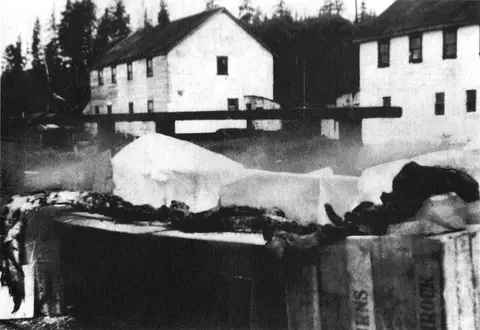 LAKE & SEA MONSTER · 1933
Cadborosaurus
Cadboro Bay and the Salish Sea, off Victoria, British Columbia
“Caddy,” the horse-headed sea serpent of British Columbia’s coast, named in 1933 after Victoria’s Cadboro Bay and still reported in the Salish Sea.
WIDELY REPORTED LAKE & SEA MONSTER · 1934Colossal Claude
Mouth of the Columbia River, near Astoria, Oregon
A long-necked sea serpent reported by lightship and fishing crews at the mouth of the Columbia River between 1934 and 1939, nicknamed Colossal Claude.
LOCAL LEGEND OTHER · 1998Pacific Northwest Tree Octopus
Olympic Peninsula rainforests near Hood Canal, Washington
A tree-climbing octopus said to live in the Olympic Peninsula rainforest – a famous 1998 internet hoax used to teach students to check sources.
HOAX / DEBUNKEDThe legends of Washington
Washington also gave the world Batsquatch, a blue-furred, bat-winged primate reported in 1994 by a young man whose truck stalled near Buckley, in the foothills of Mount Rainier. Off the coast, the Salish Sea and Puget Sound share Cadborosaurus, a long-necked sea serpent, with British Columbia; skeptics suggest oarfish, sea lions in a line and floating kelp.
Today Bigfoot hunters converge on the Gifford Pinchot National Forest, the Olympic Peninsula and the Mount Rainier foothills. Skeptics point to black bears, the region’s mountain lore and a long history of hoaxes, including footprints faked in the region’s mud and snow.
Hotspots
Named after miners’ 1924 claims of an attack by “apemen.”
Huge Cascade forest that consistently produces Bigfoot reports.
Temperate rainforests and remote valleys with a long Sasquatch tradition.
Where Batsquatch was reported in 1994.
Inland waters shared with British Columbia, where Cadborosaurus is said to swim.
Sightings timeline
- July 1924The Ape Canyon attack Bigfoot
A party of miners that included Fred Beck told newspapers that hairy “ape men” bombarded their cabin with rocks through the night after Beck shot at one of the creatures. The story ran in the Oregonian in mid-July 1924 and gave Ape Canyon its name; Forest Service investigators reportedly found no evidence, and a prank or misunderstanding has long been suspected.
- March 1934The lightship crews’ sighting Colossal Claude
Crews of the lightship Columbia and the tender Rose reported a 40-foot creature with an eight-foot neck. Officers refused to let sailors approach it in a small boat.
- 1937The trawler <em>Viv</em> Colossal Claude
Captain Charles Graham and his crew described a hairy, tan animal about 40 feet long with a horse-like head, seen at close range.
- Later in 1937From Devil’s Churn to Heceta Head Colossal Claude
Beachgoers reported a hairy creature, estimated at 55 feet with its head held high above the water, and followed it down the coast until it headed out to sea.
- April 13, 1939The <em>Argo</em> encounter Colossal Claude
Captain Chris Anderson reported the creature passing within ten feet of his fishing boat and apparently stealing fish from the lines – the last widely accepted sighting.
- April 1, 1969Skamania County protects Sasquatch Bigfoot
County commissioners adopted Ordinance 69-01, which threatened anyone who deliberately killed a Sasquatch with a fine of up to $10,000 and up to five years in jail. Passed on April Fool’s Day, it was nonetheless real; it was amended in 1984 and remains on the books.
- April 1994Brian Canfield’s encounter Batsquatch
The teenager said a winged, furry giant landed in front of his stalled truck and stared at him before flying toward Mount Rainier. His account, published in the Tacoma News Tribune, is the foundation of the entire legend.
- 1998The website appears Pacific Northwest Tree Octopus
Lyle Zapato published his “Save the Pacific Northwest Tree Octopus” page, complete with a scientific name, a faked photo and calls to protect the species.
- November 26, 2002Ray Wallace and the wooden feet Bigfoot
When logging contractor Ray Wallace died, his family told reporters that he had used carved wooden feet to create the 1958 Bluff Creek tracks as a prank. “Bigfoot just died,” his son said, though some researchers argue the carvings do not match the casts.
- 2006The UConn internet-literacy study Pacific Northwest Tree Octopus
Researchers reported that all 25 middle-school students in one test group were fooled by the site, prompting national news coverage about online literacy.
- 2018Enters the Library of Congress Pacific Northwest Tree Octopus
The tree octopus site was among 30 websites in the initial collection of the Library of Congress’s Web Cultures archive, preserved as a landmark of online humor.
Latest from Washington
No recent cryptid headlines from Washington. See all the latest cryptid news.
Videos
 ARCHIVE.ORG3:07
Patterson–Gimlin film (unedited)
Roger Patterson and Bob GimlinThe original 1967 Bluff Creek footage – the most famous and most debated minute in Bigfoot history. Marked public domain on archive.org.
 ARCHIVE.ORG4:59
The Film That Made Bigfoot A Star
Oregon Public BroadcastingOPB’s short documentary on how the Patterson–Gimlin film turned a regional legend into a global icon – and the hoax claims around it.
 ▶ VIDEO
Sts’ailes Sasquatch Days in Harrison Hot Springs
Tourism Harrison River ValleyShows the festival celebrating the Sts’ailes people’s Sásq’ets, the being behind the word “Sasquatch” (no archive.org equivalent).
 ▶ VIDEO
Is This North American Sea Serpent Real or a Hoax?
Monstrum | Storied (PBS)A folklorist’s well-researched look at Caddy’s history, the 1937 carcass and the 1933 media frenzy.