STATE FILE · CO
Cryptids of Colorado
What cryptids are in Colorado? The best-known are Bigfoot, Tommyknockers and Slide-Rock Bolter.
Colorado’s cryptid lore is rooted in the Rockies – a sweep of forests, high valleys and peaks over 14,000 feet that cover much of the state. Bigfoot reports come from many mountain counties, and the state’s Front Range towns have embraced the idea with humour. The best-known example is Bailey, in Park County southwest of Denver, where the Sasquatch Outpost on Main Street combines a gift shop with a small Bigfoot museum, a sightings map and an annual Bigfoot-themed weekend.
Cryptids reported in Colorado
 HOMINID · 1958
Bigfoot
Pacific Northwest forests, reported across North America
North America’s most famous cryptid: a huge, hairy, upright ape-like being reported from the Pacific Northwest to Florida since the 1958 “Bigfoot” tracks.
WIDELY REPORTED HUMANOID · 1820sTommyknockers
Gold and silver mines of Colorado’s Front Range, around Idaho Springs and Central City
Little mine spirits brought from Cornwall to the American West, said to knock in Colorado’s gold and silver mines – warning, teasing or guiding the miners.
FOLKLORE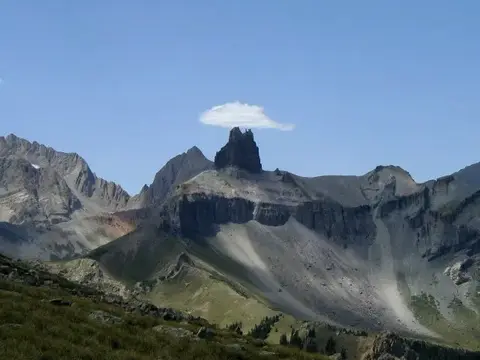 OTHER · 1910
Slide-Rock Bolter
San Juan Mountains near Rico and Lizard Head, Colorado
A giant, whale-like beast that hooks its tail over Colorado ridges and toboggans down to swallow tourists – a tall tale from the 1910 Fearsome Creatures.
FOLKLOREThe legends of Colorado
Colorado has older tall tales too. Miners and loggers told of fanciful “fearsome critters” such as the Slide-Rock Bolter, a giant whale-like beast said to anchor itself to mountain ridges with its tail before sliding down to swallow tourists – a joke for greenhorns rather than a belief. The broad, empty San Luis Valley in the south is better known for UFO reports and cattle-mutilation stories, and has a roadside UFO Watchtower near Hooper.
Skeptics note that black bears, elk and moose are common in Colorado’s backcountry, that thin mountain air and long distances can make shapes hard to judge, and that tourism has a clear interest in keeping the legends alive. For enthusiasts, the state offers easy access to huge national forests and wilderness areas within an hour or two of Denver.
Hotspots
Park County mountain town with the Sasquatch Outpost museum and many local sighting stories.
One of the world’s largest flat-topped mountains, a remote plateau of lakes and forest cited in western Colorado Bigfoot reports.
A vast high-desert valley famous for UFO reports and its roadside UFO Watchtower near Hooper.
Rugged southwestern ranges where hunters and hikers report tracks, howls and tree structures.
Sightings timeline
- 1859 onwardThe Colorado gold rush Tommyknockers
Gold strikes in the mountains west of Denver drew experienced Cornish hard-rock miners, and with them the tommyknocker tradition took root in Colorado’s mines.
- 1910Described in Fearsome Creatures of the Lumberwoods Slide-Rock Bolter
William T. Cox’s illustrated catalog of lumberjack monsters introduced the slide-rock bolter, with its Latin name Macrostoma saxiperrumptus, alongside the hodag, squonk and other critters.
- Undated (in Cox’s tale)The ranger’s dummy tourist Slide-Rock Bolter
In Cox’s story, a ranger lures a bolter from Lizard Head with an explosive-filled dummy tourist; the blast supposedly flattened half the buildings in Rico, which were never rebuilt. It is a joke, not a historical event.
Latest from Colorado
No recent cryptid headlines from Colorado. See all the latest cryptid news.
Videos
 ARCHIVE.ORG3:07
Patterson–Gimlin film (unedited)
Roger Patterson and Bob GimlinThe original 1967 Bluff Creek footage – the most famous and most debated minute in Bigfoot history. Marked public domain on archive.org.
 ARCHIVE.ORG4:59
The Film That Made Bigfoot A Star
Oregon Public BroadcastingOPB’s short documentary on how the Patterson–Gimlin film turned a regional legend into a global icon – and the hoax claims around it.
 ▶ VIDEO
Sts’ailes Sasquatch Days in Harrison Hot Springs
Tourism Harrison River ValleyShows the festival celebrating the Sts’ailes people’s Sásq’ets, the being behind the word “Sasquatch” (no archive.org equivalent).