FIELD FILE · BIGFOOTHOMINIDWIDELY REPORTED
Bigfoot
Also known as Sasquatch, Sásq’ets, Big Foot, Wild man of the woods, Woodbooger (Virginia), Grassman (Ohio)
North America’s most famous cryptid: a huge, hairy, upright ape-like being reported from the Pacific Northwest to Florida since the 1958 “Bigfoot” tracks.
Bigfoot – also called Sasquatch – is the name given to a large, hair-covered, two-legged creature that thousands of people say they have seen in the forests of North America. Witnesses describe something taller than a person, with a powerful build, a conical head and long arms, that walks upright and vanishes into the trees. No body, skeleton or confirmed DNA has ever been produced, and mainstream biology does not recognise the animal, yet Bigfoot remains the best-known cryptid on the continent and a genuine pillar of North American popular culture.
Long before the word “Bigfoot” existed, many Indigenous nations of the Pacific Northwest and beyond told of wild, hairy people of the mountains and forests. The word “Sasquatch” itself comes from the Halq’eméylem term sásq’ets of the Sts’ailes (Chehalis) people of the Harrison River valley in British Columbia, for whom the being is a respected presence able to move between the physical and spiritual worlds rather than a zoological curiosity. Other nations have their own distinct traditions – the Kwakwaka’wakw Dzunuk̓wa, the “wild woman of the woods” carved on masks and poles, is one well-known example. In the 1920s the Indian agent and teacher J. W. Burns collected Sts’ailes accounts and published them in Maclean’s magazine (“Introducing B.C.’s Hairy Giants”, April 1929); his anglicised spelling, “Sasquatch”, entered the English language. These traditions are living cultural knowledge, and many communities ask that they be understood on their own terms rather than as evidence for a missing ape.
The modern legend took shape in the twentieth century. In July 1924 newspapers reported that a group of miners near Mount St. Helens, Washington, had fought off “ape men” who pelted their cabin with rocks – the origin of the name Ape Canyon. Then in August 1958 bulldozer operator Jerry Crew found enormous human-like footprints around a logging road at Bluff Creek in Humboldt County, California. On October 6, 1958, the Humboldt Times ran his photo with a plaster cast on its front page, and columnist Andrew Genzoli popularised the crew’s nickname for the track-maker: “Big Foot”. Wire services carried the story nationwide, and the name stuck.
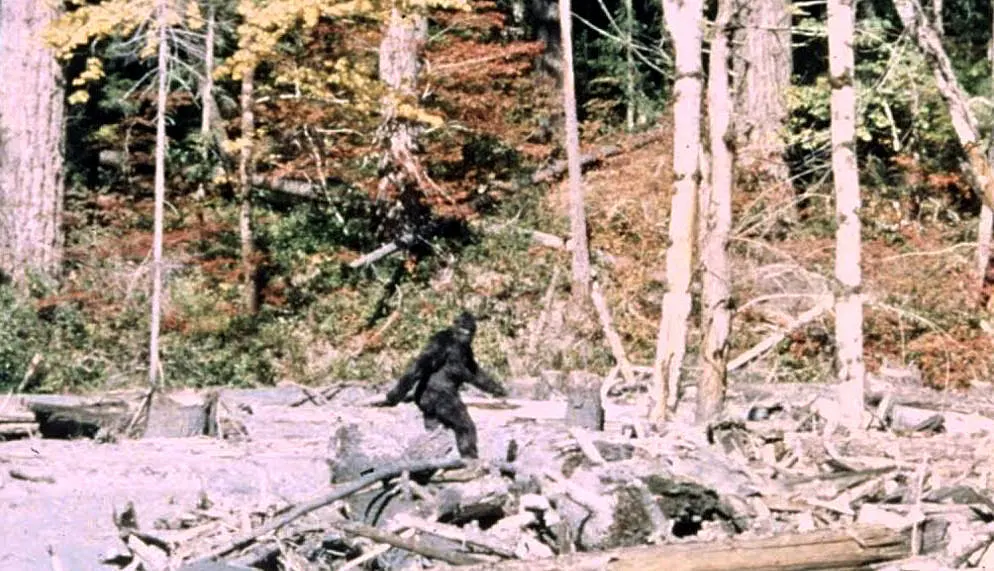
Nine years later, on October 20, 1967, Roger Patterson and Bob Gimlin shot about a minute of 16mm film at Bluff Creek showing a dark, hairy figure striding across a sandbar and glancing back at the camera. The Patterson–Gimlin film became the most analysed – and most disputed – piece of footage in cryptozoology: supporters point to the subject’s gait and proportions, while most scientists regard it as a person in a costume, and a costume maker and an acquaintance of Patterson later claimed involvement. The story took another turn in December 2002, when the family of logging contractor Ray Wallace, who had employed Jerry Crew in 1958, announced after his death that Wallace had made the original Bluff Creek prints with carved wooden feet. Some researchers dispute that the Wallace feet match the casts, but the revelation became a landmark in the skeptical case.
Since the 1970s Bigfoot has moved from newspaper oddity to a full-fledged research subculture. In 1969 Skamania County, Washington, passed an ordinance (No. 69-01) making the premeditated killing of a Sasquatch punishable by a fine of up to $10,000 and five years in jail – partly to protect people from armed hunters roaming the woods; it was amended in 1984 and never repealed, and Whatcom County declared itself a Sasquatch refuge in 1992. The Bigfoot Field Researchers Organization (BFRO), founded in 1995 by Matt Moneymaker, built a public database of thousands of reports organised by state and county, and its investigators later starred in Animal Planet’s Finding Bigfoot. Washington leads the BFRO tallies, followed by California, Florida, Ohio, Illinois, Texas and Oregon – a spread that shows the creature is now reported almost everywhere there is forest.
Science has taken Bigfoot claims seriously enough to test them. A 2014 study led by Oxford geneticist Bryan Sykes, published in Proceedings of the Royal Society B, sequenced 30 hair samples attributed to Bigfoot, the yeti and similar creatures: every one came from a known animal – bears, horses, cows, raccoons, porcupines and a human, among others. An earlier claim by veterinarian Melba Ketchum that her team had sequenced a human–primate hybrid genome (2013) was widely rejected by geneticists, and an FBI hair analysis from 1976–77, released in 2019, identified a supposed Bigfoot sample as deer hair. Ecologists have also noted that Bigfoot reports closely track the range of the American black bear. For skeptics, the absence of bones, roadkill or clear modern photographs – in an age when nearly everyone carries a camera – is the strongest argument of all. For enthusiasts, Bigfoot endures as a symbol of the wild places left in North America, and it supports museums, festivals, statues and a thriving tourism trade from Willow Creek, California, to Harrison Hot Springs, British Columbia.
- Type
- Hominid
- Status
- Widely reported
- First reported
- 1958
- Best-known location
- Pacific Northwest forests, reported across North America
- Also called
- Sasquatch, Sásq’ets, Big Foot, Wild man of the woods, Woodbooger (Virginia), Grassman (Ohio)
What witnesses describe
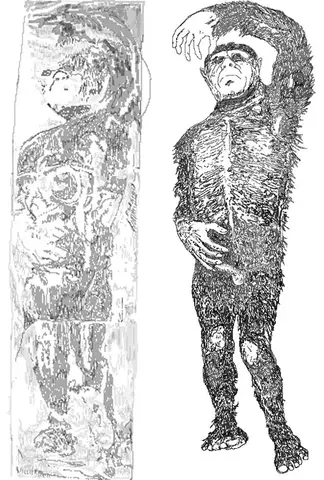
Usually described as 6–10 feet (1.8–3 m) tall and very heavily built, covered in dark brown, black, reddish or grey hair, with a sloping forehead, a pointed or conical crown, a flat face, no visible neck and arms that hang to the knees. It walks upright with a smooth, long stride and leaves human-shaped footprints often 14–18 inches (35–45 cm) long. Witnesses report a powerful musky or rotten smell, whoops, howls, “wood knocks” and thrown rocks, and say the creature avoids people and moves away quickly.
Where and when it’s seen
Dense, remote forest with water and cover – above all the conifer forests and mountain valleys of Washington, Oregon, northern California and British Columbia, but also river bottoms and swamps in the South and Midwest and the Appalachian woods. Most reports come at dusk or night, from hunters, campers and drivers on rural roads, and peak in summer and autumn.
Notable sightings
- July 1924The Ape Canyon attack Mount St. Helens, Washington
A party of miners that included Fred Beck told newspapers that hairy “ape men” bombarded their cabin with rocks through the night after Beck shot at one of the creatures. The story ran in the Oregonian in mid-July 1924 and gave Ape Canyon its name; Forest Service investigators reportedly found no evidence, and a prank or misunderstanding has long been suspected.
- October 6, 1958“Bigfoot” gets its name Bluff Creek, Humboldt County, California
After bulldozer operator Jerry Crew found giant footprints around his logging road in August, the Humboldt Times printed his photo with a plaster cast on its front page. Columnist Andrew Genzoli’s use of the crew’s nickname, “Big Foot”, went national within days.
- October 20, 1967The Patterson–Gimlin film Bluff Creek, California
Roger Patterson and Bob Gimlin filmed a dark, hair-covered figure walking along a creek bed, which turns its head toward the camera before disappearing into the trees. Frame 352 became the world’s most recognisable Bigfoot image; the film has never been conclusively authenticated or debunked.
- April 1, 1969Skamania County protects Sasquatch Skamania County, Washington
County commissioners adopted Ordinance 69-01, which threatened anyone who deliberately killed a Sasquatch with a fine of up to $10,000 and up to five years in jail. Passed on April Fool’s Day, it was nonetheless real; it was amended in 1984 and remains on the books.
- November 26, 2002Ray Wallace and the wooden feet Centralia, Washington
When logging contractor Ray Wallace died, his family told reporters that he had used carved wooden feet to create the 1958 Bluff Creek tracks as a prank. “Bigfoot just died,” his son said, though some researchers argue the carvings do not match the casts.
- July 2014The Oxford hair study University of Oxford, UK
Bryan Sykes and colleagues published DNA results for 30 hairs submitted as evidence of Bigfoot, the yeti and similar beings. All matched known species, including black bears, horses, cows, raccoons and a human, though the authors noted this could not prove a negative.
What could explain it?
- Misidentified black bears, which often stand on their hind legs, are the most likely source of many sightings; a 2009 ecological study found Bigfoot reports closely match black bear distribution.
- Hoaxes are well documented, from Ray Wallace’s carved wooden feet in 1958 to rubber-suit “bodies” in freezers, staged photos and fake footprint casts.
- DNA testing of hair, scat and blood samples has consistently identified known animals – bears, deer, cows, dogs, raccoons or humans – and never an unknown primate.
- The absence of bones, carcasses, roadkill or clear modern images from a population large enough to survive is, for biologists, strong evidence against a living species.
- Expectation and pareidolia: shadows, stumps and distant people in dim forest light are easily read as a hairy figure, especially once a legend is known locally.
- Gigantopithecus, a giant ape of Asia, is sometimes proposed as an ancestor, but no fossil has ever been found in the Americas and the animal was probably not bipedal.
- Indigenous wild-man traditions are often cited as evidence, but they are cultural and spiritual knowledge with their own meanings, not zoological reports.
Legend, culture and tourism
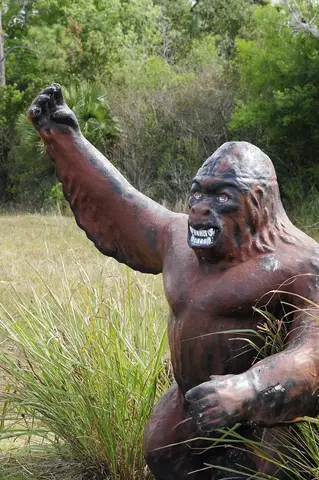
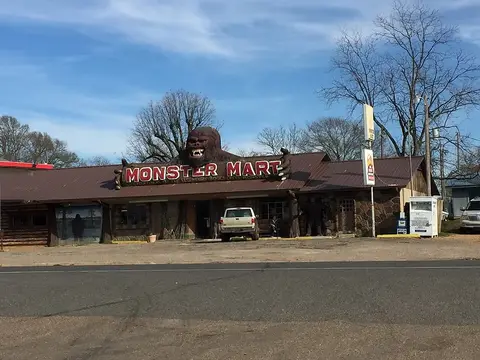
Bigfoot is one of North America’s great pop-culture icons, from the 1972 docudrama The Legend of Boggy Creek and the 1987 film Harry and the Hendersons to beef-jerky commercials, road signs and countless festivals. Willow Creek, California, calls itself the gateway to Bigfoot Country, with a carved statue, the Bigfoot collection at the Willow Creek–China Flat Museum and the Bigfoot Daze festival each Labor Day weekend. Harrison Hot Springs in British Columbia holds Sasquatch Days with the Sts’ailes First Nation, celebrating the being’s Indigenous roots with canoe races, dances and storytelling. Dedicated museums include the North American Bigfoot Center in Boring, Oregon, and Expedition: Bigfoot! in Cherry Log, Georgia, while Washington’s Skamania County still keeps its 1969 Sasquatch ordinance on the books.
Places to visit
Local history museum with a large Bigfoot wing of casts, photos and Bluff Creek memorabilia, at the heart of the 1958 and 1967 events.
Labor Day weekend festival with a parade, music and Bigfoot-themed contests in the self-styled gateway to Bigfoot Country.
Museum and research center outside Portland displaying footprint casts, film analyses and the history of Sasquatch research.
The Ape Canyon trail on the flank of Mount St. Helens passes the site of the famous 1924 miners’ story in the heart of Bigfoot country.
Lakes and forest in Sts’ailes territory, the homeland of the word “Sasquatch”, near the town that hosts Sasquatch Days.
Large private museum in the north Georgia mountains with dioramas, casts and a research library.
Watch
 ARCHIVE.ORG3:07
Patterson–Gimlin film (unedited)
Roger Patterson and Bob GimlinThe original 1967 Bluff Creek footage – the most famous and most debated minute in Bigfoot history. Marked public domain on archive.org.
 ARCHIVE.ORG4:59
The Film That Made Bigfoot A Star
Oregon Public BroadcastingOPB’s short documentary on how the Patterson–Gimlin film turned a regional legend into a global icon – and the hoax claims around it.
 ▶ VIDEO
Sts’ailes Sasquatch Days in Harrison Hot Springs
Tourism Harrison River ValleyShows the festival celebrating the Sts’ailes people’s Sásq’ets, the being behind the word “Sasquatch” (no archive.org equivalent).
Where it’s reported
Alaska Alabama Arkansas Arizona California Colorado Florida Georgia Iowa Idaho Illinois Indiana Kentucky Massachusetts Maryland Maine Michigan Minnesota Missouri Mississippi Montana North Carolina North Dakota Nebraska New Hampshire New Jersey New Mexico Nevada New York Ohio Oklahoma Oregon Pennsylvania South Carolina South Dakota Tennessee Texas Utah Virginia Vermont Washington Wisconsin West Virginia Wyoming Canada
Bigfoot in the news
- Thousands turn out for Blue Bridge Squatch Fest
- The Mystery Of Bigfoot: Maine Unusual Sightings Explained
- Five days, eight encounters: The Bigfoot mystery in Ohio
- The Best Bigfoot Movie Ever Might Have Just Been Announced, And the Main Influence Is John Wick
- Sasquatch calling contest returns to Glenburn
- Snake the Bigfoot Hunter reveals Bigfoot body!
- Bigfoot sightings in New England are not as rare as you might think
- Bigfoot hunter suggests there a conspiracy after Cornell University denies conducting DNA tests on remains
Sources
- The Weather Network: True origins of Sasquatch can be traced back to this Canadian location
- Proceedings of the Royal Society B (via PMC): Genetic analysis of hair samples attributed to yeti, bigfoot and other anomalous primates
- KUOW: Why you shouldn’t mess with Bigfoot in Washington state
- Blue Mountain Eagle: Bigfoot feat – remarkable hoax looms large in family’s history (2002)
- BFRO: Geographic database of Bigfoot sightings
- Wikipedia: Bigfoot
First published · Updated