STATE FILE · AK
Cryptids of Alaska
What cryptids are in Alaska? The best-known are Kushtaka, Iliamna Lake Monster and Bigfoot.
Alaska is so vast and thinly populated – more than 660,000 square miles with fewer than a million people – that it is easy to imagine something unknown hiding in it. Its cryptid lore reflects that scale: rainforest islands in the southeast, enormous glacier-fed lakes in the southwest, and tundra and mountains that few people ever walk. The phrase “Alaska Triangle,” coined for the region between Anchorage, Juneau and Utqiaġvik, has become shorthand for the many people and aircraft that have vanished there, though the explanation is usually weather, terrain and distance.
Cryptids reported in Alaska
 HUMANOID · Pre-colonial
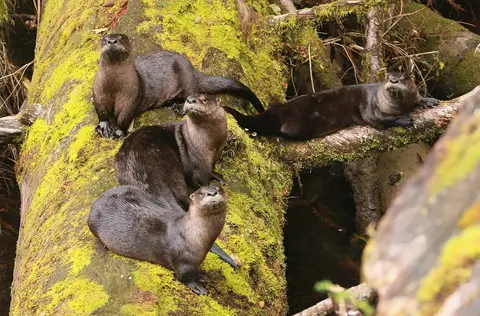
Kushtaka
Southeast Alaska (Tlingit homelands)
The Land Otter Man of Tlingit tradition in Southeast Alaska – a shape-shifting being linked to people lost at sea, later recast by outsiders as a cryptid.
FOLKLORE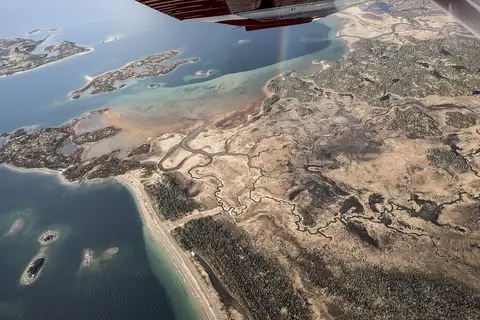 LAKE & SEA MONSTER · 1942
Iliamna Lake Monster
Iliamna Lake, southwest Alaska
“Illie,” a giant fish-like creature reported by bush pilots and villagers in Iliamna Lake, Alaska’s largest lake, since the 1940s.
REGIONAL LEGEND HOMINID · 1958
Bigfoot
Pacific Northwest forests, reported across North America
North America’s most famous cryptid: a huge, hairy, upright ape-like being reported from the Pacific Northwest to Florida since the 1958 “Bigfoot” tracks.
WIDELY REPORTEDThe legends of Alaska
Some of the state’s most important stories belong to Alaska Native peoples and should be understood as living cultural traditions rather than “monsters.” Among the Tlingit and Tsimshian of the southeast, the Kóoshdaa Káa (often written Kushtaka) is a shape-shifting “land otter man” said to lure people lost at sea or in the woods; families and clan histories still carry these accounts. Many Alaska communities also describe large, hairy forest people, and modern Bigfoot researchers point to reports from the Tongass National Forest and around Ketchikan and Prince of Wales Island.
In southwest Alaska, Lake Iliamna – the state’s largest lake, about 77 miles long – is home to the legend of “Illie,” a huge fish or sea-monster-like animal described by local residents and bush pilots. Biologists suggest large white sturgeon or Pacific sleeper sharks as candidates, though neither is confirmed in the lake, and big lake trout or seals may account for some sightings. Remote, cold and rarely surveyed, Alaska remains a favourite destination for cryptozoology TV crews and expeditions.
Hotspots
Alaska’s largest lake, where locals and pilots have reported a giant fish or creature nicknamed “Illie.”
The country’s largest national forest, a temperate rainforest of islands and fjords tied to both Kushtaka traditions and Bigfoot reports.
Southeast Alaska communities where hairy forest-giant and land-otter-man stories are frequently told.
The huge region between Anchorage, Juneau and Utqiaġvik, known for disappearances of hikers and small aircraft.
Sightings timeline
- 1900The Thomas Bay “devil creatures” Kushtaka
Prospector Harry D. Colp recorded how a partner, sent to find gold on a tip from a Tlingit man in Wrangell, returned shaken, claiming hairy creatures had chased him from a lake above the bay. The tale gave the area the nickname “Devil’s Country.”
- 1909Land otter stories recorded Kushtaka
Ethnologist John R. Swanton’s Tlingit Myths and Texts, published by the Smithsonian’s Bureau of American Ethnology, preserved Tlingit stories involving land otters alongside many other traditional narratives.
- 1942Pilots spot giant fish Iliamna Lake Monster
Bush pilot Babe Alsworth and passenger Bill Hammersley reported several enormous, dull aluminum-colored fish below their plane. Theirs is usually counted as the first modern report of Illie.
- 1953“The Strangest Story Ever Told” published Kushtaka
After Colp’s death in 1950, his daughter Virginia had his manuscript printed. In a 1974 interview she would neither vouch for nor dismiss the story, but expressed confidence in her father’s honesty.
- 1959Tom Slick’s aerial search Iliamna Lake Monster
Adventurer Tom Slick, who also funded Yeti expeditions, hired Alsworth to fly over the lake searching for the creature. Nothing was seen.
- 1972De Laguna’s Yakutat ethnography Kushtaka
Anthropologist Frederica de Laguna’s Under Mount Saint Elias documented Yakutat Tlingit beliefs about land otters, including the idea that drowned people could be transformed into Land Otter People. She noted that nearly everyone she met, herself included, had experienced a startling encounter with a land otter.
- c. 1979A $100,000 reward Iliamna Lake Monster
The Anchorage Daily News reportedly offered $100,000 for convincing evidence of the creature’s existence. Accounts differ on the exact year and amount, but the prize was never claimed.
- May 2012The sleeper shark theory Iliamna Lake Monster
Biologist Bruce Wright of the Aleutian Pribilof Islands Association suggested Illie might be a Pacific sleeper shark that had entered the lake, while acknowledging no one knows whether the sharks can live in fresh water.
- June 19, 2017Three backs off Kokhanok Iliamna Lake Monster
About nine adults and several children watched three large, dark shapes surface and dive for roughly 40 minutes in the evening. The witnesses reported no heads, tails or dorsal fins.
Latest from Alaska
No recent cryptid headlines from Alaska. See all the latest cryptid news.
Videos
 ARCHIVE.ORG3:07
Patterson–Gimlin film (unedited)
Roger Patterson and Bob GimlinThe original 1967 Bluff Creek footage – the most famous and most debated minute in Bigfoot history. Marked public domain on archive.org.
 ARCHIVE.ORG4:59
The Film That Made Bigfoot A Star
Oregon Public BroadcastingOPB’s short documentary on how the Patterson–Gimlin film turned a regional legend into a global icon – and the hoax claims around it.
 ▶ VIDEO
Sts’ailes Sasquatch Days in Harrison Hot Springs
Tourism Harrison River ValleyShows the festival celebrating the Sts’ailes people’s Sásq’ets, the being behind the word “Sasquatch” (no archive.org equivalent).