STATE FILE · NM
Cryptids of New Mexico
What cryptids are in New Mexico? The best-known are Chupacabra, La Llorona, Bigfoot and Elephant Butte Giant Catfish.
New Mexico’s mysteries are shaped by its high deserts, volcanic mesas and mountain ranges – and by layers of Pueblo, Hispano and Anglo storytelling. Its most famous strange event is the 1947 Roswell incident, when debris found on a ranch was first announced as a “flying disc” and then explained as a weather balloon; the U.S. Air Force later said it came from Project Mogul, a classified balloon program. Roswell embraced the story, opening the International UFO Museum and Research Center and holding a UFO festival every July.
Cryptids reported in New Mexico
 OTHER · 1995
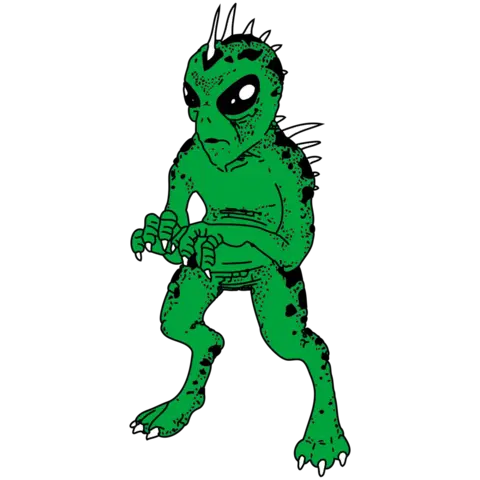
Chupacabra
Canóvanas, Puerto Rico
The “goat-sucker” of 1990s Puerto Rico: a spiny, bloodsucking beast blamed for livestock deaths that spread across Latin America and Texas.
WIDELY REPORTED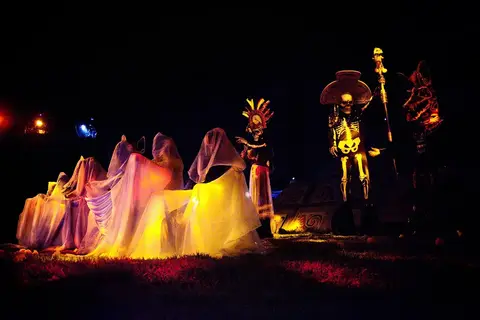 SPECTRAL · 16th century
La Llorona
Canals of Xochimilco, Mexico City
A weeping ghost in white who wanders rivers and canals at night crying for the children she lost – Mexico’s most famous and most widely told legend.
FOLKLORE HOMINID · 1958
Bigfoot
Pacific Northwest forests, reported across North America
North America’s most famous cryptid: a huge, hairy, upright ape-like being reported from the Pacific Northwest to Florida since the 1958 “Bigfoot” tracks.
WIDELY REPORTED LAKE & SEA MONSTER · 2007Elephant Butte Giant Catfish
Elephant Butte Dam, Rio Grande, New Mexico
Catfish “as big as a Volkswagen” said to lurk at the foot of Elephant Butte Dam – New Mexico’s take on a classic American divers’ legend.
LOCAL LEGENDThe legends of New Mexico
The chupacabra crossed into New Mexico in the late 1990s and 2000s, when ranchers blamed livestock deaths on the “goat-sucker” and several hairless, gray-skinned canines were photographed or killed. Wildlife biologists identified such animals as coyotes and dogs suffering from severe sarcoptic mange. Older and deeper is La Llorona, the weeping woman of Hispanic folklore who is said to wander arroyos, acequias and riverbanks searching for her drowned children – a story told to generations of New Mexican children to keep them away from the water, including along the Santa Fe River.
Bigfoot reports come from the Jemez and Sangre de Cristo mountains in the north and the vast Gila National Forest in the southwest. Skeptics point to black bears, elk and the tricks that dark forests and long distances play on observers.
Hotspots
Home of the International UFO Museum and an annual July UFO festival.
One of the waterways where La Llorona is said to weep at night.
Vast wilderness in southwestern New Mexico with scattered Bigfoot reports.
Volcanic highlands west of Santa Fe where hikers report Bigfoot-type encounters.
Sightings timeline
- 1979The real state record Elephant Butte Giant Catfish
An angler landed a 78-pound catfish nearly four feet long, still cited as New Mexico’s record – a genuine giant that lends credibility to bigger tales.
- April 5, 2007Guides tell the dam-diver stories Elephant Butte Giant Catfish
Local fishing guides and a water-sports shop owner told the Daily Lobo about divers who reportedly saw catfish the size of Volkswagens and buses near the dam. None had seen the fish themselves.
- 2011“Tracking the Chupacabra” published Chupacabra
Benjamin Radford’s book, the result of a five-year investigation, argued that the original description was shaped by the 1995 film Species and that later carcasses were mangy canids.
Latest from New Mexico
No recent cryptid headlines from New Mexico. See all the latest cryptid news.
Videos
 ARCHIVE.ORG3:07
Patterson–Gimlin film (unedited)
Roger Patterson and Bob GimlinThe original 1967 Bluff Creek footage – the most famous and most debated minute in Bigfoot history. Marked public domain on archive.org.
 ARCHIVE.ORG4:59
The Film That Made Bigfoot A Star
Oregon Public BroadcastingOPB’s short documentary on how the Patterson–Gimlin film turned a regional legend into a global icon – and the hoax claims around it.
 ▶ VIDEO
Sts’ailes Sasquatch Days in Harrison Hot Springs
Tourism Harrison River ValleyShows the festival celebrating the Sts’ailes people’s Sásq’ets, the being behind the word “Sasquatch” (no archive.org equivalent).
 ▶ VIDEO
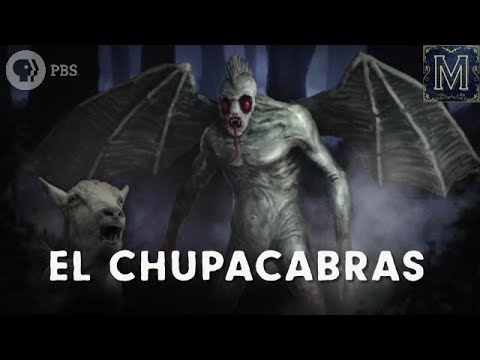
El Chupacabras, a Modern Mystery
Monstrum | PBS StoriedFolklorist Emily Zarka traces both the Puerto Rican and the Texas chupacabra and the real explanations behind them.
 ARCHIVE.ORG3:04
La Llorona
Pikes Peak Library DistrictA short 2010 storytelling segment from a Colorado public library’s community TV channel – a good example of how the legend is told in the US Southwest.
 ▶ VIDEO
The Legend of La Llorona
Monstrum | PBS StoriedFolklorist Emily Zarka explains the legend’s Nahua and colonial roots and its many regional versions.