Field file · Reptilian · Folklore
Klagenfurt Lindwurm
Also known as Lindwurm of Klagenfurt, Klagenfurter Lindwurm
A winged dragon said to haunt marshes where Klagenfurt now stands; a famous ice-age rhinoceros skull modelled its fountain statue.
Klagenfurt, capital of the Austrian province of Carinthia, takes its dragon seriously: the Lindwurm, a winged serpent, appears on the city’s coat of arms and crowns its most famous monument. In local legend, the site was once swamp, flooded by the River Glan and haunted by a water dragon that killed many people at the river crossings. The name Klagenfurt is sometimes explained as “ford of lament.”
In the story, the duke of Carinthia ordered knights to build a tower and use a chained bull as bait. The dragon swallowed the bull and was caught on the chain, and the knights killed it. The marshes were then drained, a castle was built where the tower had stood, and the town was founded. One historian points out that the dragon already appeared on the city seals in the thirteenth century, so the legend is older than the later story of the skull.
In 1335 a large skull was found in a gravel pit near Klagenfurt and was taken to be the head of the dragon. In the nineteenth century, scientists recognised it as the skull of an ice-age woolly rhinoceros. It is still held at the Landesmuseum für Kärnten. The stone Lindwurm, carved from a single block of slate and credited to Ulrich Vogelsang in 1590, took the skull as its model, and is sometimes called the first palaeontological reconstruction. Sources differ on details: one dates the monument to 1583, and another puts the skull’s discovery in the sixteenth century, not 1335.
The statue stands on the Neuer Platz in the middle of the old town and is the city’s best-known landmark. A figure of Hercules was added to the monument at a later date.
What does Klagenfurt Lindwurm look like?
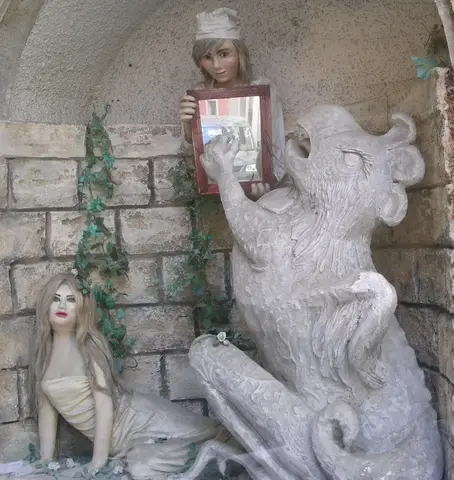
A heavy, four-legged dragon with a lizard-like body, a blunt head modelled on a rhinoceros skull, a pair of wings and a curling tail.
Where is Klagenfurt Lindwurm seen?
The marshes of the Glan and Wörthersee lowlands before the town was built, according to the legend.
Klagenfurt Lindwurm sightings
- 1335The skull is found Near Klagenfurt
A gravel pit yielded the cranium of an ice-age woolly rhinoceros, which people took to be the skull of the dragon.
- 1590The Lindwurm monument Neuer Platz, Klagenfurt
The Lindwurm monument was erected, credited to Ulrich Vogelsang, with its head modelled on the skull. Another source gives 1583 for the work.
- 1996–97Restoration Klagenfurt
The monument was removed for restoration between September 1996 and July 1997.
Is Klagenfurt Lindwurm real? What could explain it
- The skull belonged to an ice-age woolly rhinoceros (Coelodonta antiquitatis), and fossil bones across Europe have given rise to dragon and giant stories.
- The legend appears to be older than the skull and relates to real flooding and swamp dangers in the Glan valley.
- The tower-and-bull hunt echoes the classic ‘baited hook’ dragon-slaying story, as in the Norse tale of Thor and the Midgard Serpent.
Legend, culture and tourism
The Lindwurm is the symbol of Klagenfurt, appearing on its arms, souvenirs and cafes. The fountain on the Neuer Platz is a major attraction, and the skull remains on show at the state museum.
Places to visit
The dragon monument in the heart of Klagenfurt, in the town square.
Where it’s reported
Sources
First published · Updated