FIELD FILE · WOLPERTINGEROTHERFOLKLORE
Wolpertinger
Also known as Wolperdinger, Woiperdinger, Raurackl (Austria), Rasselbock (Thuringia)
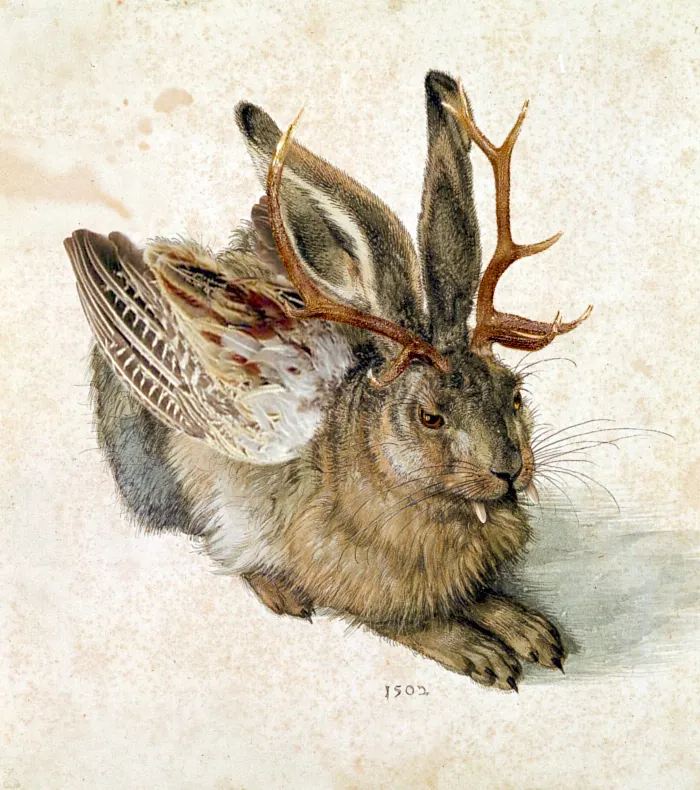
Bavaria’s tongue-in-cheek forest chimera – a horned hare with wings and duck’s feet – made by taxidermists, hunted by the gullible, loved by tourists.
Walk into an old Bavarian inn and you may find one glaring down from the wall: a hare’s head with a pair of small antlers, the body of a squirrel or rabbit, pheasant’s wings and perhaps a duck’s webbed feet, all stitched together with great skill. This is the Wolpertinger, the mischievous mixed-up animal of Bavarian folklore, said to roam the mountain forests of southern Germany.
Nobody knows exactly where the name comes from. The director of Munich’s German Hunting and Fishing Museum has traced it to glassmakers from the village of Wolterdingen near Donaueschingen, who made animal-shaped schnapps glasses called “Wolterdinger”; another theory links it to a dialect word for Walpurgis Night. Regional cousins abound – the Raurackl of Austria, the Rasselbock of Thuringia, the chicken-like Elwedritsche of the Palatinate – and the American jackalope and Swedish skvader belong to the same family of jokes.
What is clear is that 19th-century Bavarian taxidermists began combining parts of different animals into fantastic mounts, selling them to visitors as genuine local wildlife. The legend grew alongside the trade, complete with hunting rules: a Wolpertinger can only be seen by a pretty young woman, at dusk under a full moon, in the company of the right sort of man who knows the lonely forest edges – or caught by sprinkling salt on its tail, or by luring it with a candle into a sack.
The Wolpertinger is, in short, a running joke that Bavarians have been playing on outsiders for well over a century. It is now a regional mascot, the star of books, souvenirs and novels, and a permanent resident of the German Hunting and Fishing Museum in Munich.
- Type
- Other
- Status
- Folklore
- First reported
- 19th century
- Best-known location
- Alpine forests of Bavaria, southern Germany
- Also called
- Wolperdinger, Woiperdinger, Raurackl (Austria), Rasselbock (Thuringia)
- Reported in
- Austria Germany
What witnesses describe
No two are alike. The classic form has the head of a hare with small deer antlers, a squirrel-like body, the wings of a pheasant or duck, sharp fangs and sometimes webbed feet. Some versions give it legs of different lengths on each side, so it can only run around hills in one direction.
Where and when it’s seen
The forests and forest edges of the Bavarian Alps and foothills, as well as parts of Baden-Württemberg and Austria – and, more reliably, glass cases in museums, inns and souvenir shops.
Notable sightings
- 19th centuryTaxidermists’ creations Bavaria
Bavarian taxidermists began assembling composite mounts from the parts of hares, birds, deer and other animals and selling them to tourists as genuine Wolpertingers.
- November 3, 1966A home in Munich Munich, Bavaria
The German Hunting Museum reopened in Munich’s former Augustinian church. Its collection, renamed the German Hunting and Fishing Museum in 1982, includes a celebrated display of stuffed Wolpertingers.
- 1968<em>Der Wolpertinger lebt</em> Germany
Peter Kirein’s humorous book “The Wolpertinger Lives” was one of a run of popular titles that turned the joke creature into a fixture of Bavarian identity.
- 2003Walter Moers’s <em>Rumo</em> Germany
The novelist Walter Moers made a horned, wolf-like Wolpertinger the hero of Rumo & His Miraculous Adventures, carrying the name into international fantasy fiction.
What could explain it?
- The Wolpertinger is openly a joke and a taxidermy tradition – composite mounts made from real animal parts – not a reported animal.
- Old woodcuts of “horned hares” may show real rabbits infected with the Shope papilloma virus, which causes horn-like growths on the head; such animals may have inspired the idea.
- Similar creatures across German-speaking Europe and North America (the jackalope) show a shared tradition of hunters’ tall tales and pranks on newcomers.
- The “only seen by pretty young women at full moon” rule is a wink: it was a classic excuse for a romantic walk in the woods.
Legend, culture and tourism
The Wolpertinger is a beloved Bavarian mascot, found in beer-hall décor, souvenir shops and children’s books, and featured in novels by Walter Moers and Alban Nikolai Herbst. The German Hunting and Fishing Museum in Munich displays a collection of the creatures, and Wolpertingers even appear as pets in the video game World of Warcraft.
Places to visit
Housed in a former Augustinian church in Munich’s pedestrian zone, the museum shows several stuffed Wolpertingers alongside real wildlife.
Where it’s reported
Austria Germany Bavaria Baden-Württemberg
Wolpertinger in the news
No recent headlines about the Wolpertinger. Our news desk checks every day — see all cryptid news.
Sources
First published · Updated