FIELD FILE · TATZELWURMREPTILIANREGIONAL LEGEND
Tatzelwurm
Also known as Stollenwurm, Stollwurm, Bergstutz, Springwurm, Arassas (French Alps)
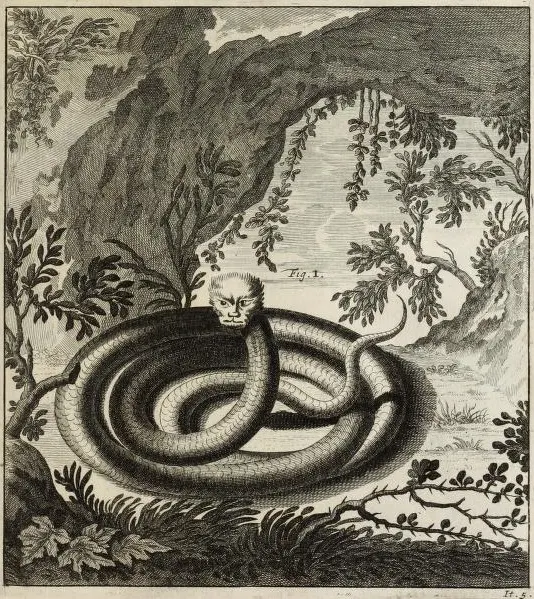
The “worm with paws” of the Alps: a stubby, cat-faced lizard said to lurk in mountain crevices, hiss, and kill with its poisonous breath.
High in the Alps, among scree slopes, mine tunnels and summer pastures, herders and hunters once told of a strange little dragon. In Bavaria and Austria it was the Tatzelwurm – roughly “worm with paws” – while the Swiss called it the Stollenwurm (“tunnel worm” or “stubby-legged worm”) and parts of Austria the Bergstutz, the “mountain stump.” French Alpine villagers had their own version, the arassas.
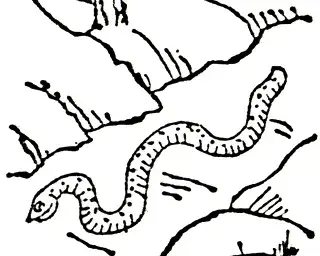
The descriptions agree on a few odd details: a thick, short, snake-like body, one or two pairs of stubby legs (sometimes only front legs), a rounded, cat-like head, and a hiss or whistle. It was said to appear after hot, humid weather or before a change in the weather, to suck milk from cows in the pasture, and to have poisonous breath that could sicken or kill.
The legend has a surprisingly long paper trail. In 1680 the Swiss physician Johann Jakob Wagner recorded mountain “dragon” encounters, including Andreas Roduner’s 1660 meeting with a four-legged, cat-faced beast on Mt. Wangersberg; the naturalist Johann Jakob Scheuchzer reprinted them with engravings in 1723. In the early 1800s the Bernese folklorist Samuel Studer gathered fresh eyewitness accounts and even offered a reward in gold for a genuine Stollenwurm specimen.
The Tatzelwurm had its media moment in 1934, when a German photographer named Balkin published a photo from the Aare Gorge near Meiringen in the Berliner Illustrirte, showing what looked like a fat, finned lizard on a rock. Expeditions headed for the Bernese Oberland and a 1,000-Reichsmark reward was offered, but nothing was found; the Swiss press suspected a clever tourism promoter inspired by the new Loch Ness craze. Today the creature is a beloved mascot of Alpine tourism.
- Type
- Reptilian
- Status
- Regional legend
- First reported
- 1660
- Best-known location
- The Alps of Switzerland, Austria and Bavaria
- Also called
- Stollenwurm, Stollwurm, Bergstutz, Springwurm, Arassas (French Alps)
- Reported in
- Switzerland France Austria Germany Italy Slovenia
What witnesses describe
A stout, lizard- or snake-like creature usually 0.5 to 2 metres long, grey, brown or black, with a cat-like head, large eyes and one or two pairs of short clawed legs. Some accounts add bristles or a crest along the back. It is said to hiss, whistle or shriek, and to leap at intruders.
Where and when it’s seen
Rocky slopes, caves, crevices, old mine tunnels and high pastures of the Alps, particularly in the Bernese Oberland and eastern Switzerland, Tyrol, Salzburg, Styria and the Bavarian Alps. It is said to appear in sultry summer weather.
Notable sightings
- 1660Andreas Roduner’s mountain dragon Wangersberg, Sargans, Switzerland
Roduner described a four-legged, cat-faced creature that reared up as tall as a man, with bristles along its back. His story was recorded by Johann Jakob Wagner in 1680 and later illustrated by Scheuchzer.
- 1779The death of Hans Fuchs The Alps
According to a widely retold story, farmer Hans Fuchs met two of the creatures in the mountains, ran home in terror and died of a heart attack after describing them to his family.
- 1811Schoolmaster Heinrich’s report Guttannen valley, Canton Bern
A schoolmaster told Samuel Studer he had seen a Stollenwurm about a fathom long, as thick as a man’s leg, with a broad head, forked tongue and two stubby feet.
- 1934Balkin’s photograph Aare Gorge, near Meiringen
The photo published in the Berliner Illustrirte caused a sensation across Europe and launched expeditions and a reward. The Neue Zürcher Zeitung dismissed it the following year, and it is now widely regarded as a hoax.
What could explain it?
- Real Alpine animals may lie behind many reports: large lizards and snakes, fire salamanders, stoats and otters, and – for southern Alpine reports – the olm, a pale cave salamander.
- Some cryptozoologists have suggested a large, unknown lizard or a European relative of the Gila monster, but no specimen or fossil supports this.
- Poisonous breath, milk-sucking and treasure-guarding are classic features of European dragon lore, suggesting folklore rather than zoology.
- The 1934 photograph was most likely staged, possibly with a model or a dead fish, and appeared in the wake of the Loch Ness monster craze.
Legend, culture and tourism
The Tatzelwurm lives on as a cheerful Alpine emblem. Wooden figures hide along the path through the Aare Gorge, it appears on plush toys and sweets in the Haslital, and near Oberaudorf in Bavaria a mountain pass area, waterfalls and an inn carry its name, complete with a fiery Tatzelwurm sculpture.
Places to visit
A dramatic 1.4-kilometre gorge with walkways where the famous 1934 photo was supposedly taken; carved Tatzelwurms hide along the route.
Where it’s reported
Switzerland France Austria Germany Italy Slovenia Bern St. Gallen
Tatzelwurm in the news
No recent headlines about the Tatzelwurm. Our news desk checks every day — see all cryptid news.
Sources
First published · Updated