Field file · Reptilian · Folklore
Basilisk of Vienna
Also known as Wiener Basilisk, Basilisk of Schönlaterngasse
A basilisk whose gaze turned people to stone was said to be found in a Vienna well in 1212 and killed by a baker’s apprentice with a mirror.
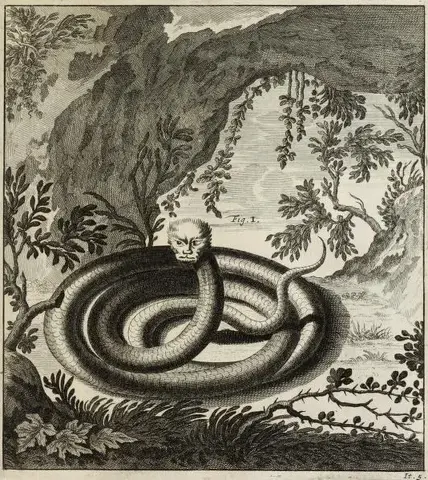
In Vienna’s old town, a house at Schönlaterngasse 7, known as the Basiliskenhaus, carries one of the city’s best-loved monster legends. According to the story, on a day in the summer of 1212, a baker’s servant went to draw water in the courtyard and found a basilisk at the bottom of the well. In medieval belief, the creature, hatched from a cock’s egg and often shown as a rooster with a serpent’s tail, could kill with a glance or breath.
Panic spread, and nobody dared go near the well. A baker’s apprentice finally lowered a mirror to the creature, whose own deadly stare was turned on itself, causing it to burst. Versions of the tale differ on the date (12 or 26 June 1212) and on names; some add a second man, lowered into the well, who was pulled back almost dead, or that the apprentice claimed the baker’s daughter as his reward.
The story is told on the house’s facade, where a carved basilisk and an inscription recount the event. The wording was set into the walls in 1932, using an older text from 1577. The house stands opposite the ‘beautiful lantern’ that gave Schönlaterngasse (“Beautiful Lantern Alley”) its name.
No contemporary record of a 1212 event is cited, and the earliest text mentioned is dated 1577. The basilisk was a common figure in medieval bestiaries and alchemical imagery, and Vienna’s version is one of several European legends in which the monster is defeated by a mirror.
What does Basilisk of Vienna look like?
A small serpent-like creature, often with a cock’s head and a snake’s tail, said to kill with a glance; at Vienna it is carved in stone on the facade.
Where is Basilisk of Vienna seen?
A well in the courtyard of Schönlaterngasse 7, in Vienna’s old town.
Basilisk of Vienna sightings
- June 1212 (legendary)The baker’s apprentice Schönlaterngasse 7, Vienna
A basilisk was said to have been found in a well, and a baker’s apprentice killed it by holding up a mirror. Sources give 12 and 26 June as the date.
- 1577The original text Vienna
The inscription retelling the legend is based on a text of 1577, the earliest source usually cited.
- 1932The inscription restored Schönlaterngasse 7
The facade was inscribed with the story, using the wording of the 1577 text.
Is Basilisk of Vienna real? What could explain it
- A basilisk is a mythical animal of medieval bestiaries, not a species. Medieval writers described it as killing with a glance, so a mirror was a classic way to defeat it.
- A well can accumulate toxic gases, and stories of a ‘deadly gaze’ may have arisen from a real danger of foul air in cellars and wells.
- No source from 1212 is known to the writers cited here; the story is probably a later local legend attached to a house with a distinctive carving.
Legend, culture and tourism
The Basiliskenhaus is a stop on Vienna walking tours, and the legend appears in guidebooks and school books.
Places to visit
The house with the carved basilisk and the story inscribed on its facade.
Where it’s reported
Sources
First published · Updated