Country file · Africa
Cryptids of South Africa
What cryptids are in South Africa? The best-known are Inkanyamba, Grootslang, Mamlambo and Impundulu, among 5 on file.
South Africa’s most powerful monster is a living belief. In Zulu and Xhosa tradition the inkanyamba is a vast serpent of deep pools and storms, whose body becomes the funnel of a tornado when it rises into the sky. Its best-known home is the plunge pool below Howick Falls – KwaNogqaza, “the place of the tall one” – on the uMngeni River in KwaZulu-Natal, where traditional healers still make offerings and where visitors have reported a great head breaking the surface. When tornadoes struck the Hogsback–Alice area of the Eastern Cape in the late 1990s, many people saw the inkanyamba’s hand in the destruction.
- 5 cryptids
- 12 recorded sightings
Cryptids reported in South Africa
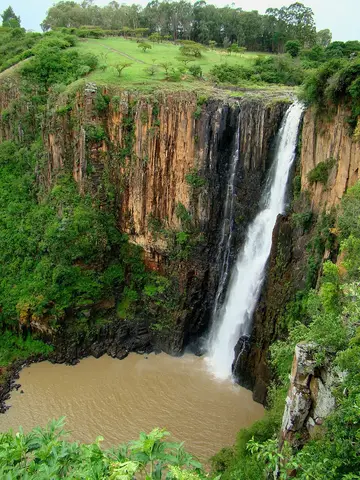
Inkanyamba
The great storm-serpent of Zulu and Xhosa belief, said to live in the pool beneath KwaZulu-Natal’s Howick Falls and to ride the summer tornadoes. Regional legend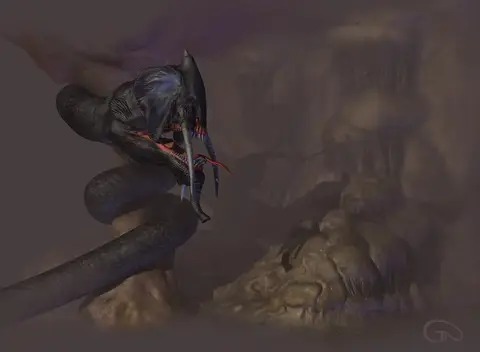
Grootslang
A colossal serpent said to guard a diamond-filled cave in South Africa’s Richtersveld – a prospectors’ legend of greed, peril and treasure. Folklore
Mamlambo
A river being of Xhosa and Zulu belief, a purchased familiar tied to wealth, that made headlines in 1997 as a ‘giant reptile’ blamed for drownings. Regional legendImpundulu
The ‘lightning bird’ of Zulu, Xhosa and Mpondo belief, a thunder-making witch’s familiar that can take human form; a living belief in southern Africa. FolkloreTokoloshe
A dwarf-like water spirit of Nguni belief sent by witches to harm sleepers; the reason many South African beds stand on bricks. A living tradition. FolkloreThe legends of South Africa
At the opposite corner of the country, in the stark mountain desert of the Richtersveld near the Orange River, prospectors’ lore tells of the Grootslang – Afrikaans for “great snake” – a colossal serpent said to guard a diamond-filled cave known as the Wonder Hole. The writer Lawrence G. Green recorded the story in 1948, and it has since become one of the internet’s favourite African monsters. Behind it lie real perils: a hot, waterless land, a diamond rush and southern African rock pythons that can exceed five metres.
South Africa also gave the world its most famous “living fossil”. In December 1938 a trawler landed a strange steel-blue fish near East London, and museum curator Marjorie Courtenay-Latimer recognised it as something extraordinary: a coelacanth, a fish thought to have died out with the dinosaurs. That specimen is still on display at the East London Museum – a favourite stop for anyone who believes the natural world has surprises left – while Howick Falls, Augrabies Falls and the |Ai-|Ais/Richtersveld Transfrontier Park draw visitors to the settings of the country’s serpent legends.
Hotspots
- Howick Falls (KwaNogqaza), KwaZulu-Natal
A 95-metre waterfall on the uMngeni River whose deep pool is said to be the inkanyamba’s lair.
- |Ai-|Ais/Richtersveld Transfrontier Park
Rugged desert mountains along the Orange River, the setting of the Grootslang and its Wonder Hole.
- Augrabies Falls National Park
Dramatic Orange River gorge whose deep pool features in related tales of the great snake’s treasure.
- East London Museum, Eastern Cape
Home of the 1938 coelacanth, the “living fossil” that showed science can still be surprised.
- Hogsback and the Amathole Mountains, Eastern Cape
Misty mountain country near the area struck by the late-1990s tornadoes linked to the inkanyamba.
- Mzintlava River, near Mount Ayliff, Eastern Cape
River valley where the 1997 Mamlambo or ‘Brain Sucker’ reports arose.
Sightings timeline
- 1930sPondoland interviews Mamlambo
The anthropologist Monica Hunter’s informants said men could obtain a mamlambo for wealth, in some accounts bringing it home from the Witwatersrand mines.
- 1930sMpondo interviews Impundulu
Monica Hunter recorded detailed accounts of the impundulu from Mpondo informants, including deaths attributed to it and the strategies used against it.
- 1931Soga’s account of the familiar Mamlambo
The missionary-ethnographer John Henderson Soga wrote that the form of the mamlambo was a matter of individual fancy, one of the older printed records of the belief.
- 1948Lawrence G. Green records the Wonder Hole Grootslang
In Where Men Still Dream, Green described the legendary pit, noted that the prospector-author Fred Cornell had written about the Great Snake and that “scores” of people living near the Orange River had written to newspapers claiming to have seen it, and gave witnesses’ estimates of 40 feet. He concluded that exceptionally large pythons had probably been seen and their size exaggerated.
- December 7, 1955A newspaper headline Tokoloshe
A 1955 newspaper headline about the tokoloshe is reproduced in encyclopedia coverage, showing the belief was already a press topic by the mid 20th century.
- 1970s and 1981The caretaker’s sightings Inkanyamba
Johannes Hlongwane, who looked after a caravan park beside the falls from 1969 to 1985, reported seeing the creature twice (sources give 1971 or 1974 for the first sighting), describing a head and long neck rising high out of the pool and a crest along its back.
- September 1995A head in the plunge pool Inkanyamba
A local restaurant owner said he saw a snake-like head and neck emerge from the water below the falls. Without a camera, he offered a reward for a photograph; the images later published in response were dismissed as hoaxes.
- 1997Searches by officials Mamlambo
One account says armed conservation officers patrolled the river after the reports without finding anything; the claim comes from a secondary source.
- January–April 1997The ‘Brain Sucker’ reports Mamlambo
South African newspapers reported villagers’ claims of a giant river creature and up to nine deaths. Police attributed the deaths to drowning and the injuries to river crabs.
- 1998Tornadoes and the snake in the sky Inkanyamba
Local accounts linked destructive tornadoes in the area to the inkanyamba. Researcher Felicity Wood later documented clay figures and narratives made by local artists in response to the storms.
- 2005Attack on a toddler Tokoloshe
News coverage reported that a man’s belief in omens and spirits led to an attack on a toddler, in a case discussed as an example of the harm that witchcraft-related belief can cause.
- November 7, 2005A homicide conviction Impundulu
The Herald reported that a man was convicted of culpable homicide for killing a two-year-old child he believed to be an impundulu.

