COUNTRY FILE · AFRICA
Cryptids of Republic of the Congo
What cryptids are in Republic of the Congo? The best-known are Mokele-mbembe, Emela-ntouka and Mbielu-mbielu-mbielu.
No country is more closely tied to the idea of a “living dinosaur” than the Republic of the Congo. Its northern Likouala department is a maze of swamp forest, blackwater rivers and seasonally flooded grassland – part of one of the largest wetlands on Earth – and it is here, around Lake Télé and the Likouala-aux-Herbes River, that the Mokele-mbembe, the horned emela-ntouka and the plank-backed mbielu-mbielu-mbielu are said to live.
Cryptids reported in Republic of the Congo
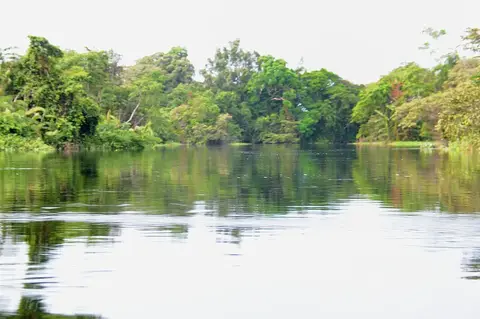 REPTILIAN · 1913
Mokele-mbembe
Likouala swamps and Lake Télé, Republic of the Congo
A long-necked, elephant-sized river beast of Congo Basin lore, hunted since 1980 by expeditions hoping to find a living sauropod in the Likouala swamps.
REGIONAL LEGEND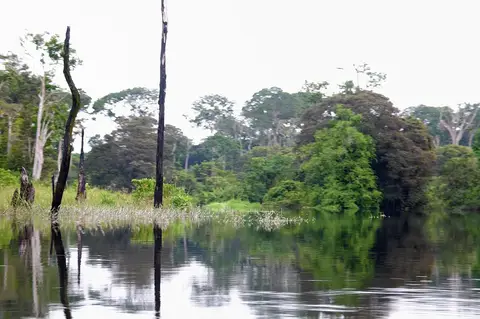 OTHER · 1954
Emela-ntouka
Likouala swamps, northern Republic of the Congo
A one-horned, elephant-sized swamp beast of the northern Congo, said to gore elephants and buffalo – pegged by some as a surviving horned dinosaur.
LOCAL LEGEND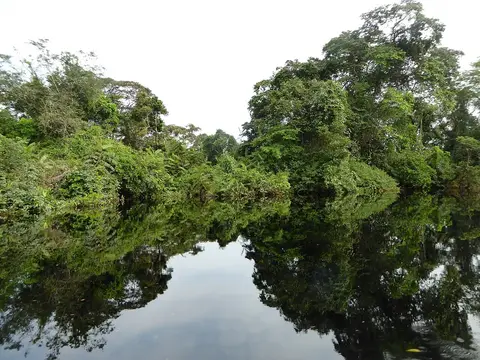 REPTILIAN · 1980
Mbielu-mbielu-mbielu
Likouala-aux-Herbes River, northern Republic of the Congo
A river creature of the Likouala said to show only its back – a row of algae-covered “planks” – which some cryptozoologists have linked to a stegosaur.
LOCAL LEGENDThe legends of Republic of the Congo
The river peoples and forest communities of the Likouala have long told of powerful beings in the water, and those stories are part of a living local culture. From 1980 onwards, however, they also drew a stream of foreign expeditions – scientists, adventurers, film crews and creationist ministries – who arrived with dinosaur picture books and left with interviews, blurry footage and no physical evidence. The country’s first appearance in this lore is even older: in 1776 a French priest’s history of the Loango kingdom on the coast relayed missionaries’ reports of huge clawed footprints.
Today the heart of monster country is the Lac Télé Community Reserve, a vast protected swamp forest known to biologists for its exceptional numbers of western lowland gorillas. Getting there still means long river journeys from Impfondo and Epena, permits, and local guides – which is a large part of why the legend has stayed so durable.
Hotspots
A shallow, almost round lake deep in the swamp forest that became the classic target of Mokele-mbembe expeditions from 1981 onwards.
The slow blackwater river where Roy Mackal’s teams travelled and where several of the region’s water creatures are said to surface.
The riverside town that serves as the last stop for expeditions heading on foot and by canoe towards Lake Télé.
Sightings timeline
- 1776Abbé Proyart’s missionary tracks Mokele-mbembe
In his Histoire de Loango, Kakongo, et autres royaumes d’Afrique, the French priest Liévin-Bonaventure Proyart relayed that missionaries passing a forest had seen the trail of an unseen, very large animal with clawed prints about three feet in circumference. Cryptozoologists later claimed it as the first Mokele-mbembe report, but the account is second-hand, names no creature, and fits a rhinoceros or hippopotamus at least as well.
- 1954Blancou’s article in Mammalia Emela-ntouka
Former game inspector Lucien Blancou published the first printed use of the name, describing a horned beast larger than a buffalo that was said to kill elephants, buffalo and hippos if disturbed.
- 1980–1981Roy Mackal’s expeditions Mokele-mbembe
Biologist Roy Mackal travelled into the Likouala with James Powell in 1980 and returned in 1981 with a team including J. Richard Greenwell and Congolese zoologist Marcellin Agnagna. They collected many interviews and heard a large animal plunge into the water on the Likouala-aux-Herbes, but found nothing more than ambiguous tracks.
- 1980The Bouanila interview Mbielu-mbielu-mbielu
During Roy Mackal’s first Congo expedition, villager Odette Gesonget chose an illustration of a Stegosaurus as the creature described to her by her elders. It remains the core of the stegosaur identification.
- 1981The Regusters expedition to Lake Télé Mokele-mbembe
American aerospace engineer Herman Regusters and his wife Kia reached Lake Télé and later said they had seen a long-necked animal in the lake, photographed it and recorded its call. The images were never judged convincing, and even fellow investigators remained unpersuaded.
- 1980–1981Mackal’s interviews Emela-ntouka
During his two expeditions in search of the Mokele-mbembe, Roy Mackal also collected descriptions of the emela-ntouka and later proposed, with caution, that it could be a horned dinosaur. No animal or remains were found.
- 1983Marcellin Agnagna’s lake sighting Mokele-mbembe
Leading a Congolese expedition, zoologist Marcellin Agnagna reported watching a head and neck rise from the lake roughly 275 metres away. He said he filmed it, but no usable footage resulted – he first blamed a forgotten lens cap, later a wrong camera setting – and critics note the details of his account shifted over time.
- 1987Publication in “A Living Dinosaur?” Mbielu-mbielu-mbielu
Mackal’s book brought the name to an international audience, alongside the Mokele-mbembe and emela-ntouka. He favoured a giant monitor lizard over a dinosaur, while admitting it would be unlike any known species.
- 1992The Japanese aerial footage Mokele-mbembe
A Tokyo Broadcasting System crew filming from an aircraft over Lake Télé captured a blurry object leaving a V-shaped wake. Believers still cite it; skeptics think it most likely shows people in a dugout canoe.
Latest from Republic of the Congo
No recent cryptid headlines from Republic of the Congo. See all the latest cryptid news.
Videos
 ARCHIVE.ORG0:42
Mokele-Mbembe 1992 Footage
Tokyo Broadcasting System (archived copy)The famous blurry aerial footage of a wake on Lake Télé – the clip most often cited as evidence.
 ARCHIVE.ORG2:53
CNN mokele-mbembe report (1987)
CNN (archived copy)A short late-1980s news report interviewing a would-be Mokele-mbembe hunter, a snapshot of the expedition boom.