Country file · Europe
Cryptids of Norway
What cryptids are in Norway? The best-known are Kraken, Selma, Draugen and Nøkken.
Norway’s long Atlantic coast, deep fjords and cold inland lakes have bred sea monsters for as long as Norwegians have gone to sea. The most famous is the kraken, an island-sized creature that fishermen said rose from the deep on calm summer days and could drag a boat down in the whirlpool it left behind. Its roots go back to the medieval King’s Mirror, but it was Erik Pontoppidan, Bishop of Bergen, who made it world-famous in his Natural History of Norway (1752–53), translated into English in 1755. Science later caught up with part of the legend: the giant squid is real, and probably the animal behind it.
- 4 cryptids
- 8 recorded sightings
Cryptids reported in Norway
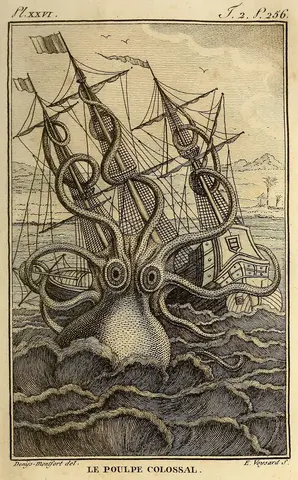
Kraken
The island-sized sea monster of Norwegian fishermen’s lore, made famous by Bishop Pontoppidan in 1752 – and probably inspired by the giant squid. Folklore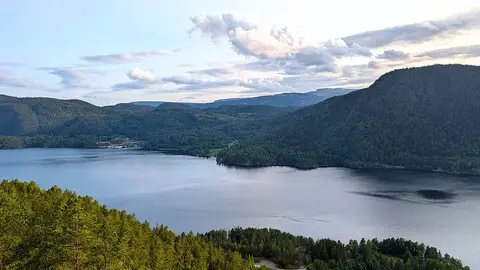
Selma
Norway’s best-known lake serpent, said since 1750 to swim the narrow lake at Seljord in Telemark, where she now graces the town’s coat of arms. Regional legend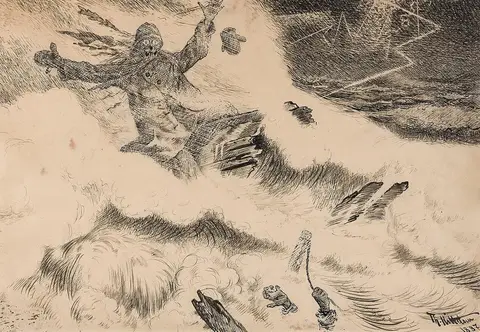
Draugen
Norway’s sea ghost: the seaweed-headed spirit of a drowned fisherman who rows a half-boat through the fog – an omen of death for those who see it. FolkloreNøkken
Nøkken, the shape-shifting water spirit of Denmark and Scandinavia: a fiddler in lakes and streams who lures children and women, and a brook horse. FolkloreThe legends of Norway
Norway is also a land of sea serpents – the sjøorm – and they are said to live not only in the ocean but in its lakes. The best known is Selma, the serpent of Seljordsvatnet in Telemark, first recorded in 1750 when a boatman said a serpent overturned one of his boats. Expeditions with sonar and a mini-submarine have searched the lake, most famously in 1998, and since 1989 a golden sea serpent has been Seljord’s coat of arms.
Norway’s monsters are celebrated with good humour, from Seljord’s lakeside serpent-watching tower to the 2026 Norwegian monster film Kraken. A road trip might run from Bergen, Pontoppidan’s see, along the western fjords, then inland to Telemark and the narrow lake at Seljord.
Hotspots
- Seljordsvatnet, Telemark
The narrow lake where Selma has been reported since 1750, with a serpent-watching tower on the shore.
- Bergen and the western coast
Bishop Pontoppidan’s city and the fjord coast whose fishermen supplied his kraken stories.
- The Norwegian Sea
Deep waters off the coast where the kraken was said to rise – and where giant squid really do live.
- Bø, Nordland
Municipality whose coat of arms shows the half-boat of the sea draug.
Sightings timeline
- 1741Hans Egede’s mention Draugen
Hans Egede’s Det gamle Grønlands nye Perlustration mentioned the sea-draug among ‘sea spectres’, in a passage on the kraken.
- 1750The capsized boat Selma
A boatman from Bø reported that a serpent attacked and overturned one of his boats as he crossed the lake. It is the oldest written account of the creature.
- 1786The priest’s description Selma
Hans Jacob Wille noted the strange creature of the lake in his published description of the parish, keeping the tradition on record.
- 1887Kittelsen’s Draugen Draugen
Theodor Kittelsen’s illustration in Troldskab gave Draugen the visual form that is still famous today.
- 1904Kittelsen’s Nøkken Nøkken
Theodor Kittelsen’s drawing of the water sprite became the defining image of Nøkken for generations of Scandinavians.
- August 7, 1987The half-boat coat of arms Draugen
The municipality of Bø adopted a coat of arms with a silver half-boat on a black field, a reference to the legends of the draug.
- September 15, 1989A serpent on the coat of arms Selma
Seljord was granted its coat of arms, a gold sea serpent on red designed by Trygve Magnus Barstad – official recognition of Selma as the village’s emblem.
- August 1998Jan-Ove Sundberg’s expedition Selma
A 12-member international team led by Swedish monster hunter Jan-Ove Sundberg spent two weeks searching the lake with modern equipment, followed by a British TV crew. Local witnesses had reported two sightings earlier that summer.