FIELD FILE · KRAKENLAKE & SEA MONSTERFOLKLORE
Kraken
Also known as Krake, Horven, Hafgufa (Old Norse), Sea-krake
The island-sized sea monster of Norwegian fishermen’s lore, made famous by Bishop Pontoppidan in 1752 – and probably inspired by the giant squid.
For centuries, fishermen along Norway’s long Atlantic coast told of a creature so vast that it could be mistaken for a cluster of small islands. It rose from the deep on calm, hot summer days; a sudden shallowing of the water, when the sounding line should have found no bottom, was the warning to row for shore. When it sank again, the whirlpool it left was said to be able to drag a boat down. They called it the krake – “the kraken” – a word linked to Old Norse terms for a crooked, branching tree trunk or a grappling hook.
The idea has deep roots. The 13th-century Norwegian King’s Mirror describes the hafgufa, a sea monster that looked more like land than a fish, and later writers such as the missionary Hans Egede linked it to the kraken. But it was Erik Pontoppidan, the Danish-born Bishop of Bergen, who made the kraken world-famous. In his Natural History of Norway, published in Danish in 1752–53 and in English in 1755, he gathered fishermen’s testimony and described an animal perhaps a mile and a half around, with arms that could pull down the largest ship. He speculated that it might be a kind of giant crab, starfish or polyp.
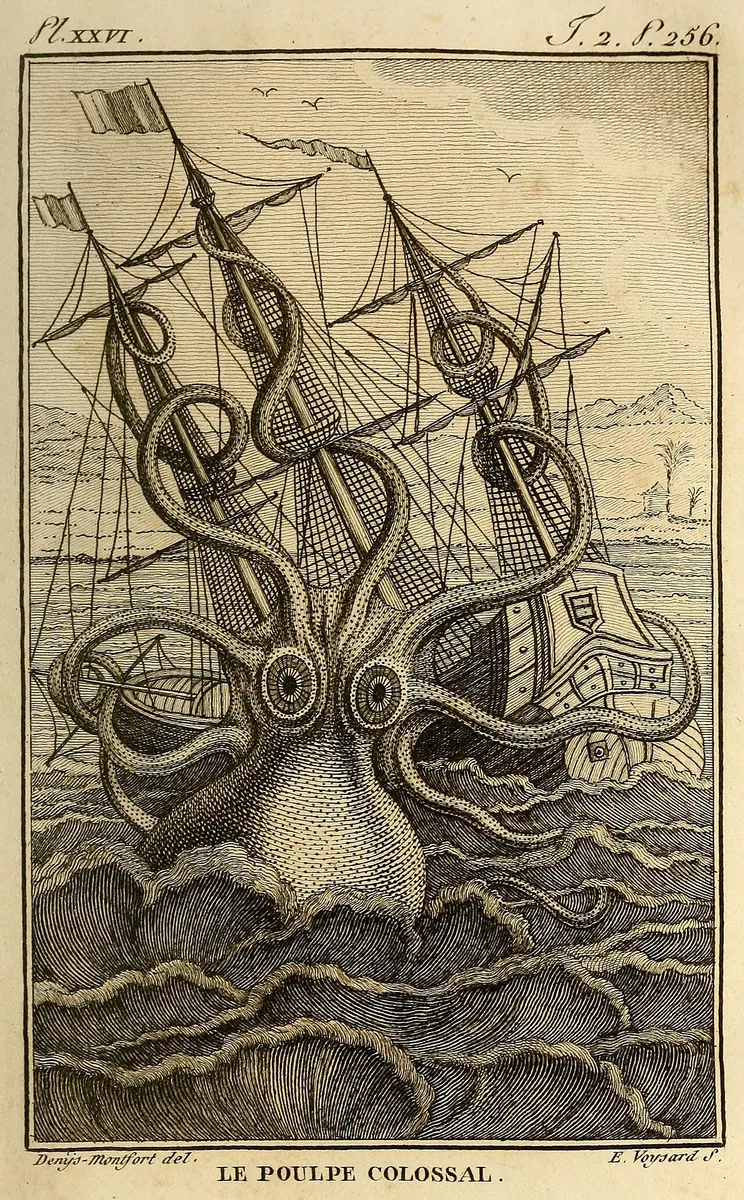
From there the kraken swam into European imagination. The French naturalist Pierre Denys de Montfort published his famous image of a “colossal octopus” attacking a ship in 1801, Alfred Tennyson wrote his poem The Kraken in 1830, and Victor Hugo and Jules Verne set giant cephalopods against human heroes. In the 20th and 21st centuries the kraken became a fixture of films, games and fantasy, most memorably in the Pirates of the Caribbean films.
Meanwhile, science caught up with part of the legend. In the 1850s the Danish zoologist Japetus Steenstrup described the giant squid, Architeuthis, from the remains of stranded animals, and later linked such squid to old Scandinavian sea-monster stories. Today most researchers see the giant squid – which can grow to more than 10 metres including its long feeding tentacles – as the real animal behind the kraken, magnified by fear, distance and centuries of retelling.
- Status
- Folklore
- First reported
- 1752
- Best-known location
- Norwegian Sea, off the coast of Norway
- Also called
- Krake, Horven, Hafgufa (Old Norse), Sea-krake
What witnesses describe
In Pontoppidan’s telling, an enormous, flat-backed mass rising like a group of islets, with mast-like arms or horns that could rise from the water. Later accounts shaped it into a gigantic octopus or squid with long, sucker-lined arms, huge eyes and a beak.
Where and when it’s seen
The deep waters of the Norwegian Sea and North Atlantic off Norway and Iceland, rising in calm, warm summer weather. Its real-life counterpart, the giant squid, lives at depths of several hundred metres in all the world’s oceans.
Notable sightings
- 1752–53Pontoppidan’s <em>Natural History of Norway</em> Bergen and Copenhagen
Bishop Erik Pontoppidan published his natural history of Norway, including a long account of the kraken drawn from fishermen’s reports. The English translation of 1755 spread the creature’s fame across Europe and America.
- 1801The “Colossal Octopus” Paris, France
Pierre Denys de Montfort published an illustration of a gigantic octopus wrapping its arms around a three-masted ship, an image that defined the kraken for generations.
- 1861The <em>Alecton</em> encounter Off Tenerife, Canary Islands
Sailors on the French corvette Alecton tried to haul a huge squid aboard and secured part of its body. The incident helped persuade scientists that giant squid were real.
- September 30, 2004First photos of a live giant squid Ogasawara Islands, Japan
Tsunemi Kubodera and Kyoichi Mori photographed a living giant squid attacking a baited line at about 900 metres – the first images of the animal in its natural habitat.
- June 19, 2019A giant squid in the Gulf of Mexico About 100 miles southeast of New Orleans
During NOAA’s Journey into Midnight expedition, Edith Widder and Nathan Robinson’s Medusa camera filmed a juvenile giant squid some 3–3.7 metres long at a depth of 759 metres.
What could explain it?
- The giant squid (Architeuthis dux) is real and enormous – more than 10 metres long including its tentacles – and dead or dying specimens floating at the surface would have astonished fishermen.
- Pontoppidan’s “floating islands” may reflect several things at once: whales, the shoaling of fish over sea mounts, banks of floating seaweed or volcanic phenomena, combined with tall tales.
- Medieval monsters such as the hafgufa, and the old story of sailors landing on a sleeping whale they mistook for an island, were folded into the kraken legend.
- No real animal approaches the mile-wide size of Pontoppidan’s kraken, and no squid is known to pull down ships.
Legend, culture and tourism
The kraken is one of the world’s best-known sea monsters, from Tennyson’s 1830 poem to the Pirates of the Caribbean films and the phrase “Release the Kraken!” from Clash of the Titans. Seattle’s NHL team is the Seattle Kraken, and Norway itself returned to the legend with the 2026 monster film Kraken. Real giant squid specimens can be seen in museums such as the Natural History Museum in London.
Places to visit
Home of “Archie,” a preserved giant squid caught by a trawler off the Falkland Islands in 2004 and put on display in the Darwin Centre in 2006.
Where it’s reported
Kraken in the news
No recent headlines about the Kraken. Our news desk checks every day — see all cryptid news.
Sources
First published · Updated