Field file · Spectral · Folklore
Draugen
Also known as The Sea Draug, Havdraug, Sjødraug
Norway’s sea ghost: the seaweed-headed spirit of a drowned fisherman who rows a half-boat through the fog – an omen of death for those who see it.
Draugen, the sea draug, is a figure of Norwegian coastal folklore. The old Norse word draugr described a malevolent revenant that guarded its burial mound in the Icelandic sagas, but in later Norwegian tradition, especially in the north, it came to mean the ghost of a drowned fisherman who had not been buried in consecrated ground.
Stories describe the draug in a leather or oilskin jacket, often with a bundle of seaweed where its head should be. It sails in a half-boat, made of only half the hull, with the sail set stiffly against the wind, and its sighting is taken as an omen of death or shipwreck for the crew who see it. The municipality of Bø in Nordland has had a silver half-boat on its coat of arms since 1987, a nod to this tradition.
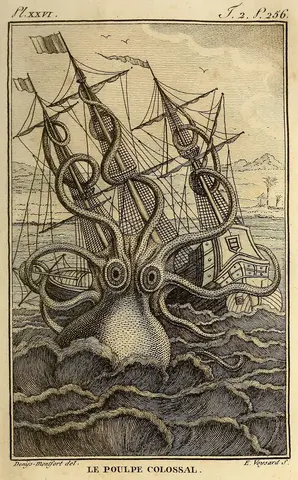
The earliest written reference cited by scholars comes from the priest Hans Egede, who mentioned the sea-draug in 1741, in a passage on the kraken, saying it had no fixed form. Later writers such as Jonas Lie, and the illustrator Theodor Kittelsen, whose picture Draugen (from Troldskab, 1887) is the best-known image, helped to fix the figure in the Norwegian imagination.
Folklore from the north also tells of Christmas customs in which people left beer and food outside for the draug and other spirits, and of the draug joining the Wild Hunt. The tales are most common where fishing dominated life and drowning was a constant risk.
What does Draugen look like?
A bloated or faceless figure in old fishing clothes, with a bundle of seaweed for a head, sometimes seen rowing a half-boat.
Where is Draugen seen?
Coastal waters and beaches of northern Norway, especially Nordland, Lofoten and Vesterålen, in fog or storm and often before a death at sea.
Draugen sightings
- 1741Hans Egede’s mention Greenland and Norway
Hans Egede’s Det gamle Grønlands nye Perlustration mentioned the sea-draug among ‘sea spectres’, in a passage on the kraken.
- 1887Kittelsen’s Draugen Norway
Theodor Kittelsen’s illustration in Troldskab gave Draugen the visual form that is still famous today.
- August 7, 1987The half-boat coat of arms Bø, Nordland
The municipality of Bø adopted a coat of arms with a silver half-boat on a black field, a reference to the legends of the draug.
Is Draugen real? What could explain it
- The draug gave fishing communities a way of talking about the real danger of drowning and of bodies lost at sea and never given a proper burial.
- Sightings in fog, with oars creaking and sails seen in the mist, are explained by optical effects of fog banks and the mirage-like distortion of boats at sea.
- Scholars separate the sea draug from the saga draugr: the latter is a land-based undead, the former a later coastal development, with similar beings in Sámi tradition called rávga.
Legend, culture and tourism
The draug lives on in Norwegian fairy tales, art and horror, and in the 2019 adventure game Draugen, set in 1920s Norway. In the north it is treated as an old part of the coastal story tradition rather than a modern creature.
Where it’s reported
Sources
First published · Updated