Field file · Spectral · Folklore
Nøkken
Also known as Nøkke, Näcken (Sweden), Nix, Strömkarlen, Fossegrim
Nøkken, the shape-shifting water spirit of Denmark and Scandinavia: a fiddler in lakes and streams who lures children and women, and a brook horse.
Nøkken (Danish nøkke) is the Danish and Norwegian form of the nix, a shape-shifting water spirit known throughout Germanic folklore. In Scandinavian tradition the nix is usually male, appearing as a fair young man, an old bearded figure sitting on a rock, or an animal. His best-known trait is music: he plays an enchanted fiddle that draws women and children toward the water, and in grim versions he drowns them.
Many beliefs grew up around him. Pregnant women and unbaptised children were considered especially at risk, and the spirit was said to be most active at Midsummer, Christmas Eve and on Thursdays. Naming a malicious nix by name was believed to defeat him, steel thrown in the water or a knife stuck in the ground protected a swimmer, and his cry, likened to a loon’s, was an omen of a coming drowning. In other stories he is harmless and would teach the fiddle, for a price such as three drops of blood or a black animal.
The nix also appears as a brook horse, a beautiful white horse standing near a stream in fog. Whoever mounts it cannot dismount, and it plunges into the water. The motif has parallels in the Scottish kelpie and Welsh ceffyl dŵr.
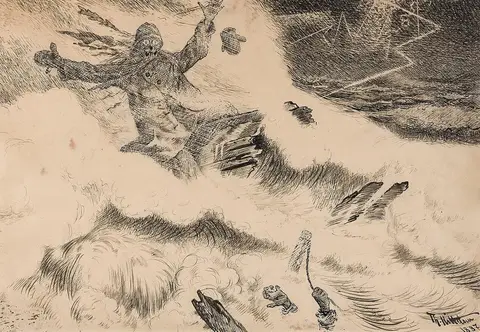
The nix also gave his name to the water lily, called nøkkerose in Norwegian and näckros in Swedish. The Norwegian painter Theodor Kittelsen (1857–1914) shaped the modern look of Nøkken in his art, and Nøkken remains the best-known water spirit of the region.
What does Nøkken look like?
A shape-shifter: a fair youth or old man playing a fiddle, a floating object, or a white or black horse; often green-haired.
Where is Nøkken seen?
Lakes, ponds, streams and waterfalls, especially in mist or at twilight and on Midsummer night.
Nøkken sightings
- c. 1180–1210Nix in the Nibelungenlied Danube, Germanic lands
The German epic mentions the nix, the earliest dated attestation in the wider Germanic tradition.
- 1904Kittelsen’s Nøkken Norway
Theodor Kittelsen’s drawing of the water sprite became the defining image of Nøkken for generations of Scandinavians.
Is Nøkken real? What could explain it
- Rivers and lakes drowned many children; a seductive spirit gave families a reason to keep them from the water.
- The horse form may be older than the human form, since Scandinavian names for the creature derive from a word for “river horse.”
- Music from waterfalls and rapids can sound like faint fiddling or singing, which may have inspired the music-playing nix.
Legend, culture and tourism
Nøkken inspired folk ballads, Romantic poetry, Kittelsen’s paintings and later fantasy; Scandinavian water lilies are named after it, and Sweden holds a contest called Årets Näck for water-spirit fiddlers.
Where it’s reported
Sources
First published · Updated