FIELD FILE · STORSJOODJURETLAKE & SEA MONSTERREGIONAL LEGEND
Storsjöodjuret
Also known as The Great Lake Monster, Storsie, Storsjöormen
Sweden’s Great Lake Monster, a dog- or cat-headed serpent said to swim Storsjön – once hunted with a royal-backed trap and even legally protected.
Storsjön, “the Great Lake,” lies at the heart of the province of Jämtland in central Sweden, with the city of Östersund on its eastern shore and the island of Frösön in the middle. It is a big, cold lake, up to about 74 metres deep, and for about four centuries people have claimed to see a long, humped animal moving across its surface on still summer days. Swedes call it Storsjöodjuret, the Great Lake Monster.
Its legend is unusually old. A manuscript of 1635 by Morten Pedersen Herdal describes a lake serpent that the rune-master Kettil Runske bound to the bottom by carving a spell on the Frösö Runestone, the northernmost runestone in Sweden. A 1685 account adds that the serpent’s head lay under the stone and its tail far away across the lake. Later folk tales say two trolls, Jata and Kata, brewed the creature in a cauldron by the shore, and that it grew big enough to wrap around Frösön.
Sightings multiplied in the 19th century. In 1894 a local company set out to catch the creature, with backing from King Oscar II; it built a huge iron trap baited with a pig, and the effort failed amid national mockery. In 1899 the naturalist Peter Olsson published 22 eyewitness accounts and concluded that an unknown aquatic mammal was the likeliest answer. Some 500 people are said to have reported sightings over the centuries.
In 1986, the year Östersund turned 200, the county administrative board declared the monster an endangered species protected by law – a status withdrawn in 2005 after criticism from Sweden’s Parliamentary Ombudsman. Today the creature is a much-loved symbol of Jämtland, and its baby-faced cartoon version, Birger, is Östersund’s mascot.
- Status
- Regional legend
- First reported
- 1635
- Best-known location
- Lake Storsjön, Östersund, Jämtland
- Also called
- The Great Lake Monster, Storsie, Storsjöormen
- Reported in
- Sweden
What witnesses describe
Usually described as 3 to 14 metres long, with a snake-like body, several humps and a long neck. The head is often said to be dog-like, with ears or ear-like fins; older lore gives it a cat’s head. Its colour is typically dark – grey, brown or black, “black and gleaming” in an 1857 report.
Where and when it’s seen
Lake Storsjön in Jämtland, especially around Frösön, Vallsundet, Sunne and Rödön. Reports peak on warm, calm summer days, though autumn sightings, and even one on new ice in December, are on record.
Notable sightings
- 1635The serpent bound by runes Frösön, Storsjön
Morten Pedersen Herdal’s manuscript describes a lake serpent chained to the bottom by Kettil Runske’s spell on the Frösö Runestone – the earliest written trace of the legend.
- July 1857The iron-mill workers’ sighting Forssbacka, Storsjön
Newspapers reported that workers at the Forssbacka ironworks saw a creature with a gleaming black head about the size of a large cat’s, moving like a sea serpent.
- 1894The royal-backed hunt Östersund
A company was founded to catch the monster, with the support of King Oscar II. Its giant baited trap caught nothing, and the cartoonist Albert Engström lampooned the attempt.
- 1899Peter Olsson’s report Jämtland
The naturalist Peter Olsson published a booklet collecting 22 eyewitness accounts and argued that the witnesses were describing an unknown aquatic mammal.
- 1986A protected species Jämtland County
The county administrative board declared the creature, its offspring and its nest protected by law. The protection was revoked in 2005.
- August 2008Infrared footage Storsjön
A film crew claimed underwater cameras had captured a warm-bodied mass in the lake. The footage was not accepted as evidence of an unknown animal.
What could explain it?
- Swimming elk, deer, otters and beavers, as well as large fish such as pike, can produce a head-and-wake effect that looks like a long animal.
- Logs, boat wakes and standing waves on a large lake can mimic a row of humps, especially on glassy summer days.
- Storsjön was covered by ice until about 10,000 years ago and could not support a breeding population of very large animals unseen.
- The legend clearly began as folklore tied to the Frösö Runestone and troll tales, and was later reinterpreted as a zoological mystery – a pattern shared with Nessie and many other lake monsters.
Legend, culture and tourism
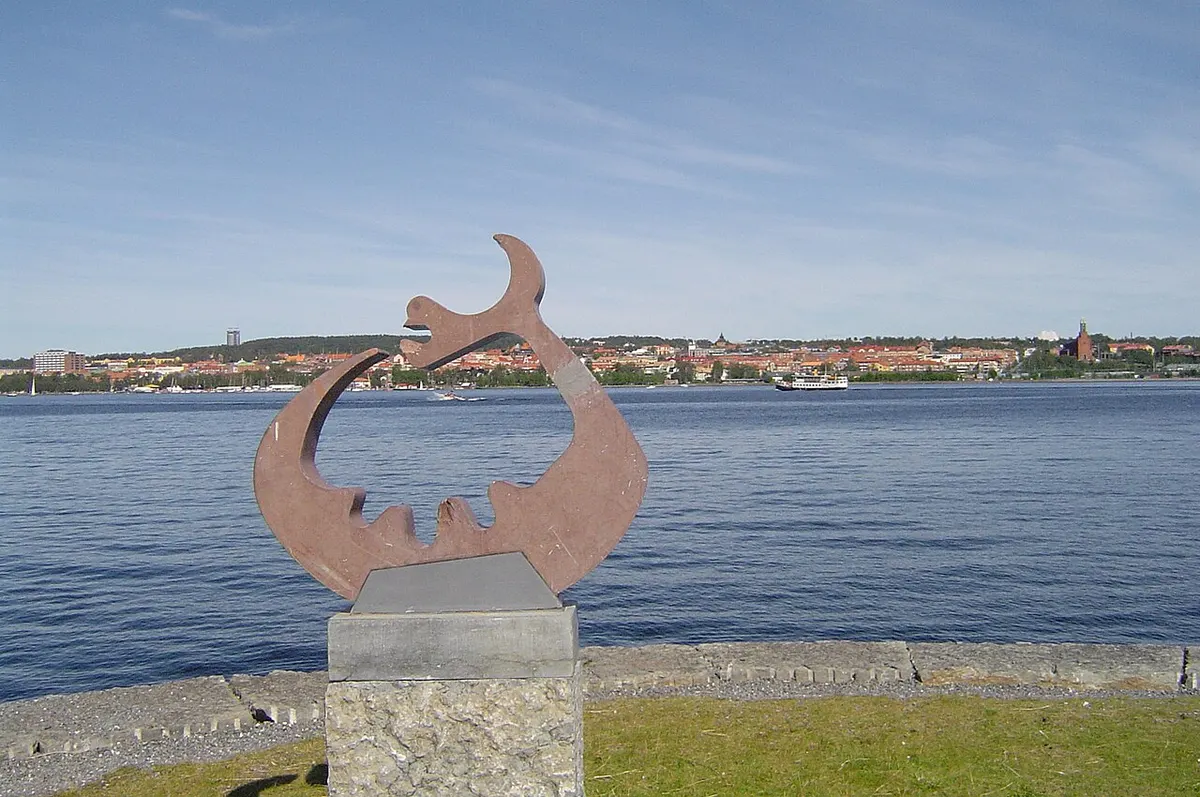
Storsjöodjuret is the pride of Östersund. The Jamtli museum displays the 19th-century trap and witness accounts, the city has official observation spots around the lake, and Birger, the “little Storsjö monster,” stars in children’s books and appears on soft toys and sweets. A dragon-like sculpture of the creature stands by the lake near the city.
Places to visit
The county museum’s monster exhibition includes the giant 1890s trap and first-hand witness accounts.
Spots such as Vallsundet bridge on Frösön, the Sunne church ruin and Badhusparken in Östersund are recommended for scanning the water.
Where it’s reported
Sweden Jämtland
Storsjöodjuret in the news
No recent headlines about the Storsjöodjuret. Our news desk checks every day — see all cryptid news.
Sources
First published · Updated