FIELD FILE · DOBHAR-CHULAKE & SEA MONSTERREGIONAL LEGEND
Dobhar-chú
Also known as Water hound, King otter, Irish crocodile, Anchu
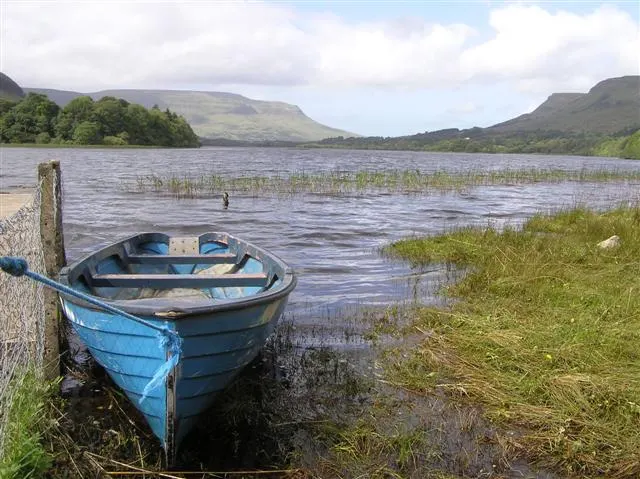
Ireland’s “water hound”: a giant otter-like beast said to have killed Grace Connolly at Glenade Lough in 1722 – a tale tied to a carved local gravestone.
The Dobhar-chú (pronounced roughly “dower-koo”) is the “water hound” of Irish folklore – a creature like an enormous otter or dog that lives in lakes and attacks people at the water’s edge. The name is simply an old Irish word for an otter (dobhar, an old word for water, and cú, hound), and the legend imagines a monstrous “king otter” far larger and fiercer than the real animal.
One of the earliest written accounts comes from the historian Roderic O’Flaherty, who in 1684 described a beast in a lake of West Connacht “of the pitch of an ordinary greyhound”, with black slimy skin, that seized a man by the head and dragged him into the water until he stabbed it with his knife. Local people, O’Flaherty wrote, said such creatures lived in other Irish lakes too, and called them dovarchu – a water dog.
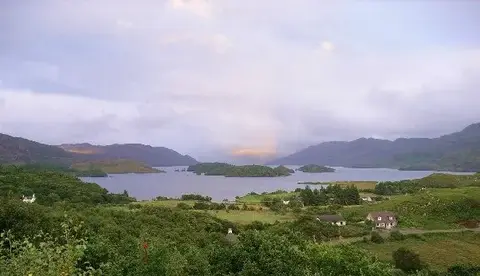
The most famous story belongs to Glenade, a steep valley in north County Leitrim. In 1722, the tale goes, Grace Connolly, the wife of Terence McGloughlin, went down to Glenade Lough to wash clothes and was killed by a Dobhar-chú. Her husband found the creature lying on her body and killed it with a dagger, but its dying whistle summoned a mate from the lake, and he had to fight and kill a second beast before escaping. The story is anchored by a real object: a sandstone headstone in the old cemetery of Congbháil (Conwal) in Glenade, carved with a dog-like animal with a tufted tail, which local tradition identifies as Grace’s grave.
The legend survives mainly in oral tradition, but it has never quite faded. People continue to report unusually large or strange otter-like animals in the lakes and along the coasts of the west of Ireland, and Glenade’s carved gravestone has become a pilgrimage spot for folklore lovers.
- Status
- Regional legend
- First reported
- 1684
- Best-known location
- Glenade Lough, County Leitrim
- Also called
- Water hound, King otter, Irish crocodile, Anchu
What witnesses describe
Usually described as an otter- or dog-like animal several times the size of a normal otter, sometimes said to reach 3–4.5 metres. Some traditions give it a pale or white pelt with black-tipped ears and a dark cross-shaped mark on its back; O’Flaherty’s 1684 account described a greyhound-sized creature with black, slimy, hairless skin. It is said to whistle or shriek.
Where and when it’s seen
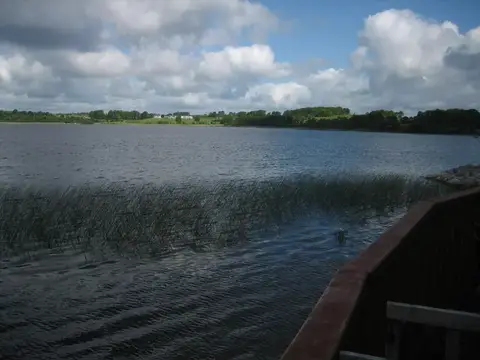
Freshwater loughs and their shores in the west and north-west of Ireland – above all Glenade Lough in County Leitrim and lakes of Connacht such as Lough Mask – as well as rocky western coasts and islands.
Notable sightings
- 1684O’Flaherty’s water dog Lake in West Connacht (identified by later editors as Lough Mask)
In his Chorographical Description of West or H-Iar Connaught, Roderic O’Flaherty recorded a man’s account of being seized by a greyhound-sized lake beast and escaping after stabbing it. He noted that country people called such creatures dovarchu.
- 1722The death of Grace Connolly Glenade Lough, County Leitrim
According to local tradition, Grace Connolly was killed by a Dobhar-chú while washing clothes at the lough, and her husband Terence McGloughlin killed it and its mate. A carved headstone said to mark her grave stands in Conwal cemetery in Glenade.
- 1948The tombstones are studied Glenade, County Leitrim
Patrick Tohall described the Dobhar-chú carvings of Glenade’s cemeteries in the Journal of the Royal Society of Antiquaries of Ireland, bringing the gravestone to the attention of scholars.
- 2003The Omey Island creature Omey Island, Connemara, County Galway
Artist Sean Corcoran and his wife said they saw a large, dark, fast-swimming animal with orange, flipper-like feet that let out a haunting screech, which they linked to the Dobhar-chú. Their account was retold in an Irish Times column in 2009.
What could explain it?
- Eurasian otters, which are common in Ireland, can look large and dog-like in the water and make shrill whistling calls – the most likely source of the legend.
- Seals, which sometimes swim up rivers and into lakes, may account for some reports of big, dark, flippered animals.
- The Glenade story may be a dramatic local legend attached to an unusual carved gravestone; the carving itself could be a family or heraldic emblem rather than a record of an attack.
- Some writers have suggested folk memory of extinct giant otters, but there is no fossil evidence of such animals in Ireland.
Legend, culture and tourism
The Dobhar-chú is one of Ireland’s best-loved folk monsters, featured in books, local storytelling and artworks around Leitrim, Sligo and Connemara. The Glenade gravestone is a quiet place of interest for visitors exploring the dramatic Glenade valley between Kinlough and Manorhamilton.
Places to visit
The old graveyard where the carved headstone linked to Grace Connolly and the Dobhar-chú can be seen.
Where it’s reported
Scotland Ireland County Leitrim County Galway County Mayo
Dobhar-chú in the news
No recent headlines about the Dobhar-chú. Our news desk checks every day — see all cryptid news.
Sources
- Wikipedia: Dobhar-chú
- Roderic O’Flaherty, <em>A Chorographical Description of West or H-Iar Connaught</em> (written 1684, published 1846), via Internet Archive
- Patrick Tohall, “The Dobhar-chú Tombstones of Glenade, Co. Leitrim”, <em>Journal of the Royal Society of Antiquaries of Ireland</em> 78 (1948), JSTOR
First published · Updated