Country file · Oceania
Cryptids of New Zealand
What cryptids are in New Zealand? The best-known are Taniwha, Waitoreke, Moehau and Pouākai, among 5 on file.
Aotearoa New Zealand is a land without native land mammals – apart from a few species of bat, the islands evolved as a world of birds, from the giant moa to the huge Haast’s eagle, both wiped out within a few centuries of human arrival. That makes its mystery-animal stories unusual. The deepest tradition belongs to Māori: taniwha, powerful beings of rivers, lakes and the sea, some revered as tribal guardians and others remembered as man-eaters slain by heroes. The Waikato River is famous as the river “of a hundred taniwha”, and the Hokianga and Wellington harbours are said to have been carved by them.
- 5 cryptids
- 12 recorded sightings
Cryptids reported in New Zealand
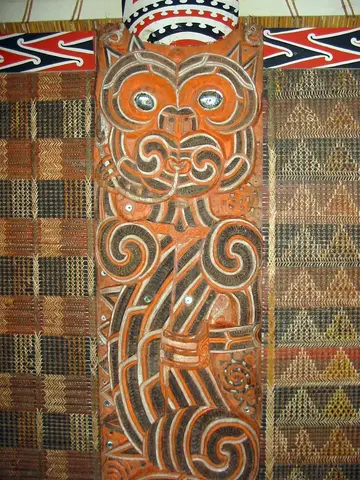
Taniwha
Powerful water beings of Māori tradition – guardians to some iwi, man-eaters in other tales – said to dwell in deep pools, caves and harbour mouths. Folklore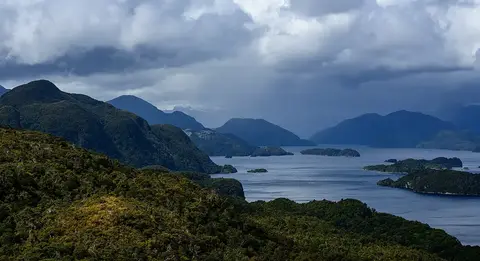
Waitoreke
A small, otter-like swimmer reported in South Island rivers since Captain Cook’s day, in a country whose only native land mammals are bats. Regional legend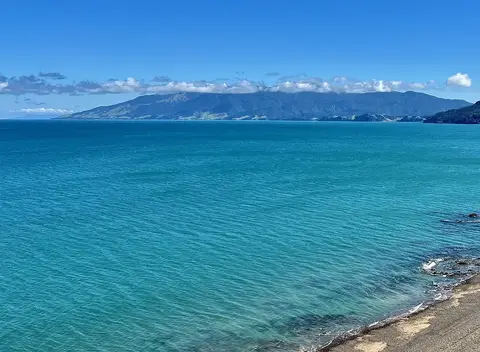
Moehau
A hairy, man-sized wild being said to roam the Coromandel’s Moehau Range – New Zealand’s answer to Bigfoot, declared “dead” by a newspaper in 1970. Local legend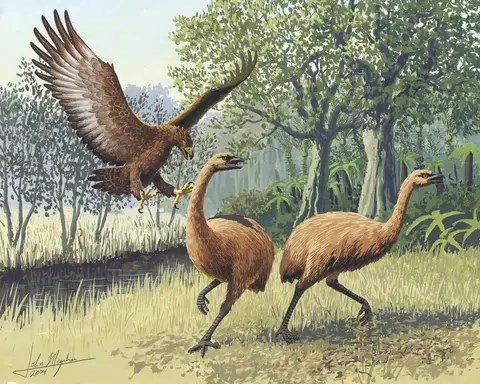
Pouākai
The giant man-killing bird of Māori tradition, widely identified with Haast’s eagle, the largest eagle known, which died out around 1445. Folklore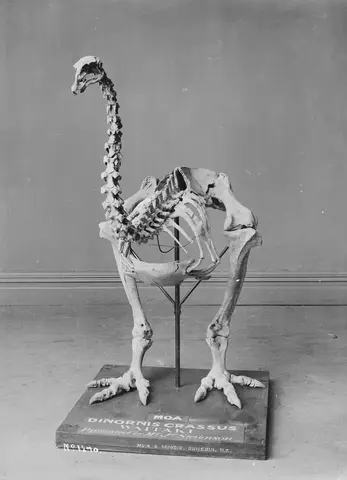
Surviving Moa
Claims that giant moa outlived their extinction around 1445 in the remote South Island, from 1820s tales to Alice McKenzie’s Fiordland sighting. Extinct animal?The legends of New Zealand
Taniwha are part of modern public life too. In 2002 the Ngāti Naho hapū objected that a new stretch of State Highway 1 near Meremere would destroy the lair of their taniwha Karutahi, and Transit New Zealand agreed to partly reroute the road – a decision debated across the country. European settlers added their own mysteries: the waitoreke, an otter-like swimmer reported in South Island rivers since Captain Cook’s crew glimpsed a strange animal at Dusky Sound in 1773, and tracked by the geologist Julius von Haast on the upper Ashburton River in 1861; and the Moehau, a hairy wild man of the Coromandel Peninsula’s Moehau Range that newspapers declared “dead” in 1970.
For visitors, New Zealand’s legends are best experienced through its landscapes and museums. The carved meeting house Hotunui at Auckland Museum includes the guardian taniwha Ureia, walking tracks circle the foot of the Moehau Range at the tip of the Coromandel, and the farmland streams around Otautau in Southland have produced most of the modern waitoreke reports.
Hotspots
- Waikato River
New Zealand’s longest river, “of a hundred taniwha”, including Karutahi near Meremere.
- Hokianga Harbour, Northland
Harbour said to have been dug by the sons of the taniwha Āraiteuru, who guards its southern head.
- Moehau Range, Coromandel
Sacred, bush-clad mountains at the tip of the Coromandel Peninsula, home of the Moehau legend.
- Otautau, Southland
Small town on the Aparima River at the centre of most modern waitoreke sightings.
- Wellington Harbour (Te Whanganui-a-Tara)
Harbour said in tradition to have been formed by the taniwha Ngake and Whātaitai.
- Fiordland National Park, Southland
Remote wilderness where Alice McKenzie said she saw a moa.
- Egmont National Park, Taranaki
Home of the Pouākai Range and tarns on Mount Taranaki.
Sightings timeline
- c. 1888–1912Pelorus Jack escorts the ships Taniwha
A Risso’s dolphin began meeting ships near French Pass around 1888 and was given legal protection by an Order in Council in 1904. In some Māori traditions the dolphin was seen as a manifestation of a guardian taniwha of the strait; it was last seen in 1912.
- 1954Under the glass-bottomed boat Waitoreke
A paua fisherman reported that an animal he took to be an otter swam beneath his glass-bottomed boat – one of the accounts later collected by Lloyd Esler.
- November 29, 1969“Hairy Man of Moehau” in the Herald Moehau
The New Zealand Herald reported on the creature under the headline “Fearless dog would not attack Hairy Man of Moehau”, one of the stories that made the legend nationally known.
- April 7, 1970The monster is “buried” Moehau
The Press, following the Auckland Star the day before, declared the Moehau monster dead after a local councillor said the story had started as a joke.
- 1989Anderson’s review Surviving Moa
Atholl Anderson concluded in a 1989 paper that the evidence did not show moa survived into European times.
- 1993A blurry photograph Surviving Moa
A photograph reported to the Department of Conservation was identified as a red deer.
- 2002Karutahi and State Highway 1 Taniwha
The Ngāti Naho hapū said a planned new section of State Highway 1 would destroy the lair of their taniwha Karutahi. Transit New Zealand agreed to partially reroute the highway, a decision that drew both support and ridicule.
- 2005Ngāwhā prison opens Taniwha
Local hapū had opposed the Northland Region Corrections Facility because it lay on the path of Takauere, a log-shaped taniwha associated with Lake Ōmāpere and the Ngāwhā hot springs. The objections failed and the prison opened in 2005.
- June 2013CT study of the skull Pouākai
Paul Scofield’s team reported that the bird’s anatomy fits an ambush hunter.
- December 10, 2013Eleven witnesses near Otautau Waitoreke
The Otago Daily Times reported that Lloyd Esler had gathered 11 sightings dating from 1929 to 2011, ten within 25 km of Otautau, and appealed for more witnesses and a photograph.
- 2015Coppell’s search begins Moehau
Paranormal investigator Marc Coppell began years of fieldwork after what he called strange experiences in remote bush, later reporting footprints, wood-knocks and thrown stones and making a cast of a footprint.
- February 2024Back in the headlines Moehau
Stuff and RNZ revisited the legend with Coppell and author Scott Bainbridge, while the Department of Conservation said its Coromandel staff had never found any evidence.