COUNTRY FILE · OCEANIA
Cryptids of Australia
What cryptids are in Australia? The best-known are Yowie, Bunyip, Tasmanian Tiger (Thylacine) and Queensland tiger, among 5 on file.
Australia’s mystery creatures grow from deep roots. Aboriginal traditions across the continent include water beings of billabongs and swamps and hairy, man-like beings of the ranges, and these stories – told in many languages and belonging to many peoples – were the seeds of two of the country’s best-known legends. The bunyip entered colonial newspapers in July 1845, when the Geelong Advertiser reported a “new animal” from fossil bones near Geelong, and for decades settlers wrote of booming cries from swamps and rivers. The yowie, a tall “hairy man” of the eastern forests, appeared in the press from the 1870s and became a national phenomenon in the 1970s.
Cryptids reported in Australia
Yowie
Forests of the Great Dividing Range, eastern Australia
Australia’s hairy “bush man”: a tall, ape-like figure of eastern forests, rooted in Aboriginal hairy-man stories and colonial-era newspaper tales.
WIDELY REPORTED LAKE & SEA MONSTER · Pre-colonialBunyip
Billabongs, swamps and rivers of south-eastern Australia
The water spirit of Aboriginal tradition said to lurk in billabongs and swamps – turned by colonial newspapers into Australia’s first great monster story.
FOLKLORE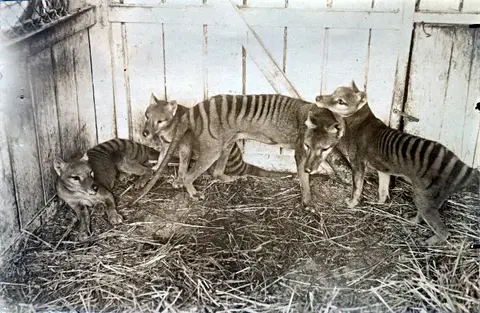 DOGMAN & CANINE · 1936
Tasmanian Tiger (Thylacine)
Tasmania’s north-west and south-west wilderness
A striped, dog-like marsupial officially extinct since the last one died in a Hobart zoo in 1936 – yet over a thousand people say they have seen one since.
EXTINCT ANIMAL?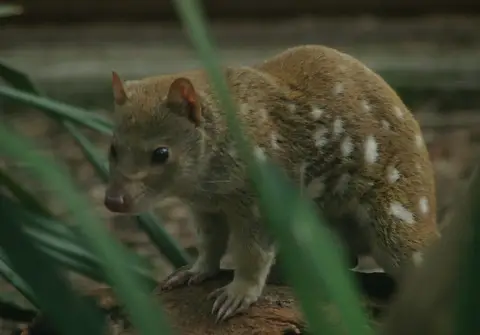 BIG CAT · 1871
Queensland tiger
Rainforests and tablelands of far north Queensland
A striped, tree-climbing “marsupial cat” of north Queensland’s rainforests, reported since 1871 and linked by some to the extinct marsupial lion.
REGIONAL LEGEND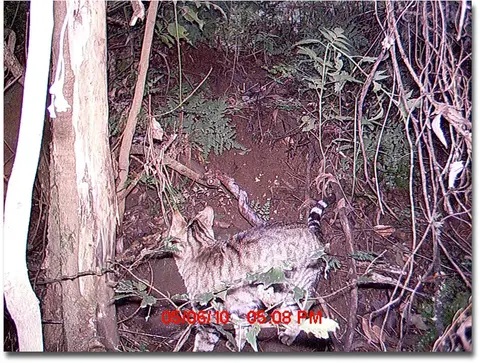 BIG CAT · 1933
Gippsland phantom cat
Gippsland, eastern Victoria
Puma- or panther-sized cats reported across Gippsland since the 1930s, blamed on wartime mascots – yet every one examined so far has been a feral moggy.
REGIONAL LEGENDThe legends of Australia
Australia also has one of the world’s most poignant cryptid stories: the thylacine, or Tasmanian tiger, whose last known individual died in Hobart’s Beaumaris Zoo on 7 September 1936. Hundreds of people have since reported seeing one, from Tasmania’s north-west to Cape York. North Queensland adds the Queensland tiger – a striped, tree-climbing “marsupial cat” reported since 1871 – and Victoria the Gippsland phantom cat, one of many “big cats” that a 2012 state government review concluded were most likely large feral cats.
Monster-hunting in Australia means getting into some spectacular country. Yowie enthusiasts head for the Blue Mountains and the Gold Coast hinterland – the town of Kilcoy in Queensland even has a Yowie Park – thylacine hopefuls go to the takayna/Tarkine wilderness of north-west Tasmania, and the town of Murray Bridge in South Australia has kept a mechanical bunyip on its riverbank since 1972.
Hotspots
Deep sandstone valleys west of Sydney with a long record of yowie reports and searches.
Home of Kilcoy’s Yowie Park and of the 1970s sightings around Springbrook.
Remote rainforest and buttongrass country of the north-west, the focus of many thylacine sightings.
River town whose roaring mechanical bunyip has entertained visitors since 1972.
Rainforest uplands where the Queensland tiger has been reported since the 19th century.
Sightings timeline
- Early 1970sOn the Upper Barron road Queensland tiger
Jane Leadley, a long-time resident near Lake Barrine, described a dog-sized animal with a flat head and a long, striped tail crossing the road between the Mount Hypipamee crater road and Longlands Gap.
- January 29, 1972Murray Bridge’s mechanical bunyip Bunyip
South Australian Premier Don Dunstan opened a coin-operated bunyip that rose roaring from the river. Built by local businessman Dennis Newell, “Bertha” is still a beloved roadside attraction more than fifty years later.
- 1976Rex Gilroy and the Yowie on national TV Yowie
After the Queanbeyan Age published Rex Gilroy’s claims to have evidence for the Yowie, the ABC’s This Day Tonight ran a story on the hunt. Coverage like this turned a scattered folk tradition into a national cryptid.
- 1977A future senator’s sighting Yowie
Bill O’Chee, later a Queensland senator, told the Gold Coast Bulletin he had seen a very tall hairy creature at Springbrook while on a school trip. The Springbrook plateau has since gathered more reports than anywhere else in Australia.
- December 28, 1979The Kilcoy encounter Yowie
Two 16-year-olds reported a two-to-three-metre brown, hairy creature and later returned with their biology teacher to cast a large footprint. The town embraced the story with a Yowie statue and park.
- Autumn 1982Hans Naarding’s torchlight encounter Tasmanian Tiger (Thylacine)
Parks and Wildlife ranger Hans Naarding reported watching an apparently healthy adult thylacine for several minutes in his spotlight while sheltering from rain in his vehicle. Because of his experience, the report was taken seriously and led to a confidential search lasting more than a year, which found no proof.
- 2000The Piper film Yowie
Canberra bushwalker Steve Piper filmed what he said was a large dark figure moving through the bush. Like most Yowie footage, the images are too indistinct to settle the question.
- June 2005Kurt Engel’s black cat Gippsland phantom cat
Deer hunter Kurt Engel said he shot a big black cat, photographed it and kept the tail. In October 2005 a hair examiner working for the state environment department said the hair came from a domestic cat; DNA tests on the tail later confirmed Felis catus.
- September 2012The government review Gippsland phantom cat
A 22-page report by the Departments of Primary Industries and Sustainability and Environment found big cats “highly unlikely” to exist in Victoria, attributing most reports to large feral cats, but recommended further DNA sampling to settle the question.
- March 2017Cape York camera-trap survey Tasmanian Tiger (Thylacine)
James Cook University ecologists Sandra Abell and Bill Laurance announced a camera-trap survey after two people described seeing striped, dog-like animals at close range at night. The researchers called the odds of finding a thylacine very small and designed the survey to record other threatened mammals too.
- February 2021The “thylacine family” photos Tasmanian Tiger (Thylacine)
Neil Waters of the Thylacine Awareness Group announced camera-trap pictures that he believed showed a family of thylacines. After reviewing them, the Tasmanian Museum and Art Gallery said the animals were most likely Tasmanian pademelons, a small wallaby, and other zoologists agreed.
- March 2023Statistical study of 1,237 sightings Tasmanian Tiger (Thylacine)
A team led by Barry Brook modelled 1,237 sighting records since 1910 and concluded the thylacine may have survived in tiny numbers into the late twentieth century, with a small chance it persists in the south-west. Thylacine expert Nick Mooney and others cautioned that the underlying sightings are unreliable.
Latest from Australia
- The misunderstood Tasmanian tiger was driven to extinction by a myth
- Extinct Tasmanian tiger snap unlike any living mammal bite
- Have we misunderstood the Tasmanian tiger?
- How Tassie Tiger Outfoxed Its Prey-New UniSC Research
- Not tiger, not wolf: Australian thylacine skull reveals far different hunting style
- Jaw-dropping News On Tassie Tiger
- A united kingdom collector paid £62,000 for a mounted fox head; X-rays revealed the skull of an extinct thylacine hidden inside
- X-rays confirm skull of extinct thylacine in united kingdom collector rare auction find
- The googly-eyed stuffed fox revealed to be a thylacine
- Googly-Eyed Stuffed Fox Turns Out To be Rare Tasmanian Tiger
Videos
 ARCHIVE.ORG6:13
The Hunt for Australia’s Mythical Half-Ape, Half-Human, the Yowie (1976)
Australian Broadcasting Corporation (This Day Tonight)A vintage ABC report from the moment the Yowie became a national story, featuring Rex Gilroy’s claims.
 ARCHIVE.ORG1:59
The Bunyip
Murray Bridge News (re-uploaded to the Internet Archive)Short clip about the bunyip legend and Murray Bridge’s famous riverside bunyip; marked public domain by the uploader.
 ▶ VIDEO
Rita & Michael Lindsay – Mulyawonk (Bunyip) song
Murray Bridge NewsA Ngarrindjeri performance about the mulyawonk recorded at Murray Bridge – the bunyip from an Aboriginal perspective (no archive.org equivalent).
 ARCHIVE.ORG0:22
Last Known Thylacine Footage (1935)
Sidney Cook (uploaded to the Internet Archive)Clip from the 1935 travelogue <em>Tasmania the Wonderland</em> – the last known moving images of a living thylacine, rediscovered in 2020. Historic footage, generally regarded as public domain.
 ARCHIVE.ORG1:13
Colorized Tasmanian Tiger (1933 footage)
National Film and Sound Archive of Australia (re-uploaded to the Internet Archive)The NFSA’s 2021 colourisation of David Fleay’s December 1933 film of a thylacine at the Beaumaris Zoo, Hobart.