COUNTRY FILE · ASIA & THE MIDDLE EAST
Cryptids of Mongolia
What cryptids are in Mongolia? The best-known are Mongolian Death Worm and Almas.
Mongolia’s two great mystery creatures belong to its two great landscapes. The almas, a hairy, human-like wild man, is said to live in the Altai Mountains and on the margins of the Gobi; the Russian explorer Nikolai Przhevalsky heard about such beings in the 1870s, and in the Soviet era the almas became the emblem of an ambitious scientific hunt for “snowmen” and surviving Neanderthals. In parts of Mongolia it is connected to older beliefs, and people may avoid naming it directly.
Cryptids reported in Mongolia
 OTHER · 1922
Mongolian Death Worm
Southern and western Gobi Desert, Mongolia
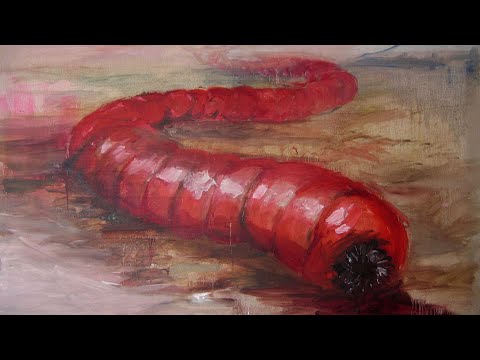
A blood-red, sausage-shaped worm said to lurk beneath the Gobi’s dunes and kill with venom or an electric jolt – Mongolia’s most famous desert legend.
REGIONAL LEGEND HOMINID · 1876Almas
Altai Mountains and Gobi margins of Mongolia
Central Asia’s “wild man”: a hairy, human-like figure reported from the Altai and Gobi to the Pamirs and Caucasus, once hailed as a surviving Neanderthal.
REGIONAL LEGENDThe legends of Mongolia
The Gobi itself is home to the olgoi-khorkhoi, the Mongolian death worm – a blood-red, sausage-shaped creature said to lie under the sand and kill with venom or an electric jolt. Western readers first heard of it through the American Museum of Natural History’s Central Asiatic Expeditions: in 1922 Mongolian officials in Urga (now Ulaanbaatar) described the worm to Roy Chapman Andrews, whose expeditions went on to find the first scientifically recognised nests of dinosaur eggs at the Flaming Cliffs. Since 1990 a string of expeditions, from Czech explorer Ivan Mackerle’s to the Centre for Fortean Zoology’s in 2005, has searched the dunes without finding the worm.
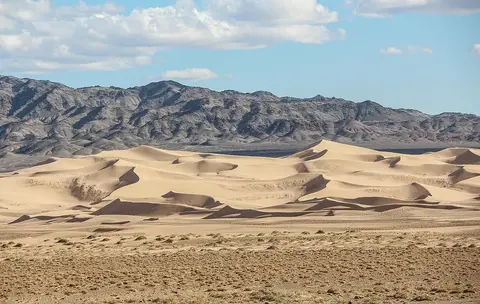
Few places offer such a stark setting for a monster hunt. Travellers who want to walk in the death worm’s country head for the great dunes of Khongoryn Els in Gobi Gurvansaikhan National Park and the red sandstone of Bayanzag, the Flaming Cliffs, while almas stories are best heard in the far west, in the glaciated peaks of Altai Tavan Bogd National Park.
Hotspots
The Gobi’s great “singing dunes” in Gobi Gurvansaikhan National Park, classic death worm territory.
Red sandstone cliffs where Roy Chapman Andrews’s expeditions found dinosaur eggs in the 1920s.
Glaciated mountains of far-western Mongolia, part of the almas’s legendary range.
The capital, formerly Urga, where officials first described the death worm to Andrews in 1922.
Sightings timeline
- 1870s (published 1876)Przhevalsky’s informants Almas
The Russian explorer Nikolai Przhevalsky recorded local descriptions of a flat-faced, upright, black-haired creature with long claws, so feared that people moved away from places it was said to frequent.
- April 1906The disputed Baradiin sighting Almas
According to an account later published by Boris Porshnev, the caravan of Buryat scholar Badzar Baradiin saw a hairy, ape-like man on a dune at sunset. A 1983 study of Baradiin’s diaries found no mention of the event and concluded that the story is in grave doubt.
- 1922Officials describe the worm to Roy Chapman Andrews Mongolian Death Worm
While preparing his Central Asiatic Expeditions, Andrews was told about the olgoi-khorkhoi by a gathering of Mongolian officials, including the prime minister. They described a sausage-shaped worm about two feet long whose touch meant death, though none had seen it personally.
- 1926The legend reaches the West Mongolian Death Worm
Andrews published the account in his book On the Trail of Ancient Man, introducing the creature to Western readers. He presented it as a story he had heard, not as an animal he believed in.
- 1983Witnesses shown a sand boa Mongolian Death Worm
According to later accounts, people who said they had seen an olgoi-khorkhoi were shown a Tartar sand boa (Eryx tataricus), a stubby, burrowing snake, and agreed that it was the animal they meant.
- 1990 and 1992Ivan Mackerle’s expeditions Mongolian Death Worm
The Czech explorer led two small expeditions that gathered nomads’ stories and tried to draw the worm out with vibrations and small explosive charges. No specimen or photograph was obtained.
- 2005Centre for Fortean Zoology search Mongolian Death Worm
Zoologist Richard Freeman’s team interviewed witnesses across the desert but found no worm. Freeman concluded that the tales were largely apocryphal and that any real basis might be an unrecognised burrowing reptile.
- August 2009David Farrier’s expedition Mongolian Death Worm
The New Zealand reporter joined a search for the worm, interviewed local people and again found no evidence, noting that reported sightings seemed to have peaked decades earlier.
Latest from Mongolia
No recent cryptid headlines from Mongolia. See all the latest cryptid news.
Videos
 ▶ VIDEO
The Mongolian Death Worm
Ben G ThomasA folklore-focused explainer on the legend, Roy Chapman Andrews and the expeditions that followed.
 ARCHIVE.ORG21:27
Yeren, Almas, and Yeti: Cryptid Hominoids in Asia
Think AnomalousAn overview of Asia’s many “wild man” traditions, from the almas to the yeren and yeti, and how they appear in old art and literature (license not stated).