FIELD FILE · ALMASHOMINIDREGIONAL LEGEND
Almas
Also known as Almasty, Alma, Kümün görügesü (Mongolian “wild man”), Kaptar (Caucasus), Gul-biavan (Pamir), Abnauayu (Abkhazia)
Central Asia’s “wild man”: a hairy, human-like figure reported from the Altai and Gobi to the Pamirs and Caucasus, once hailed as a surviving Neanderthal.
The almas (also almasty or alma) is the best-known name for the hair-covered “wild people” of Central Asian and Caucasian folklore. Mongolian tradition speaks of kümün görügesü, the “man-beast”, and in parts of Övörkhangai and Bayankhongor people traditionally avoided the name altogether, calling it akhai (“uncle-brother”) instead. Similar figures go by other names across a huge arc of mountains: the kaptar of the Caucasus, the gul-biavan of the Pamirs and the abnauayu of Abkhazia.
Western interest began with the Russian explorer Nikolai Przhevalsky, whose informants in the 1870s described a flat-faced, black-furred creature that walked upright and was so feared that herders abandoned its territory. In the early twentieth century the Buryat scholar Tsyben Zhamtsarano is said to have collected Mongolian reports and mapped sightings up to 1928, but his archive was lost after his arrest in 1937, and the most famous early sighting – a hairy figure seen at sunset by the scholar Badzar Baradiin’s caravan in 1906 – has been called into serious doubt by researchers who examined Baradiin’s own diaries.
The almas became a scientific talking point during the Soviet Union’s “snowman” fever of the late 1950s. The Academy of Sciences set up a commission to study reports, and in 1958 an expedition led by the hydrologist Alexander Pronin went to the Pamirs, with the historian Boris Porshnev and the surgeon Marie-Jeanne Koffmann among those involved. Porshnev went on to argue, most fully in 1963–64, that the almas were a relict population of Neanderthals that had survived into modern times – an idea that most Soviet scientists rejected.
Koffmann continued to collect testimony in the North Caucasus for decades, and the related story of Zana, a “wild woman” said to have been captured in Abkhazia in the nineteenth century, became one of cryptozoology’s most discussed cases. Genetic studies have since shown Zana’s remains to be those of a modern human woman of largely African ancestry. Today the almas survives both as living folklore in western Mongolia and as a chapter in the history of Cold War science.
- Type
- Hominid
- Status
- Regional legend
- First reported
- 1876
- Best-known location
- Altai Mountains and Gobi margins of Mongolia
- Also called
- Almasty, Alma, Kümün görügesü (Mongolian “wild man”), Kaptar (Caucasus), Gul-biavan (Pamir), Abnauayu (Abkhazia)
What witnesses describe
Usually described as roughly human-sized or slightly shorter, walking upright, covered in reddish-brown to black hair, with a sloping forehead, prominent brow ridges, a flat nose and a receding chin. Some Mongolian accounts mention a pointed back of the head. Almas are said to be shy, nocturnal and wordless, communicating with cries rather than speech.
Where and when it’s seen
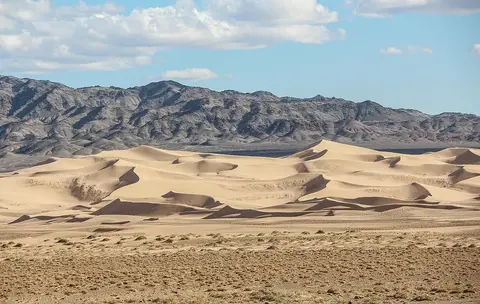
Remote mountain valleys and desert margins of western and southern Mongolia, especially the Altai ranges and the edges of the Gobi; related traditions place similar beings in the Tian Shan, the Pamirs and the North Caucasus. Almas are said to be timid and mostly nocturnal, so encounters are typically reported at dusk or after dark.
Notable sightings
- 1870s (published 1876)Przhevalsky’s informants Mongolia
The Russian explorer Nikolai Przhevalsky recorded local descriptions of a flat-faced, upright, black-haired creature with long claws, so feared that people moved away from places it was said to frequent.
- April 1906The disputed Baradiin sighting Alashan Desert, Inner Mongolia
According to an account later published by Boris Porshnev, the caravan of Buryat scholar Badzar Baradiin saw a hairy, ape-like man on a dune at sunset. A 1983 study of Baradiin’s diaries found no mention of the event and concluded that the story is in grave doubt.
- 1958Soviet “snowman” expedition to the Pamirs Pamir Mountains, Tajik SSR
After a wave of reports, the USSR Academy of Sciences sent an expedition led by hydrologist Alexander Pronin, with Boris Porshnev and Marie-Jeanne Koffmann involved, to look for the yeti and almas. It returned without conclusive evidence.
- 1963–1964Porshnev’s Neanderthal theory Moscow, USSR
Porshnev published his argument that almas and similar “wild men” were surviving Neanderthals. The idea shaped Western cryptozoology but was not accepted by mainstream Soviet science.
- July 2014DNA tests on “almasty” hair University of Oxford, UK
A genetic study led by Bryan Sykes analysed hair samples attributed to anomalous primates. The Russian almasty samples turned out to come from bears, horses, cows and a raccoon.
What could explain it?
- DNA analysis of hair attributed to almasty has so far identified only known animals such as bears, horses and cattle.
- Brown bears standing upright, seen at a distance in poor light, are a commonly suggested source of encounters.
- Folk memory of marginalised people – hermits, fugitives or individuals with conditions such as hypertrichosis – may lie behind some stories; the remains of Zana, Abkhazia’s famous “wild woman”, proved to be those of a modern human.
- Some of the classic accounts, notably the 1906 Baradiin sighting, appear to have been embellished or invented in later retellings.
- “Wild people” living beyond the edge of settled life are a near-universal folklore motif, and the almas fits that pattern.
Legend, culture and tourism
In parts of Mongolia the almas is linked to older beliefs, including a Darkhad deity known as Almas khara tenger (“Almas the Black God”), and to taboos on naming the creature directly. In the Soviet era it became the emblem of the “snowman question”, and the work of Porshnev and Koffmann inspired Western cryptozoologists such as Bernard Heuvelmans and Ivan Sanderson. Porshnev’s long-unpublished 1963 book on relict hominids was finally translated into English in 2021.
Places to visit
The glaciated heart of the Mongolian Altai, part of the mountain chain where almas traditions are found.
Canyons and desert ranges on the Gobi margin where older reports place the wild man.
Watch
 ARCHIVE.ORG21:27
Yeren, Almas, and Yeti: Cryptid Hominoids in Asia
Think AnomalousAn overview of Asia’s many “wild man” traditions, from the almas to the yeren and yeti, and how they appear in old art and literature (license not stated).
Where it’s reported
China Mongolia Russia Govi-Altai Bayankhongor Övörkhangai
Almas in the news
No recent headlines about the Almas. Our news desk checks every day — see all cryptid news.
Sources
First published · Updated