Country file · Asia & the Middle East
Cryptids of India
What cryptids are in India? The best-known are Yeti and Mande Barung.
India’s share of the Himalaya – from the high desert of Ladakh through the glaciers of Sikkim to the forested ridges of Arunachal Pradesh – is part of the yeti’s home range, and the legend is as familiar in Darjeeling and Gangtok as it is in Kathmandu. Sherpa, Bhutia and Tibetan communities on the Indian side of the range share the old stories of wild beings that live above the last pastures, and some of the most famous moments in the yeti’s modern history happened on Indian soil.
- 2 cryptids
- 5 recorded sightings
Cryptids reported in India
Yeti
The Himalaya’s “Abominable Snowman”: a Sherpa legend made global by footprint photos, monastery relics and DNA studies that kept finding bears. Widely reportedMande Barung
A giant, hairy ape-man said to roam the forests of Meghalaya’s Garo Hills; hair collected there in 2008 turned out to belong to a goral. Local legendThe legends of India
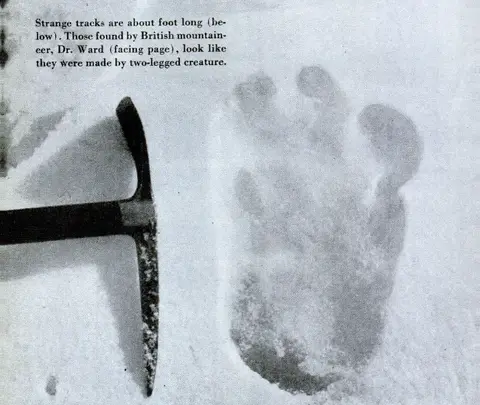
In 1925 the photographer N. A. Tombazi, with a British geological expedition in Sikkim, saw a dark, upright figure moving across the Zemu Glacier below Kangchenjunga and later found footprints where it had been – one of the most quoted early sightings by an outsider. Almost a century later, in 2014, one of the two “yeti” hair samples that Oxford geneticist Bryan Sykes linked to an ancient polar bear came from Ladakh; later reanalyses pointed to ordinary Himalayan brown bears. And in April 2019 the Indian Army made world headlines by posting photographs of giant footprints its mountaineers had found near Makalu base camp across the border in Nepal.
India’s wild-man lore does not stop at the snow line. In the Garo Hills of Meghalaya, people speak of the mande burung, or “forest man”; hairs collected there after a forester reported a sighting in 2003 were studied in Britain and, in 2008, DNA tests linked them to the Himalayan goral, a wild goat-antelope. For visitors, Sikkim’s Khangchendzonga National Park and the trekking routes towards the Zemu Glacier offer the closest thing to yeti country, while the forests of the Garo Hills are the place to hear about the mande burung.
Hotspots
- Zemu Glacier, Sikkim
Great glacier below Kangchenjunga where N. A. Tombazi watched a mysterious upright figure in 1925.
- Khangchendzonga National Park
UNESCO-listed mountain park in Sikkim, the wildest stretch of India’s eastern Himalaya and the setting of its classic yeti stories.
- Ladakh
High-altitude region whose bears supplied one of the “yeti” hair samples tested in the 2014 Oxford study.
- Garo Hills, Meghalaya
Forested hills of western Meghalaya where the mande burung or “forest man” is said to live.
Sightings timeline
- 1925Tombazi’s figure on the Zemu Glacier Yeti
N. A. Tombazi, a photographer with a British geological expedition, reported seeing an upright, dark figure stooping to pull at bushes at about 4,600 m. He later examined footprints at the spot, though he was never able to photograph the creature itself.
- 2003A forester’s account Mande Barung
According to Dipu Marak, a forest worker claimed to have seen the creature on three days in a row; hair was later gathered nearby.
- June 2007Monster-hunt tours announced Mande Barung
Press reports said enthusiasts were offering expeditions, while forest officials denied that giant primates lived in the area.
- June 2008BBC reports on the trail Mande Barung
Alastair Lawson reported on Marak’s search and returned to Britain with hair samples for study.
- July 2008Hair sent for DNA analysis Mande Barung
After microscope work at Oxford Brookes University, the hairs went to two laboratories; the identification was later given as a goral.

