FIELD FILE · MONGOLIAN-DEATH-WORMOTHERREGIONAL LEGEND
Mongolian Death Worm
Also known as Olgoi-khorkhoi, Allghoi khorkhoi, Large intestine worm
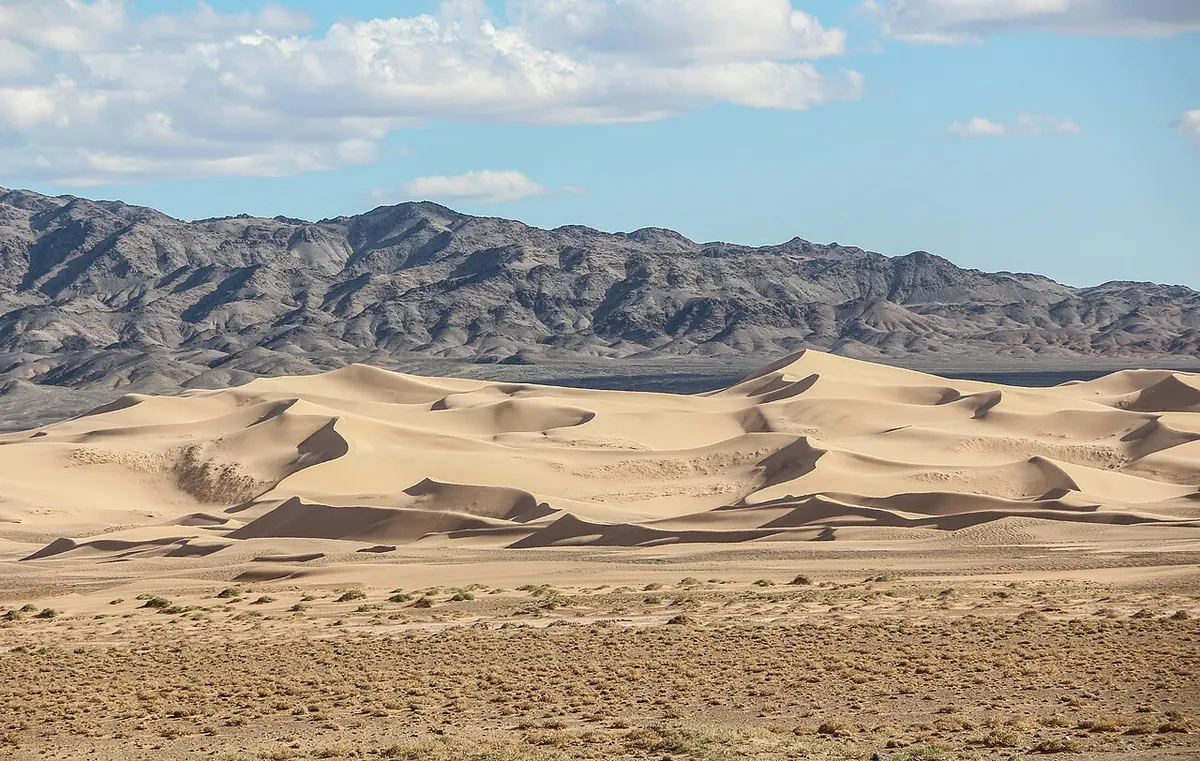
A blood-red, sausage-shaped worm said to lurk beneath the Gobi’s dunes and kill with venom or an electric jolt – Mongolia’s most famous desert legend.
Herders of the Gobi have long told stories of the olgoi-khorkhoi, a name usually translated as “large intestine worm” because the animal is said to look like a length of cattle gut: thick, dark red and with no obvious head or tail. According to the legend it spends most of its life buried in the sand, surfacing mainly in the hottest months and especially after rain, and it is so dangerous that merely touching it – or being touched by whatever it spits – can be fatal.
The creature reached Western readers through the American explorer and palaeontologist Roy Chapman Andrews, who led the Central Asiatic Expeditions of the American Museum of Natural History. In 1922 Mongolian officials, including the then prime minister, described the worm to him as about two feet long, sausage-shaped and lethal to the touch. Andrews retold the account in On the Trail of Ancient Man (1926) and again in The New Conquest of Central Asia (1932), but he was candid that nobody he met had actually seen one and that he did not believe in it himself.
Interest revived after the end of Mongolia’s socialist era opened the Gobi to foreign travellers. The Czech writer and explorer Ivan Mackerle, who had written about the legend in a 1987 book, led small expeditions in 1990 and 1992, interviewing nomads and even trying to lure the worm to the surface with a motor-driven “thumper” and small explosions, an idea partly borrowed from the sandworms of Dune. He found stories but no worm.
Later searches followed the same pattern. A Centre for Fortean Zoology team led by Richard Freeman spent weeks in the desert in 2005; the US television series Destination Truth visited in the mid-2000s; and in 2009 the New Zealand journalist David Farrier joined another expedition. All came home with interviews and empty traps, and Farrier noted that many reported encounters seemed to cluster decades in the past.
Whatever lies behind it, the death worm has become one of the world’s best-known cryptids, a fixture of monster encyclopedias, video games and a 2010 made-for-TV film. In Mongolia itself it remains a piece of desert lore – a cautionary tale about the real dangers of a harsh landscape – rather than a tourist mascot.
- Type
- Other
- Status
- Regional legend
- First reported
- 1922
- Best-known location
- Southern and western Gobi Desert, Mongolia
- Also called
- Olgoi-khorkhoi, Allghoi khorkhoi, Large intestine worm
- Reported in
- Mongolia
What witnesses describe
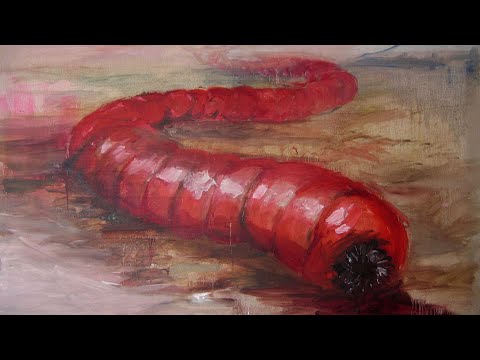
Described as a thick, segmented, worm-like animal roughly 0.6–1.5 m (2–5 ft) long, usually dark or blood-red, sometimes pale grey or brownish. Many accounts say it has no visible eyes or mouth, so its head and tail look alike; some add spike-like points at either end. It is said to spit a corrosive venom or kill at a distance with an electric shock.
Where and when it’s seen
Sand dunes and gravel plains of the southern and western Gobi, especially in Ömnögovi and neighbouring provinces. It is said to spend most of the year buried or dormant and to surface in the warm, wet season, particularly after rain.
Notable sightings
- 1922Officials describe the worm to Roy Chapman Andrews Urga (Ulaanbaatar), Mongolia
While preparing his Central Asiatic Expeditions, Andrews was told about the olgoi-khorkhoi by a gathering of Mongolian officials, including the prime minister. They described a sausage-shaped worm about two feet long whose touch meant death, though none had seen it personally.
- 1926The legend reaches the West New York, USA
Andrews published the account in his book On the Trail of Ancient Man, introducing the creature to Western readers. He presented it as a story he had heard, not as an animal he believed in.
- 1983Witnesses shown a sand boa Gobi Desert, Mongolia
According to later accounts, people who said they had seen an olgoi-khorkhoi were shown a Tartar sand boa (Eryx tataricus), a stubby, burrowing snake, and agreed that it was the animal they meant.
- 1990 and 1992Ivan Mackerle’s expeditions Southern Gobi, Mongolia
The Czech explorer led two small expeditions that gathered nomads’ stories and tried to draw the worm out with vibrations and small explosive charges. No specimen or photograph was obtained.
- 2005Centre for Fortean Zoology search Gobi Desert, Mongolia
Zoologist Richard Freeman’s team interviewed witnesses across the desert but found no worm. Freeman concluded that the tales were largely apocryphal and that any real basis might be an unrecognised burrowing reptile.
- August 2009David Farrier’s expedition Gobi Desert, Mongolia
The New Zealand reporter joined a search for the worm, interviewed local people and again found no evidence, noting that reported sightings seemed to have peaked decades earlier.
What could explain it?
- Tartar sand boas, short and thick-bodied snakes that burrow in the sand and can look reddish, are a frequently suggested model; witnesses reportedly accepted one as the creature in 1983.
- Worm lizards (amphisbaenians), legless burrowing reptiles whose heads and tails look alike, have been proposed by Richard Freeman and others, although none is known from the Gobi.
- Venomous snakes of the region, together with the very real dangers of desert travel, may have fed the idea of a creature that kills instantly.
- The more fantastic powers – spitting acid and electrocuting victims from a distance – are best understood as folklore embellishment; no specimen, bone or photograph has ever been produced despite repeated expeditions.
Legend, culture and tourism
Among Gobi nomads the worm belongs to a body of traditional warning tales about a landscape that can genuinely kill the unwary. Internationally it has become a pop-culture monster, inspiring television documentaries, the 2010 Syfy film Mongolian Death Worm, video games and countless illustrations, and guides in the southern Gobi often share the story with visitors to the dunes.
Places to visit
Mongolia’s largest dune field, the “singing dunes”, lies in the heart of the territory where the worm is said to live.
The red sandstone cliffs where Roy Chapman Andrews’ expeditions found the first dinosaur eggs, a natural stop for anyone following his footsteps.
Watch
 ▶ VIDEO
The Mongolian Death Worm
Ben G ThomasA folklore-focused explainer on the legend, Roy Chapman Andrews and the expeditions that followed.
Where it’s reported
Mongolia Ömnögovi Bayankhongor Govi-Altai
Mongolian Death Worm in the news
No recent headlines about the Mongolian Death Worm. Our news desk checks every day — see all cryptid news.
Sources
First published · Updated