COUNTRY FILE · ASIA & THE MIDDLE EAST
Cryptids of Nepal
What cryptids are in Nepal? The best-known is Yeti.
Nepal is the yeti’s home ground. From the terraced valleys of the Khumbu to the glaciers below Everest, Makalu and Cho Oyu, Sherpa communities have long told of the meh-teh and other wild beings that live above the last yak pastures. It was here, on the approaches to the world’s highest mountain, that British climbers of the 1920s and 1950s found the tracks that turned a Himalayan tradition into the international legend of the “Abominable Snowman”.
Cryptids reported in Nepal
The legends of Nepal
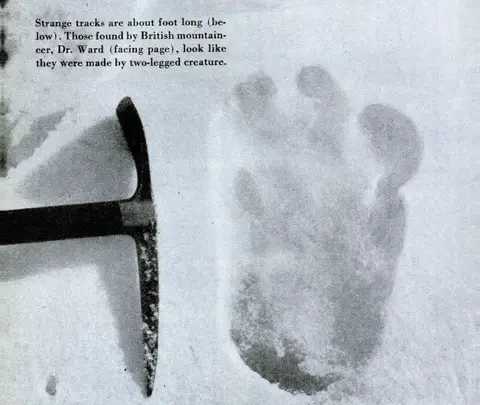
The country’s mid-century expeditions made yeti history: Eric Shipton photographed his famous footprint on the Menlung Glacier in 1951, the Daily Mail combed the Khumbu in 1954, and Sir Edmund Hillary carried the Khumjung monastery’s revered “scalp” around the world in 1960 before scientists identified it as serow hide. Later, Daniel Taylor’s search for the yeti in the remote Barun Valley helped bring about Makalu-Barun National Park.
Today the yeti is as much a part of Nepal’s tourism as its science. Trekkers on the Everest Base Camp route detour to see the Khumjung scalp, airlines and hotels carry the yeti’s name, and every reported footprint still makes international headlines – including the Indian Army’s 2019 photographs near Makalu base camp.
Hotspots
Sherpa village above Namche Bazaar whose monastery displays the famous yeti scalp Hillary took abroad in 1960.
One of the Khumbu’s oldest gompas, once home to the “Pangboche scalp” and hand examined by 1950s yeti expeditions.
Remote glacier on the Nepal–Tibet border where Eric Shipton photographed the most famous yeti footprint in 1951.
Densely forested valley that yeti researcher Daniel Taylor helped protect, now crossed by a trekkers’ “Yeti Trail”.
Sightings timeline
- November 8, 1951Shipton’s Menlung Glacier footprints Yeti
While scouting an alternative route to Everest, Eric Shipton and Michael Ward found a trail of large prints. Shipton photographed the clearest one next to an ice axe for scale; published in December 1951, the picture became the defining image of the yeti and is still debated today.
- 1954The <em>Daily Mail</em> Snowman Expedition Yeti
The newspaper’s expedition, launched by correspondent Ralph Izzard and led on the mountain by John Angelo Jackson with naturalist Charles Stonor and zoologist Biswamoy Biswas, gathered Sherpa testimony and photographed the Pangboche monastery’s “scalp”. Hairs from it were later judged not to come from a scalp at all.
- December 1960Hillary takes the Khumjung scalp abroad Yeti
Edmund Hillary’s Silver Hut expedition borrowed Khumjung’s revered scalp, accompanied by village elder Khunjo Chumbi, in exchange for help building a school. Specialists concluded it had been moulded from the skin of a serow, a Himalayan goat-antelope, and the relic was returned to the village.
Latest from Nepal
No recent cryptid headlines from Nepal. See all the latest cryptid news.
Videos
 ARCHIVE.ORG3:14
Daily Mail Yeti Expedition Newsreel (1954)
Daily MailPeriod newsreel in which members of the 1954 Snowman Expedition present their findings to the press. License not stated on archive.org.
 ARCHIVE.ORG25:27
Science in Action: Himalaya Expedition (1961)
California Academy of Sciences1961 TV episode in which Lawrence Swan, a member of Hillary’s Himalayan expeditions, reports on science in the mountains once thought home to the Abominable Snowman. CC BY-NC-ND 4.0.