COUNTRY FILE · ASIA & THE MIDDLE EAST
Cryptids of Indonesia
What cryptids are in Indonesia? The best-known are Orang Pendek, Ahool, Ebu Gogo and Orang Bati.
Spread across more than 17,000 islands, Indonesia has some of the richest rainforests on Earth – and some of the world’s most intriguing cryptids. Its most serious candidate is the orang pendek, the “short person” of Sumatra: a powerfully built, upright ape described by Dutch colonial settlers from 1910 onward and by villagers around Mount Kerinci to this day. British writer Debbie Martyr heard of it in 1989 and spent years searching the Kerinci Seblat forests with local teams, and footprint casts made by British expeditions from 1999 onward remain among the best-known pieces of evidence.
Cryptids reported in Indonesia
 HOMINID · 1910
Orang Pendek
Kerinci Seblat National Park, Sumatra
A short, powerfully built upright ape said to roam Sumatra’s Kerinci forests – the Southeast Asian cryptid taken most seriously by field researchers.
WIDELY REPORTED FLYING · 1925
Ahool
Mount Salak and the rainforests of western Java
A giant, monkey-faced bat said to swoop over the waterfalls of Java’s Mount Salak, named after its eerie “a-hool” cry in the night.
REGIONAL LEGEND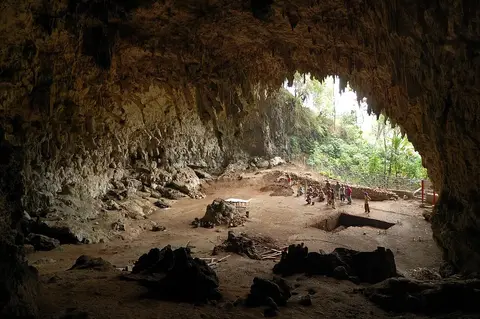 HOMINID · Pre-colonial
Ebu Gogo
Nage country, central Flores
Small, hairy “grandmothers who eat anything” from the folklore of Flores – a tale that drew new attention after the 2003 discovery of the hobbit.
FOLKLORE FLYING · Pre-colonial
Orang Bati
Seram Island, Maluku
Winged, child-snatching beings said to fly from a mountain on Seram – a legend that has long overshadowed the real Bati people of the island’s interior.
FOLKLOREThe legends of Indonesia
Indonesia’s islands keep producing surprises that make such stories feel possible. The Komodo dragon was formally described to Western science only in 1912, and in 2003 excavators at Liang Bua cave on Flores found the bones of Homo floresiensis, a tiny human species nicknamed the “hobbit” – prompting fresh attention to the Nage people’s tales of the ebu gogo, small hairy “grandmothers who eat anything”. On Java, the giant bat called the ahool is said to haunt the waterfalls of Mount Salak, following reports by naturalist Ernst Bartels in the 1920s.
Further east, the island of Seram in Maluku is the setting of the orang bati, winged beings said to fly from a mountain at night – a legend that has long overshadowed the real Bati people of the island’s interior, who regard Mount Bati as an ancestral sacred place and have recently campaigned to protect it from oil and gas exploration. Visitors interested in Indonesia’s mysteries usually head for Kerinci Seblat National Park, Mount Salak, Liang Bua and Komodo National Park.
Hotspots
Sumatra’s largest national park and the heartland of orang pendek reports, around Mount Kerinci and Lake Gunung Tujuh.
Forested volcano near Bogor whose waterfalls are the classic setting of the ahool.
Limestone cave where the “hobbit” Homo floresiensis was discovered in 2003, on the same island as the ebu gogo stories.
Mountainous island whose interior, including Manusela National Park and Mount Bati, is linked to the orang bati legend.
Home of the Komodo dragon, a real giant lizard unknown to Western science until 1912.
Sightings timeline
- May 1927Cramer’s close sighting Orang Pendek
Dutch plantation worker A. H. W. Cramer reported seeing a long-haired, black-skinned orang pendek about 10 metres away. It ran off, leaving small, human-like footprints.
- 1980s (claimed)The missionary who believed Orang Bati
Cryptozoology websites say an English missionary, Tyson Hughes, initially dismissed the stories as “orangutans with wings” but became convinced during an 18-month stay. No original account by Hughes has been found, so this remains an unverified claim.
- July 1989Debbie Martyr hears of the orang pendek Orang Pendek
Visiting as a travel writer, Debbie Martyr was told by her guide that he had seen the animal. She later reported her own sightings and spent some fifteen years searching for it with Jeremy Holden.
- 1998Gregory Forth records the tradition Ebu Gogo
In his ethnography of the Nage, Beneath the Volcano, anthropologist Gregory Forth described ebu gogo stories in detail, years before any hobbit fossils were known.
- 1999 onwardFootprint casts and hair samples Orang Pendek
British explorers Adam Davies, Andrew Sanderson and Keith Townley cast footprints and collected hairs on expeditions to Kerinci, the first cast reportedly made in 1999. Microscopy was said to look promising, but DNA testing reportedly came back human.
- September 2003The hobbit is found at Liang Bua Ebu Gogo
Indonesian and Australian archaeologists uncovered the small skeleton known as LB1 about six metres down in Liang Bua cave. It became the type specimen of Homo floresiensis.
- October 2004The discovery goes public Ebu Gogo
The announcement of the new species, then thought to have survived until about 12,000 years ago, prompted reporters to visit Nage villages and ask about the ebu gogo.
- September 2009Centre for Fortean Zoology expedition Orang Pendek
A four-person British team with an Indonesian guide said two members briefly glimpsed an upright, dark-furred animal. They brought back hair, a chewed piece of rattan and a footprint photo, but no confirmed result was ever published.
- March 31, 2016The hobbits are re-dated Ebu Gogo
A new study in Nature showed that the layers holding the hobbit’s bones and stone tools are between about 190,000 and 50,000 years old, not 12,000 – undermining the idea of recent contact with modern people.
- 2019Study of the Bati people’s ‘forgotten identity’ Orang Bati
Researcher Pieter Jacob Pelupessy presented a study describing how myths of invisible or flying people stigmatised the Bati of eastern Seram, and how the community kept a low profile with outsiders as a result.
- 2022<em>Between Ape and Human</em> Ebu Gogo
Gregory Forth published a book arguing that Lio accounts of small ‘ape-men’, gathered between 2003 and 2018, could reflect a surviving hominin – a proposal most anthropologists regard as unproven.
- July 26, 2022A sasi ritual on Mount Bati Orang Bati
Bati villagers placed palm fronds and red cloth in a traditional sasi ritual to block oil and gas exploration on their sacred mountain, followed by “Save Bati” protests in the regency capital, Bula.
Latest from Indonesia
No recent cryptid headlines from Indonesia. See all the latest cryptid news.
Videos
 ▶ VIDEO
Apakah Orang Pendek di Hutan Sumatera Ada
Mongabay IndonesiaShort Indonesian-language report from the conservation news site Mongabay on the evidence and the people searching for the orang pendek.
 ARCHIVE.ORG2:39:24
Folk Zoology Conference 2024
Floe Foxon (Folk Zoology Society)Academic conference on folklore and zoology; from 1:31:20 anthropologist Gregory Forth discusses Flores ‘ape-men’ and <em>Homo floresiensis</em>. CC BY-NC-ND 4.0.