FIELD FILE · TASMANIAN-TIGERDOGMAN & CANINEEXTINCT ANIMAL?
Tasmanian Tiger (Thylacine)
Also known as Thylacine, Thylacinus cynocephalus, Tasmanian wolf, Tassie tiger, Marsupial wolf
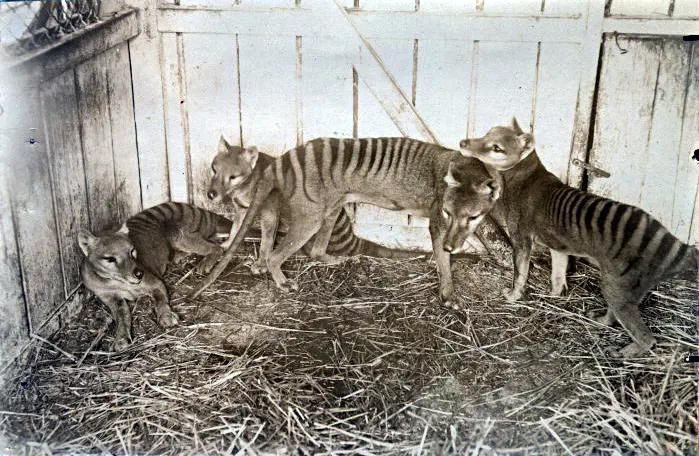
A striped, dog-like marsupial officially extinct since the last one died in a Hobart zoo in 1936 – yet over a thousand people say they have seen one since.
The thylacine was a real animal – the largest meat-eating marsupial of modern times, built like a lean dog with a stiff tail, a wide-opening jaw and dark stripes across its lower back. It vanished from mainland Australia and New Guinea roughly 3,000–3,500 years ago, probably squeezed out by dingoes, people and a drying climate, but survived on Tasmania until Europeans arrived. Its place in cryptozoology comes from what happened next: the species is officially extinct, yet sightings have never stopped.
Colonial settlers blamed the “tiger” for sheep losses, and from 1888 to 1909 the Tasmanian government paid bounties on dead animals. Thousands were killed, and habitat loss and disease did the rest. The last wild thylacine known to have been shot was killed by farmer Wilf Batty near Mawbanna in 1930. Legal protection came only on 10 July 1936; 59 days later, on the night of 7 September 1936, the last known captive animal died, reportedly after being locked out of its shelter, at the Beaumaris Zoo in Hobart. The species was formally declared extinct in the 1980s.
Because the thylacine was a shy, mostly nocturnal animal living in some of the most rugged country in Australia, many Tasmanians never accepted that it was gone. Search expeditions began within a year of the zoo animal’s death and have continued ever since. The most famous modern report came in 1982, when Parks and Wildlife ranger Hans Naarding described watching a thylacine for several minutes by torchlight in the far north-west; it triggered a confidential government search that found nothing conclusive. In 2005 The Bulletin magazine offered a A$1.25 million reward for a live animal, and no one claimed it.
Sightings are not confined to Tasmania. People in Victoria, South Australia, Western Australia and Queensland regularly report “mainland tigers”, and in 2017 James Cook University scientists put camera traps on Cape York after a former tourism operator and a long-serving ranger described seeing striped, dog-like animals there at night. A 2023 statistical study led by Barry Brook of the University of Tasmania, using more than 1,200 recorded sightings since 1910, suggested the animal may have lingered in remote areas until the late twentieth century – though critics questioned how reliable those records are.
Today the thylacine sits on a unique boundary: a documented species with museum specimens, film footage and a scientific name, which also behaves like a classic cryptid, sustained by blurry photos, footprints and heartfelt eyewitness accounts. It is also a symbol of loss in Tasmania, appearing on the state’s coat of arms and on countless logos, and is the target of an ambitious de-extinction project announced in 2022 by the University of Melbourne and the US company Colossal Biosciences.
- Type
- Dogman & canine
- Status
- Extinct animal?
- First reported
- 1936
- Best-known location
- Tasmania’s north-west and south-west wilderness
- Also called
- Thylacine, Thylacinus cynocephalus, Tasmanian wolf, Tassie tiger, Marsupial wolf
- Reported in
- Australia
What witnesses describe
A slender, dog-sized marsupial about 1–1.3 m long plus a thick, stiff tail that tapers from the body like a kangaroo’s. Its short coat was sandy to grey-brown with 15–20 dark stripes across the back, rump and tail base. Witnesses stress the stiff tail, the striped hindquarters, a stiff or awkward gait and an enormous gape; the animal was said to make a husky, coughing bark.
Where and when it’s seen
Historically open forest, woodland and grassland edges in Tasmania, especially the north and east. Modern reports cluster in Tasmania’s remote north-west (the Tarkine/takayna, Arthur River and Togari areas) and south-west wilderness, usually at night or dusk on back roads. Mainland reports come from the Otways and western Victoria, the Adelaide Hills, south-west Western Australia and Cape York.
Notable sightings
- December 1933David Fleay films a thylacine Beaumaris Zoo, Hobart, Tasmania
Naturalist David Fleay shot about a minute of black-and-white film of a caged thylacine, famously being bitten on the buttock while he worked. The clip, colourised by the National Film and Sound Archive in 2021, is the best-known moving image of the species.
- September 7, 1936Death of the last known thylacine Beaumaris Zoo, Hobart, Tasmania
The last thylacine known to science died at the zoo, reportedly after being shut out of its sleeping quarters on a cold night. Legal protection had been granted only 59 days earlier. Its remains were rediscovered in the Tasmanian Museum and Art Gallery’s collection in 2022.
- Autumn 1982Hans Naarding’s torchlight encounter Near Togari, north-west Tasmania
Parks and Wildlife ranger Hans Naarding reported watching an apparently healthy adult thylacine for several minutes in his spotlight while sheltering from rain in his vehicle. Because of his experience, the report was taken seriously and led to a confidential search lasting more than a year, which found no proof.
- March 2017Cape York camera-trap survey Cape York Peninsula, Queensland
James Cook University ecologists Sandra Abell and Bill Laurance announced a camera-trap survey after two people described seeing striped, dog-like animals at close range at night. The researchers called the odds of finding a thylacine very small and designed the survey to record other threatened mammals too.
- February 2021The “thylacine family” photos Tasmania
Neil Waters of the Thylacine Awareness Group announced camera-trap pictures that he believed showed a family of thylacines. After reviewing them, the Tasmanian Museum and Art Gallery said the animals were most likely Tasmanian pademelons, a small wallaby, and other zoologists agreed.
- March 2023Statistical study of 1,237 sightings University of Tasmania
A team led by Barry Brook modelled 1,237 sighting records since 1910 and concluded the thylacine may have survived in tiny numbers into the late twentieth century, with a small chance it persists in the south-west. Thylacine expert Nick Mooney and others cautioned that the underlying sightings are unreliable.
What could explain it?
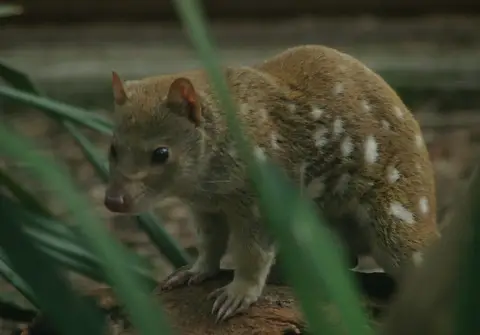
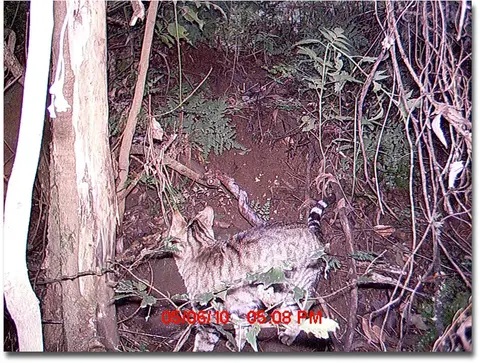
- Misidentified animals: foxes, dogs and dingo-dog hybrids with mange, spotted-tailed quolls, pademelons and other wallabies, and feral cats are regularly mistaken for thylacines, especially at night or in brief glimpses.
- A small, isolated population could not survive undetected for decades without roadkill, carcasses or clear camera-trap images; Tasmanian researchers have logged hundreds of thousands of camera-trap nights without a confirmed record.
- The animal’s fame and the wish to undo a human-caused extinction create strong expectation bias, so ambiguous shapes are readily interpreted as stripes or a stiff tail.
- Mainland reports face the added problem that the species vanished from the mainland thousands of years ago; many likely involve large feral dogs or cats.
- Some sightings of the twentieth century may well have been genuine relict animals; most specialists consider survival into the 1940s–60s plausible but survival today very unlikely.
Legend, culture and tourism
The thylacine features on Tasmania’s coat of arms and on everything from beer labels to the state government logo. Tasmanian Aboriginal people knew the animal long before Europeans – it appears in rock art on the mainland, including Western Australia and Arnhem Land, thousands of years old. Its story inspired the novel and 2011 film The Hunter, the 2000s videogame character Ty the Tasmanian Tiger, and an annual National Threatened Species Day held on 7 September, the anniversary of the last known animal’s death.
Places to visit
Its dedicated thylacine gallery holds specimens, historical records and the rediscovered remains of the last known thylacine.
Displays thylacine specimens and tells the story of the bounty era in northern Tasmania.
The vast rainforest and buttongrass country around Arthur River and Togari has produced some of the most-discussed modern sightings.
Watch
 ARCHIVE.ORG0:22
Last Known Thylacine Footage (1935)
Sidney Cook (uploaded to the Internet Archive)Clip from the 1935 travelogue <em>Tasmania the Wonderland</em> – the last known moving images of a living thylacine, rediscovered in 2020. Historic footage, generally regarded as public domain.
 ARCHIVE.ORG1:13
Colorized Tasmanian Tiger (1933 footage)
National Film and Sound Archive of Australia (re-uploaded to the Internet Archive)The NFSA’s 2021 colourisation of David Fleay’s December 1933 film of a thylacine at the Beaumaris Zoo, Hobart.
Where it’s reported
Australia Tasmania Queensland Victoria South Australia Western Australia
Tasmanian Tiger (Thylacine) in the news
- The misunderstood Tasmanian tiger was driven to extinction by a myth
- Extinct Tasmanian tiger snap unlike any living mammal bite
- Have we misunderstood the Tasmanian tiger?
- How Tassie Tiger Outfoxed Its Prey-New UniSC Research
- Not tiger, not wolf: Australian thylacine skull reveals far different hunting style
- Jaw-dropping News On Tassie Tiger
- A united kingdom collector paid £62,000 for a mounted fox head; X-rays revealed the skull of an extinct thylacine hidden inside
- X-rays confirm skull of extinct thylacine in united kingdom collector rare auction find
Sources
- Wikipedia: Thylacine
- Australian Geographic: Is the truth still out there? (2024)
- Mongabay: Thylacine survey – are we going to rediscover the moonlight tiger? (2017)
- Popular Science: Identifying animals in photos is trickier than you might think (2021)
- National Film and Sound Archive: Colourised footage of the last Tasmanian tiger
First published · Updated