FIELD FILE · YOWIEHOMINIDWIDELY REPORTED
Yowie
Also known as Hairy man, Yahoo, Australian ape-man, Dulagal (Yuin), Doolaga
Australia’s hairy “bush man”: a tall, ape-like figure of eastern forests, rooted in Aboriginal hairy-man stories and colonial-era newspaper tales.
The Yowie is Australia’s best-known cryptid: a large, hair-covered, upright creature said to roam the forested ranges of the east coast, from Victoria’s high country to the rainforests of Queensland. Modern accounts often call it “Australia’s Bigfoot”, and the comparison is apt – witnesses describe a towering, ape-like figure glimpsed crossing bush roads, heard screaming at night or leaving outsized footprints. Yet the Yowie has a longer and more tangled history than its American cousin.
Many Aboriginal nations tell of hairy beings of the bush, and those stories differ from place to place. Among the Yuin of the New South Wales south coast the hairy man is known as Dulagal; elsewhere names such as Doolaga, Jurrawarra and Ghindaring appear in the records, and in far north Queensland some Aboriginal people speak of long coexistence with such creatures. These beings are part of living traditions – often teaching children to keep away from dangerous country – and are not simply “Yowie sightings” in disguise. The word “Yowie” itself appears to come from yuwi or yowi, a Gamilaraay and Yuwaalaraay word recorded in the 1870s for a night-roaming spirit.
Colonial settlers borrowed and reshaped these stories. Newspapers of the nineteenth century reported a “Yahoo” or “hairy man of the woods”, the first well-known printed account appearing in the Australian Town and Country Journal in 1876. In 1882 Henry James McCooey told readers that he had seen an “indigenous ape” on the south coast between Batemans Bay and Ulladulla, and offered to catch one for the Australian Museum. Some historians argue these colonial tales owed as much to European wild-man legends, Jonathan Swift’s Yahoos and the fashion for captive orangutans as to Aboriginal lore.
The modern Yowie took shape in the mid-1970s. Researcher Rex Gilroy, based in the Blue Mountains, collected hundreds of reports, linked them to Bigfoot and proposed that a relict ape or early human population survived in the bush. Newspapers and television – including a 1976 ABC This Day Tonight segment – spread the idea nationally, and a Queanbeyan festival committee and local radio offered a reward for a live specimen that has never been claimed. Writer Graham Joyner, who compiled colonial “hairy man” reports in 1977, later argued that the creature was barely known before the mid-1970s and grew from misread “yahoo” stories.
Today the Yowie is part science puzzle, part bush yarn and part tourism draw. The Blue Mountains, the Gold Coast hinterland around Springbrook and the Sunshine Coast hinterland are considered hotspots, and dedicated researchers run trail cameras, record calls and publish witness databases. No body, bone or verified DNA has ever been produced, and most scientists regard the creature as a blend of folklore, misidentification and hoaxing – but for many Australians a night in the bush still comes with a half-serious glance over the shoulder.
- Type
- Hominid
- Status
- Widely reported
- First reported
- Pre-colonial
- Best-known location
- Forests of the Great Dividing Range, eastern Australia
- Also called
- Hairy man, Yahoo, Australian ape-man, Dulagal (Yuin), Doolaga
- Reported in
- Australia
What witnesses describe
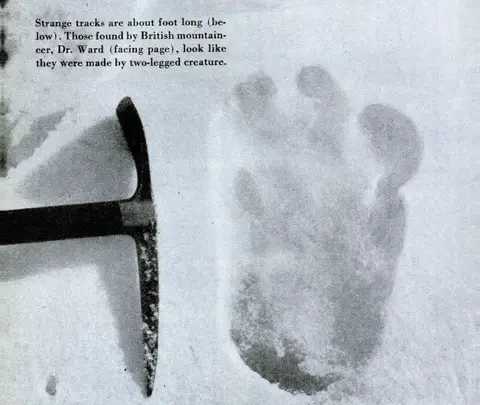
Usually described as 2–3 m tall, upright and heavily built, covered in dark brown, reddish or black hair, with long arms, a short neck, a heavy brow and sometimes glowing eyes. Some witnesses report a powerful smell, rock-throwing, tree-knocking, deep grunts and blood-curdling screams. Reported footprints are large but inconsistent in shape and toe count.
Where and when it’s seen
Dense eucalypt forest, rainforest gullies and sandstone escarpments along the Great Dividing Range – especially the Blue Mountains, the Brindabella Ranges near Canberra, the NSW south coast, and south-east Queensland’s hinterlands. Encounters are most often reported at night or dusk, on remote roads, campsites and rural properties.
Notable sightings
- November 1876The “hairy man of the woods” New South Wales
The Australian Town and Country Journal printed one of the earliest newspaper references to a hairy wild man in the bush. Such “yahoo” stories circulated widely in colonial newspapers over the following decades.
- 1882Henry McCooey’s “indigenous ape” Between Batemans Bay and Ulladulla, NSW
McCooey described a hairy, ape-like creature about the size of a man on the south coast and offered to capture one for the Australian Museum for a fee. No specimen was ever delivered.
- 1976Rex Gilroy and the Yowie on national TV Queanbeyan and the Blue Mountains, NSW
After the Queanbeyan Age published Rex Gilroy’s claims to have evidence for the Yowie, the ABC’s This Day Tonight ran a story on the hunt. Coverage like this turned a scattered folk tradition into a national cryptid.
- 1977A future senator’s sighting Springbrook, Queensland
Bill O’Chee, later a Queensland senator, told the Gold Coast Bulletin he had seen a very tall hairy creature at Springbrook while on a school trip. The Springbrook plateau has since gathered more reports than anywhere else in Australia.
- December 28, 1979The Kilcoy encounter Near Kilcoy, Queensland
Two 16-year-olds reported a two-to-three-metre brown, hairy creature and later returned with their biology teacher to cast a large footprint. The town embraced the story with a Yowie statue and park.
- 2000The Piper film Brindabella Ranges, ACT/NSW
Canberra bushwalker Steve Piper filmed what he said was a large dark figure moving through the bush. Like most Yowie footage, the images are too indistinct to settle the question.
What could explain it?
- Misidentified animals and shadows: eastern grey kangaroos standing upright, wallaroos, large dogs, feral pigs and even people seen at dusk can create a convincing upright silhouette.
- Night sounds: koala bellows, the screams of barking owls and the calls of other nocturnal animals are commonly offered as the source of the creature’s alarming vocalisations.
- Folklore transfer: historians such as Graham Joyner argue the modern Yowie merged colonial “yahoo” stories, European wild-man legends and American Bigfoot culture of the 1970s.
- Hoaxes and fabricated footprints have been documented, and Australia has no fossil record of any great ape – a large primate population would also leave remains, roadkill and clear images.
- Aboriginal hairy-man beings belong to distinct cultural and spiritual traditions; treating them as eyewitness zoology removes them from their original meaning.
Legend, culture and tourism
Aboriginal hairy-man stories, told differently by many nations, remain part of living cultural knowledge. In popular culture the Yowie gave its name to a best-selling Australian chocolate with collectable toys (launched in 1995), appears on souvenirs and in films, and has its own small-town shrine at Kilcoy, Queensland, where Yowie Park and its statue commemorate the 1979 sighting. Researchers such as Rex Gilroy (who died in 2023), Tony Healy and Paul Cropper, and Dean Harrison have kept the subject in the news for decades.
Places to visit
The town’s park commemorates the 1979 sighting; its statue has been rebuilt more than once after rot and vandalism, so check locally for its current state.
World Heritage rainforest on the plateau often called Australia’s busiest Yowie hotspot.
Sandstone gorges and dense gullies at the heart of Rex Gilroy’s Yowie research.
Watch
 ARCHIVE.ORG6:13
The Hunt for Australia’s Mythical Half-Ape, Half-Human, the Yowie (1976)
Australian Broadcasting Corporation (This Day Tonight)A vintage ABC report from the moment the Yowie became a national story, featuring Rex Gilroy’s claims.
Where it’s reported
Australia New South Wales Queensland Australian Capital Territory Victoria Northern Territory Western Australia
Yowie in the news
No recent headlines about the Yowie. Our news desk checks every day — see all cryptid news.
Sources
First published · Updated