EXPLAINER · SCIENCE
How Scientists Test Bigfoot Evidence – and What Would Convince Them
Hair DNA, eDNA, footprint casts and the Patterson–Gimlin film: how each kind of Bigfoot evidence has been tested, what it showed and what is still missing.
Every year brings new Bigfoot evidence: a hair snagged on a fence, a line of tracks in mud, a blurry figure on a trail camera, and – this summer – a body that its owner said a university lab had tested. Scientists who examine such material use a small set of tools, and each has a track record with Bigfoot claims. Here is how the testing works, what it has found, and what kind of proof would actually settle the question.
Hair and tissue: the DNA test
DNA is the most powerful test because it does not depend on anyone’s eyes. A lab extracts genetic material from a sample, reads a stretch of it and compares the sequence with public databases of known species. If an unknown primate were leaving hair in North American forests, its DNA should look like an ape’s or a human relative’s, but match nothing on file.
The largest test of this kind was led by Oxford geneticist Bryan Sykes and published in Proceedings of the Royal Society B in 2014. His team invited museums and enthusiasts to send in samples attributed to Bigfoot, the yeti and similar creatures, received 57, chose 37 for analysis and recovered DNA from 30. After cleaning the hairs to remove surface contamination, they sequenced part of a mitochondrial gene called 12S rRNA. Every result matched a known animal – among them bears, horses, cows, wolves or dogs, raccoons, a deer and a porcupine – and just one human. The authors wrote that the survey could not disprove the existence of anomalous primates, but found no evidence for them, and that it set a standard for testing future claims.
The study also shows how science corrects itself. Sykes’s team reported that two Himalayan “yeti” hairs matched an ancient polar bear, raising talk of an unknown hybrid. In December 2014, Ceiridwen Edwards of Oxford and Ross Barnett of the Natural History Museum of Denmark replied in the same journal. The short sequences, they showed, matched a modern polar bear as well as the ancient one, and the single DNA letter that set them apart from most brown bears sat exactly where age-related DNA damage tends to create false readings. Their conclusion: the hairs most likely came from Himalayan brown bears. Sykes’s team admitted an incomplete database search but disputed the damage explanation and held that the hairs still pointed to polar bears. In 2017, a team led by Charlotte Lindqvist of the University at Buffalo tested nine purported yeti specimens – bone, tooth, skin, hair and droppings. Eight came from Asian bears and one from a dog. “Our findings strongly suggest that the biological underpinnings of the Yeti legend can be found in local bears,” Lindqvist said.
When DNA claims go wrong
The opposite case is a 2013 paper led by Texas veterinarian Melba Ketchum, which said 111 samples pointed to a hybrid of humans and an unknown hominin. Writing for NBC News, Skeptical Inquirer’s Benjamin Radford noted that the paper appeared in the DeNovo journal, which had published nothing else and apparently did not exist weeks earlier, after established journals turned it down. The samples were collected by enthusiasts who had not seen what animal left them, and the most likely explanation for “human-like” results, critics said, was contamination. NYU molecular anthropologist Todd Disotell put it bluntly: a primate that close to us “that’s us.”
A newer lesson came in 2026. In July, a man known as “Snake the Bigfoot Hunter,” Charles Stuart, went on WDIV’s Local 4 Live in Detroit to say DNA testing showed his specimen, which he called “Dack,” was 58.5 percent Neanderthal and 41.5 percent human. He said the samples had been run at a Cornell University lab. Cornell told The Telegraph that it “did not conduct any testing” for him and that the documents he posted were not from the university. Stuart insisted the university was lying, but even the BFRO’s Matt Moneymaker called the body a “cheesy fake.” The simplest check – asking the lab – settled it.
Environmental DNA
Environmental DNA, or eDNA, lets biologists detect rare animals from the traces of skin and waste they leave in water or soil. Some Sasquatch groups have taken it up; in British Columbia, members of the Vancouver Island Sasquatch Society sample rivers, as the Nanaimo News Bulletin reported in March and as we noted in our B.C. roundup. The method has a built-in limit. eDNA works by matching fragments to reference sequences, and there is no reference for an animal no one has collected – so an unusual primate fragment would be hard to tell apart from human contamination. That report itself acknowledged that such samples cannot be verified without a body for comparison, and we know of no published eDNA result pointing to an unknown ape.
Footprints and dermal ridges
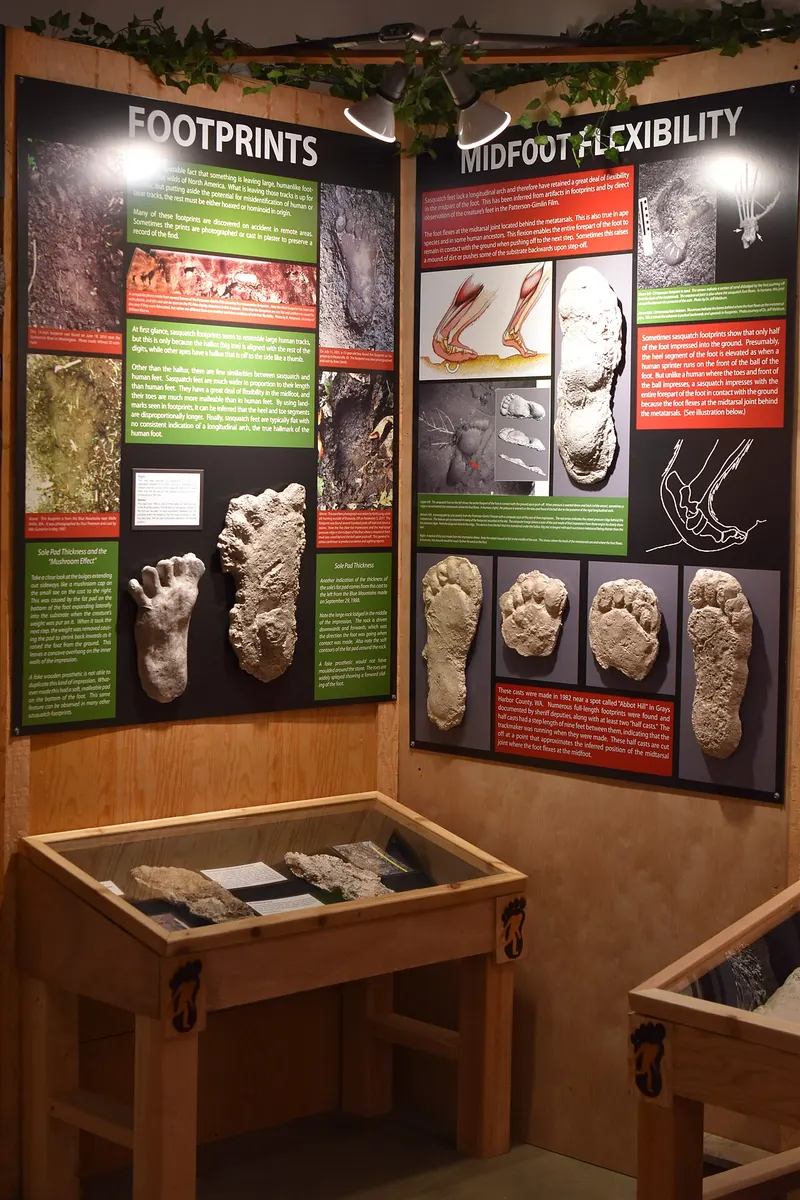
Footprint casts are the most common physical evidence. The late Idaho State University anthropologist Jeff Meldrum, who died in September 2025, argued that some casts show a flexible midfoot unlike a human’s; he lectured on “midfoot flexibility” in Sasquatch tracks to podiatrists in Boston in 2013. Retired Texas fingerprint examiner Jimmy Chilcutt went further, saying that a few casts show skin ridges consistent with a nonhuman primate. But in a 2010 interview on the skeptics’ podcast MonsterTalk, Chilcutt said that only about three of roughly 100 casts he examined convinced him, and that his on-screen claims had been stronger than he would stand behind. Researcher Matt Crowley showed that plaster poured into drying soil can create ridge-like textures, and Chilcutt said that work made him more cautious. Critics such as anthropologist David Daegling argued that Meldrum’s 2006 book failed to separate good evidence from bad. A cast can show what made a print only if the print itself is known to be genuine.
The Patterson–Gimlin film
The 1967 film of “Patty” at Bluff Creek, California, has been studied frame by frame for decades, and the analyses largely hinge on things no one can now measure. Roger Patterson did not note his camera speed, and its dial – marked 16, 24 and higher – had no click stops. Supporters such as Grover Krantz ruled out 16 and argued for 18 frames per second; at 24, primatologist John Napier argued, it “cannot be distinguished from a normal human walk.” Napier, who was open to the idea of Sasquatch, concluded the film was probably a hoax. Krantz, an anthropologist, and later special-effects artist Bill Munns argued that it shows a real animal. Bob Heironimus said in 1999 that he wore the suit, and in 2002 a North Carolina costume maker, Philip Morris, said he had sold Patterson a gorilla suit – claims supporters dispute. This October a new documentary claims a 1966 reel shows a rehearsal, which we examine in a separate report.
Sightings as data
Some researchers test the sighting reports themselves. Data scientist Floe Foxon compared Bigfoot reports logged by the Bigfoot Field Researchers Organization across the U.S. and Canada with estimates of black bear numbers, adjusting for human population and forest area. The work appeared as a preprint in January 2023 and, after peer review, in the Journal of Zoology in January 2024. Reports rose by about 4 percent for every additional 1,000 black bears – roughly one report per 5,000 bears. Foxon stressed that this does not prove Bigfoot is absent; it is a correlation, but it fits the idea that many sightings are misidentified bears, as the DNA tests also suggest.
What would settle it
New species are still found every year, and biologists describe them the same way: from a type specimen – a body, skeleton or substantial tissue – deposited in a museum where other scientists can examine it. For Bigfoot, the bar would be a specimen like that, or DNA from a sample of known origin that several independent labs sequence, publish in full and confirm as a new primate. Sykes framed his project as an open invitation when he launched it in 2012: “I’m challenging and inviting the cryptozoologists to come up with the evidence.” Until that happens, the scientific verdict on Bigfoot remains what the tests have shown so far: known animals, honest mistakes and the occasional hoax.
Sources
- Sykes et al., Proceedings of the Royal Society B: Genetic analysis of hair samples attributed to yeti, bigfoot and other anomalous primates (2014)
- Edwards & Barnett, Proceedings of the Royal Society B: Himalayan ‘yeti’ DNA: polar bear or DNA degradation? (2015)
- Melton, Sartori & Sykes, Proceedings of the Royal Society B: Response to Edwards and Barnett (2015)
- NBC News / LiveScience: Bigfoot and Yeti DNA study gets serious (May 22, 2012)
- Phys.org: Analysis of DNA evidence contradicts yeti claims (Dec. 17, 2014)
- University at Buffalo: Study ties DNA samples from purported yetis to Asian bears (Nov. 28, 2017)
- NBC News: Bigfoot DNA discovered at last? Not so fast…, by Benjamin Radford (Feb. 14, 2013)
- WDIV ClickOnDetroit: Man claims he found the first scientifically verified Bigfoot specimen (July 5, 2026)
- The Telegraph via Yahoo News: Cornell University denies testing ‘Bigfoot’ DNA (Aug. 3, 2026)
- Nanaimo News Bulletin: Finding Bigfoot: B.C. research trio track Sasquatch across Vancouver Island (Mar. 12, 2026)
- MonsterTalk #011: First Impressions, interview with Jimmy Chilcutt (Feb. 3, 2010)
- Wikipedia: Jeffrey Meldrum
- Idaho State University: ISU professor Meldrum discusses feet, bipedalism with Boston podiatrists (Feb. 4, 2013)
- Boise State Public Radio: ISU anthropologist, professor and Bigfoot researcher has died (Sept. 12, 2025)
- Wikipedia: Patterson–Gimlin film
- Phys.org: Scientist suggests Bigfoot sightings are likely black bears (Jan. 31, 2023)
- Foxon, Journal of Zoology: Bigfoot: If it's there, could it be a bear? (Jan. 13, 2024)
- ScienceAlert: Bigfoot sightings keep showing up around bear hangouts (Jan. 2024)