FIELD FILE · YETIHOMINIDWIDELY REPORTED
Yeti
Also known as Abominable Snowman, Meh-teh, Kang-mi, Mi-go, Xueren
The Himalaya’s “Abominable Snowman”: a Sherpa legend made global by footprint photos, monastery relics and DNA studies that kept finding bears.
The yeti is the most famous wild being of the Himalaya – a shaggy, upright creature said to roam the snowfields, glaciers and rhododendron forests between Nepal, Tibet, Sikkim and Bhutan. Long before mountaineers arrived, Sherpa, Tibetan and other highland communities told stories of the meh-teh, the mi-go or “wild man”, and similar beings: creatures that lived beyond the last pastures, raided crops, carried off yaks or simply left strange tracks above the tree line. The English word “yeti” is usually traced to Tibetan terms combining “rocky place” and “bear”, a hint that bears were part of the picture from the start.
The legend reached the outside world through the British Everest expeditions. In 1921 Lieutenant-Colonel Charles Howard-Bury’s reconnaissance found large tracks in the snow, and Sherpas called their maker metoh-kangmi. When the story reached Henry Newman of The Statesman in Calcutta, he rendered “metoh” as “abominable”, and the “Abominable Snowman” was born – a name that would follow the creature into newspapers, novels and films for a century.
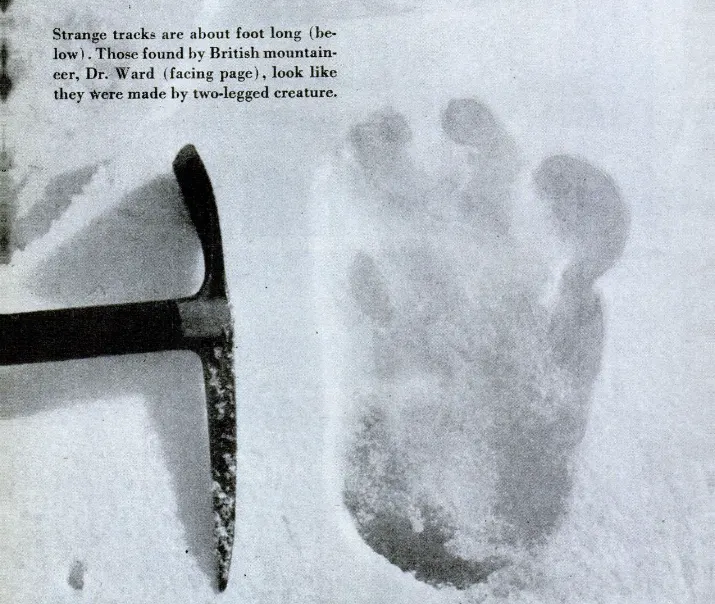
The yeti’s golden age came in the 1950s. Eric Shipton’s 1951 photographs of a huge, sharp-edged footprint on the Menlung Glacier became the single most reproduced piece of yeti evidence, and newspapers raced to fund expeditions. The Daily Mail mounted a full-scale Snowman Expedition in 1954; Texas oilman Tom Slick sponsored several searches later in the decade; and in 1960 Sir Edmund Hillary, the first man (with Tenzing Norgay) to climb Everest, led a World Book–sponsored expedition that set out to test the evidence scientifically – and came home largely unconvinced.
In the 21st century the hunt moved into the laboratory. In 2014 Oxford geneticist Bryan Sykes reported that two hair samples attributed to yetis, from Ladakh and Bhutan, matched a short DNA sequence from an ancient polar bear, prompting headlines about an unknown hybrid bear. Later reanalyses argued the match pointed to ordinary Himalayan brown bears, and in 2017 a team led by Charlotte Lindqvist found that eight of nine museum and private “yeti” specimens came from Asian bears and one from a dog.
None of this has erased the yeti from Himalayan life. It remains a figure of Sherpa storytelling and monastery lore, a mascot for airlines, hotels and trekking companies, and a reason many visitors detour to see the famous “scalp” in Khumjung. For many people in the region the yeti belongs to a wider spiritual landscape of mountain deities and wild beings, and its meaning there is not reducible to the question of whether a primate leaves footprints in the snow.
- Type
- Hominid
- Status
- Widely reported
- First reported
- 1921
- Best-known location
- Khumbu and the high Himalaya, Nepal
- Also called
- Abominable Snowman, Meh-teh, Kang-mi, Mi-go, Xueren
What witnesses describe
Accounts vary widely. Western reports usually describe an upright, ape-like animal 1.5–2.5 m tall, covered in reddish-brown to dark hair, with a conical head, long arms and a pungent smell. Sherpa tradition distinguishes several kinds, from a small, man-sized creature to a large, bear-like animal that kills yaks. Footprints attributed to it range from 20 to 45 cm, often with a prominent, thumb-like big toe.
Where and when it’s seen
High valleys, glaciers and snowfields of the Himalaya roughly between 3,000 and 6,000 m, plus the dense forests of remote valleys such as the Barun in eastern Nepal. Tracks are most often reported on fresh snow in autumn and winter, along passes and glacier approaches used by climbers and herders.
Notable sightings
- September 1921Howard-Bury’s “metoh-kangmi” tracks Northern approaches to Everest, Tibet
During the first British reconnaissance of Everest, Charles Howard-Bury’s party saw a line of tracks in high snow. He thought a wolf had probably made them, but Sherpas named a wild snow creature, and a Calcutta journalist’s translation coined the term “Abominable Snowman”.
- 1925Tombazi’s figure on the Zemu Glacier Zemu Glacier, Sikkim, India
N. A. Tombazi, a photographer with a British geological expedition, reported seeing an upright, dark figure stooping to pull at bushes at about 4,600 m. He later examined footprints at the spot, though he was never able to photograph the creature itself.
- November 8, 1951Shipton’s Menlung Glacier footprints Menlung Glacier, Nepal–Tibet border
While scouting an alternative route to Everest, Eric Shipton and Michael Ward found a trail of large prints. Shipton photographed the clearest one next to an ice axe for scale; published in December 1951, the picture became the defining image of the yeti and is still debated today.
- 1954The <em>Daily Mail</em> Snowman Expedition Khumbu region, Nepal
The newspaper’s expedition, launched by correspondent Ralph Izzard and led on the mountain by John Angelo Jackson with naturalist Charles Stonor and zoologist Biswamoy Biswas, gathered Sherpa testimony and photographed the Pangboche monastery’s “scalp”. Hairs from it were later judged not to come from a scalp at all.
- December 1960Hillary takes the Khumjung scalp abroad Khumjung, Nepal, to Chicago, London and elsewhere
Edmund Hillary’s Silver Hut expedition borrowed Khumjung’s revered scalp, accompanied by village elder Khunjo Chumbi, in exchange for help building a school. Specialists concluded it had been moulded from the skin of a serow, a Himalayan goat-antelope, and the relic was returned to the village.
- November 29, 2017DNA study traces “yeti” relics to bears University at Buffalo, USA
A team led by Charlotte Lindqvist published mitochondrial DNA results for nine purported yeti specimens, including hair, bone, skin and a tooth. Eight came from Asian black, Himalayan brown and Tibetan brown bears, and one from a dog.
What could explain it?
- Bears: Himalayan brown bears, Tibetan blue bears and Asiatic black bears all live in yeti country, and DNA tests of supposed yeti hair, skin and bone have repeatedly identified them.
- Footprint distortion: when a four-legged animal places its hind foot in or near its fore-print, or when sun melts and enlarges tracks, ordinary prints can look like the giant steps of a biped. Researcher Daniel Taylor argued Shipton’s famous print was made by a bear.
- Relics: the Khumjung scalp was shown to be shaped from serow hide, and other monastery relics have proved to be bear or other animal remains.
- Sykes’s 2014 “ancient polar bear” match rested on a short DNA fragment; critics including Eliécer Gutiérrez and Ronald Pine argued it was consistent with ordinary brown bears.
- Other animals such as langur monkeys, and occasional hoaxes, account for some sightings and photographs.
- Folklore origins: in Himalayan tradition the yeti belongs among wild and spiritual beings of the high mountains, and stories about it can carry moral or cautionary meaning rather than describe a single zoological species.
Legend, culture and tourism
The yeti is woven into Sherpa storytelling and Himalayan Buddhist lore, where it appears in tales told to children as a creature of the wild places beyond the villages. Khumjung’s gompa still displays its “yeti scalp” in a glass case, and Hillary’s visit led to the Khumjung school and the Himalayan Trust’s long work in the Khumbu. Nepal has Yeti Airlines and countless Yeti hotels; Bhutan put the creature on postage stamps in 1966. Abroad it inspired Hammer’s 1957 film The Abominable Snowman, Hergé’s Tintin in Tibet, DreamWorks’ Abominable and Disney’s Expedition Everest ride. In 2019 the Indian Army made headlines by posting photos of supposed yeti footprints near Makalu base camp.
Places to visit
The village gompa, a short walk from Namche Bazaar, displays the famous “yeti scalp” to visitors for a small fee or donation.
The UNESCO-listed Everest region where Shipton, Hillary and the 1954 expedition searched, crossed by the main Everest Base Camp trekking routes.
A remote, densely forested park whose creation grew partly out of Daniel Taylor’s yeti research in the Barun Valley; it offers a “Yeti Trail” for trekkers.
Watch
 ARCHIVE.ORG3:14
Daily Mail Yeti Expedition Newsreel (1954)
Daily MailPeriod newsreel in which members of the 1954 Snowman Expedition present their findings to the press. License not stated on archive.org.
 ARCHIVE.ORG25:27
Science in Action: Himalaya Expedition (1961)
California Academy of Sciences1961 TV episode in which Lawrence Swan, a member of Hillary’s Himalayan expeditions, reports on science in the mountains once thought home to the Abominable Snowman. CC BY-NC-ND 4.0.
Where it’s reported
Nepal Bhutan China India Koshi Province
Yeti in the news
No recent headlines about the Yeti. Our news desk checks every day — see all cryptid news.
Sources
- Wikipedia: Yeti
- National Geographic: The yeti is a bear – Daniel Taylor on the Shipton footprint
- University at Buffalo: Study ties DNA samples from purported Yetis to Asian bears (2017)
- Proceedings of the Royal Society B (via PMC): Genetic analysis of hair samples attributed to yeti, bigfoot and other anomalous primates (Sykes et al., 2014)
- Wikipedia: 1960–61 Silver Hut expedition
First published · Updated