FIELD FILE · KAPPALAKE & SEA MONSTERFOLKLORE
Kappa
Also known as Kawatarō, Kawawappa, Gatarō, Enkō, Suiko, River child
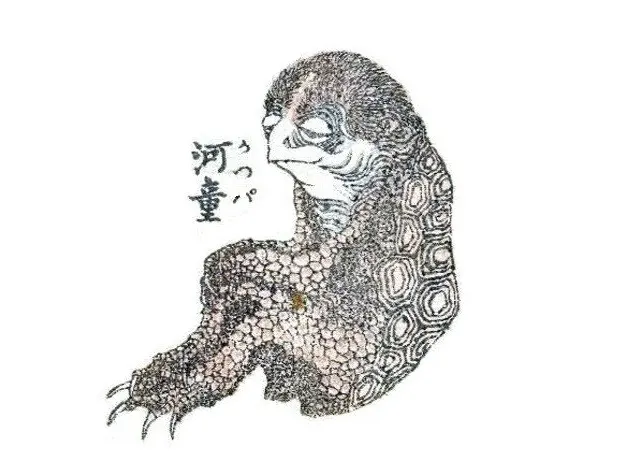
Japan’s child-sized river imp, with a water-filled dish on its head and a love of cucumbers and sumo – once feared for drownings, now a beloved mascot.
The kappa is one of the best-known yōkai (supernatural beings) of Japanese folklore: a small, amphibious creature said to live in rivers, ponds and irrigation channels. Its name is usually read as “river child,” and across the country it has gone by at least eighty regional names – kawatarō in Kyushu and the Kansai region, enkō in parts of Shikoku and western Honshu, gatarō in Hyōgo, and many more. These names hint at how varied the tradition is: in some places it was an otter-like trickster, in others an ape-like water spirit or something closer to a turtle.
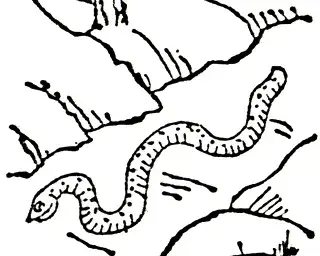
Written references go back at least to the fifteenth century. A dictionary prefaced in 1444, the Kagakushū, claims that an old otter turns into a kawarō, and the Jesuit-compiled Nippo Jisho of 1603 describes a river creature resembling an ape. Edo-period naturalists treated the kappa almost as zoology: the encyclopedia Wakan Sansai Zue (1712) gave it an entry, and the scholar Koga Tōan’s Suiko Kōryaku (1820) gathered eyewitness reports, sketches and measurements of supposedly captured specimens. Early drawings show a hairy, monkey-like animal; from the mid-1700s artists increasingly gave it a shell and frog-like features, producing the green, beaked figure most people picture today.
In traditional tales the kappa is a double-edged being. It was blamed for drownings and for dragging horses and cattle into the water, and was said to pull out the shirikodama – an imaginary organ – from its victims. Yet it is also polite to a fault: bow to a kappa and it will bow back, spilling the water from the dish on its head and losing its strength. Defeated kappa in many legends trade their freedom for a written promise, gifts of fish or secret bone-setting medicine. Cucumbers are its favorite food, and families once floated them down rivers or wrote their names on them as offerings before swimming.
In parts of Kyushu the kappa was tied to the seasons and to agricultural ritual, said to spend winter in the mountains and return to the rivers in spring. Some communities linked kappa to the drowned warriors of the Heike clan, and music called kappa-gaku is still played at festivals in places such as Kurume to calm them. The 1910 collection Tōno Monogatari, compiled by the folklorist Yanagita Kunio from stories told in Tōno, Iwate, preserved local kappa tales and helped launch Japanese folklore studies.
Today the kappa has largely shed its menace. It appears on safety signs warning children away from rivers, as a town mascot, in Akutagawa Ryūnosuke’s satirical novella Kappa (1927), in manga and anime, and in the name of the cucumber sushi roll, kappa-maki. It remains a living part of Japan’s folk culture rather than a cryptid in the Western sense – though a few temples and shrines still keep “kappa mummies” and hands that draw curious visitors.
- Status
- Folklore
- First reported
- 1444
- Best-known location
- Rivers, ponds and marshes throughout Japan
- Also called
- Kawatarō, Kawawappa, Gatarō, Enkō, Suiko, River child
- Reported in
- Japan
What witnesses describe
Usually described as the size of a child, green or bluish (red in Tōno tales), slimy or scaly, with webbed hands and feet, a beak-like mouth and a turtle-like shell. Its defining feature is the sara, a dish-shaped hollow on top of the head that must stay full of water; if it spills, the kappa weakens. Older accounts describe a hairy, ape-like creature with a strong fishy smell.
Where and when it’s seen
Rivers, ponds, swamps and irrigation ditches across Japan, especially in Kyushu and rural Tōhoku. Traditionally most active in summer, when children swam; in some Kyushu traditions kappa spend winter in the mountains as yamawaro and return to the water in spring.
Notable sightings
- 1626 (as recorded later)The Hita capture Hita, Ōita Prefecture
A kappa was said to have been caught in Hita during the Kan’ei era. The story survives in later copies and was among the reports reused, with illustrations, in Koga Tōan’s 1820 compilation Suiko Kōryaku.
- 1801A kappa in a fishing net Mito Domain coast (now Ibaraki Prefecture)
Fishermen on the domain’s eastern beach reportedly netted a kappa about a meter tall. A drawing of it, with recorded measurements and weight, was copied into Suiko Kōryaku and survives in an 1836 manuscript copy.
- 1910Tōno Monogatari is published Tōno, Iwate Prefecture
Yanagita Kunio’s collection of tales from the Tōno basin recorded local kappa legends, including red-faced kappa in the area’s rivers. The book made Tōno synonymous with Japanese folklore.
- August 1, 1984Footprints in Tsushima Tsushima, Nagasaki Prefecture
A fisherman reported strange, slimy footprints after seeing small figures by a river at night. The case was reported by the Japanese press as a modern kappa sighting.
- June 30, 1991Wet footprints in a house Saito, Miyazaki Prefecture
A couple reported finding dozens of small, wet footprints inside their home. No explanation was found, and the incident was widely linked to kappa lore.
What could explain it?
- Folklorists see the kappa above all as a cautionary figure that kept children away from dangerous rivers and explained otherwise senseless drownings.
- The shirikodama belief likely comes from the relaxed appearance of drowned bodies, a point noted by early Japanese naturalists.
- Real animals probably shaped the image: several regional names derive from otters and soft-shelled turtles, and the Japanese giant salamander is often suggested as an inspiration.
- Preserved “kappa mummies” and hands kept at temples and breweries are generally regarded as composites or remains of other animals, made or acquired as curiosities.
- Changing artistic conventions, not new observations, explain why the kappa turned from a hairy ape-like creature into a turtle- and frog-like one during the Edo period.
Legend, culture and tourism
Kappa are everywhere in Japan: on river-safety signs, as local mascots, in sake and food branding and in kappa-maki cucumber rolls. Tōno in Iwate markets itself as a land of legends, and visitors can buy a playful “kappa fishing license” to dangle a cucumber in the Kappabuchi pool behind Jōken-ji temple, whose guardian dogs are said to honor a kappa that helped put out a fire. In Tokyo, Sōgen-ji (“Kappa-dera”) honors the merchant Kappaya Kihachi, who according to legend was helped by kappa in building flood works; it displays a so-called kappa hand and receives offerings of cucumbers. Kyushu towns such as Kurume still hold water festivals tied to kappa, and the creature features in Akutagawa’s novella Kappa and in the long-running manga of Shimizu Kon.
Places to visit
A shaded stream behind a 15th-century temple where visitors can buy a kappa-fishing permit and try their luck with a cucumber.
The official tourist site for the city whose tales appear in Tōno Monogatari, with folklore museums and legend trails.
A Zen temple near the Kappabashi kitchen-supply street with kappa statues, cucumber offerings and a purported kappa hand.
Watch
 ▶ VIDEO
Who Is This Japanese Yōkai That Is Obsessed With Your Butt?
Storied (PBS) – MonstrumFolklorist Dr. Emily Zarka and Japanese studies scholar Yoshiko Okuyama trace the kappa from feared river demon to cute mascot.
Where it’s reported
Japan Iwate Tokyo Fukuoka Ōita Kumamoto Ibaraki
Kappa in the news
No recent headlines about the Kappa. Our news desk checks every day — see all cryptid news.
Sources
First published · Updated