FIELD FILE · TSUCHINOKOREPTILIANREGIONAL LEGEND
Tsuchinoko
Also known as Bachi-hebi, Nozuchi, Tsuchi-hebi, Child of the mallet
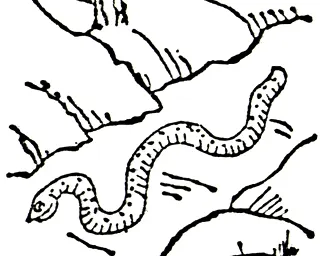
A fat-bodied, short-tailed snake said to leap, roll and even speak – Japan’s favorite cryptid, hunted every spring for prizes worth millions of yen.
The tsuchinoko (“child of the mallet”) is a snake unlike any known species: short, stubby and swollen in the middle like a beer bottle, with a narrow neck and a small tail. Names vary by region – it is tsuchinoko in western Japan and the Kansai region and bachi-hebi in the northeast – but the shape is always compared to a wooden mallet or tool handle. Folk tales give it remarkable talents: it is said to jump a meter or more, to bite its own tail and roll downhill like a hoop, to speak, to lie and to enjoy alcohol.
Its roots lie in older beliefs about the nozuchi, a mallet-shaped serpent spirit of fields and mountains that appears in early Japanese texts and in the Edo-period encyclopedia Wakan Sansai Zue (1712). For centuries it was a minor rural yōkai. That changed in the early 1970s. In 1972 the novelist Tanabe Seiko serialized Subette Koronde in the Asahi Shimbun’s evening edition, about a man obsessed with finding a tsuchinoko; NHK adapted it as a drama, a 1973 manga took up the creature, and a 1974 episode of Doraemon featured one. Within a few years the tsuchinoko had become a national craze, with search parties, magazine features and television specials.
Towns quickly realized its value. In 1988 a councilor in Shimokitayama, Nara, launched a “Tsuchinoko Expedition” offering 1 million yen for a live capture; around 200 people joined before the effort faded with the economic bubble in 1990. Other municipalities posted larger bounties – Yoshii in Okayama Prefecture famously offered 20 million yen – and Itoigawa, Niigata, has run its own hunts.
The best-known event is the Tsuchinoko Festa in Higashishirakawa, a small mountain village in Gifu Prefecture that claims numerous past sightings. Each May, thousands of visitors comb its forests with sticks and nets; the 2023 festival, the 31st, drew more than 2,500 people – more than the village’s own population. The prize grows by 10,000 yen each year it goes unclaimed and has passed 1.3 million yen. No one has ever collected it.
- Type
- Reptilian
- Status
- Regional legend
- First reported
- 1972
- Best-known location
- Mountain villages of central and western Japan
- Also called
- Bachi-hebi, Nozuchi, Tsuchi-hebi, Child of the mallet
- Reported in
- Japan
What witnesses describe
Typically 30–80 cm long with a disproportionately thick body, a triangular, viper-like head and a short, thin tail. Colors reported include dark brown, chocolate and gray, sometimes with a yellowish belly or spots. Said to move by jumping or rolling rather than slithering, to make chirping sounds and, in some tales, to be venomous.
Where and when it’s seen
Grassy slopes, forest edges and rice-field margins in mountainous rural areas, especially in Gifu, Nara, Hyōgo and Niigata. Reports cluster in late spring and summer, after hibernation season.
Notable sightings
- 1972–1974The tsuchinoko boom Nationwide
Tanabe Seiko’s newspaper novel, an NHK drama, manga and a Doraemon episode turned an obscure rural legend into a national sensation. Reports and supposed captures multiplied, though no specimen was ever confirmed.
- 1988–1990The Shimokitayama expedition Shimokitayama, Nara Prefecture
Village councilor Kazuo Nozaki offered 1 million yen for a live tsuchinoko and 300,000 yen for a skin. About 200 searchers took part over two years and found nothing; a Tsuchinoko Park opened in 2023 to commemorate the event.
- April 2007The hay-bale snake Ōkura, Yamagata Prefecture
A dead snake said to resemble a tsuchinoko was reportedly found in imported hay on a farm. Japanese snake specialists suggested it may have been an Australian death adder, since the hay came from Australia.
- May 3, 2023The Tsuchinoko Festa returns Higashishirakawa, Gifu Prefecture
After a four-year pandemic pause, more than 2,500 people hunted for the creature with sake and dried squid as bait. The 1.31-million-yen prize went unclaimed.
What could explain it?
- Japanese pit vipers (mamushi) and other snakes look strikingly fat when they have just swallowed prey or are pregnant, matching the classic silhouette.
- Escaped or released pet lizards such as blue-tongued skinks, first imported into Japan in the early 1970s, have short legs that are easy to miss and a thick, snake-like body.
- Folklorists note that the modern tsuchinoko was largely created by 1970s media – novels, TV and manga – that revived the old nozuchi spirit.
- Bounties and festivals give towns an incentive to keep the legend alive, and no physical specimen has ever been confirmed by a scientist.
Legend, culture and tourism
The tsuchinoko is a cheerful mascot of rural revitalization. Higashishirakawa in Gifu has a tsuchinoko shrine and museum, sells tsuchinoko-shaped snacks and holds the Tsuchinoko Festa every May (usually May 3, during Golden Week). Itoigawa in Niigata and Shimokitayama in Nara run their own hunts and memorials. The creature is a regular in video games (notably the Metal Gear Solid series), anime and toys.
Places to visit
Home of the annual Tsuchinoko Festa and a small museum devoted to the creature.
A park opened in 2023 to commemorate the village’s 1988–1990 tsuchinoko expedition.
Watch
 ▶ VIDEO
毎年恒例「つちのこ」本気捜索 賞金は134万円 岐阜・東白川村
中京テレビNEWS (Chūkyō TV News)Japanese-language TV news report from the annual tsuchinoko hunt in Higashishirakawa, Gifu, with its 1.34-million-yen prize.
 ▶ VIDEO
見つかった?幻の生き物「つちのこ」探し 2500人が集結 賞金は134万円 岐阜県東白川村
メ〜テレニュース (Nagoya TV News)Another Japanese news report showing the crowds of searchers at the village festival.
Where it’s reported
Japan Gifu Nara Niigata Hyōgo Okayama
Tsuchinoko in the news
No recent headlines about the Tsuchinoko. Our news desk checks every day — see all cryptid news.
Sources
First published · Updated