Field file · Spectral · Folklore
Dullahan
Also known as Dúlachán, Gan Ceann, Headless Horseman of Ireland
The dullahan, Ireland’s headless rider on a black horse who carries his own head; his arrival at a door foretells a death. First printed in 1825.
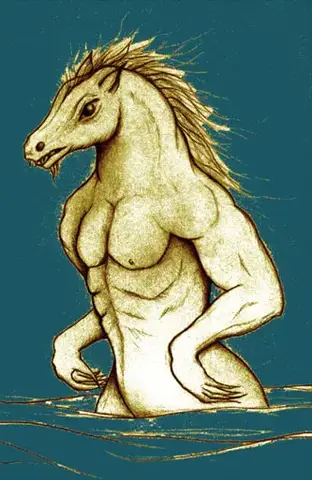
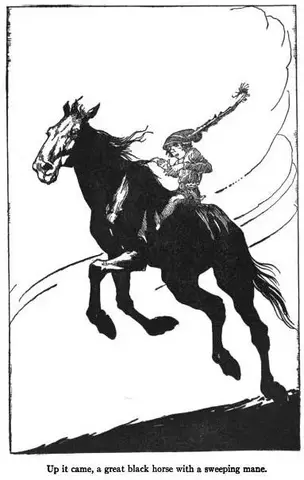
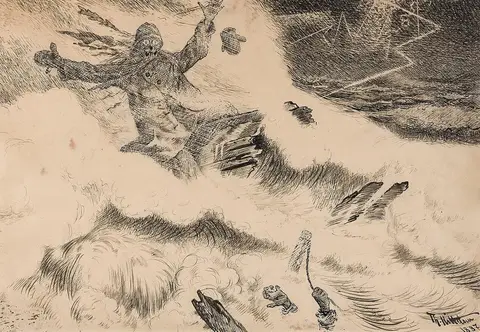
The dullahan (Irish dúlachán) is a headless figure of Irish folklore, usually pictured as a rider on a black horse or a coachman who carries his own head in his hand or under an arm. Thomas Crofton Croker, who gave the most influential early account, described the head as having parchment-like skin and fiery eyes. The “Headless Coach” or “Soundless Coach” he drives is said to roll out from graveyards.
In the stories the dullahan is an omen of death: he appears at the door of someone about to die, and in one Doneraile tale the coachman splashes blood on the person who opens the door. Later tellings add embellishments such as a whip made from a human spine, and some modern commentators say he calls out the names of the doomed or uses the head to look for the dying; such details are mostly 21st-century and do not appear in Croker. Rumours that gold objects can make him disappear are also unsupported by good sources.
The earliest printed reference is generally traced to Croker’s Fairy Legends and Traditions of the South of Ireland (first published 1825); the “Dullahan” section was expanded in later volumes of the 1820s and a one-volume selection in 1834, and the Brothers Grimm translated the work into German. W. B. Yeats included the dullahan in his 1888 collection of Irish fairy tales.
Scholars note that the dullahan is poorly attested in the Irish Folklore Commission’s archive, so some doubt that he was a part of native oral tradition before Croker’s time. Theories linking him to the old Celtic god Crom Dubh or to the Gan-Ceann are speculative, and popular claims that he inspired Washington Irving’s Headless Horseman in The Legend of Sleepy Hollow lack proof.
What does Dullahan look like?
A headless rider in black on a black horse, or a coachman, holding his own head; the head grins, with decayed skin and fiery eyes.
Where is Dullahan seen?
Country roads and graveyards at night, especially the south of Ireland; around Doneraile and Ballyhooly in County Cork.
Dullahan sightings
- 1825Croker’s Fairy Legends Ireland
Thomas Crofton Croker’s collection includes the earliest printed reference to the dullahan and the Headless Coach.
- 1888Yeats’s Fairy and Folk Tales Ireland
W. B. Yeats brought the dullahan into his anthology of Irish folk tales, linking him to the banshee.
Is Dullahan real? What could explain it
- The motif may echo older Celtic traditions of the severed head and decapitation games in Irish literature such as Bricriu’s Feast.
- Folklorists classify him as a legendary rather than mythic figure and suggest he was a relatively late invention, popularised by Croker.
- A death omen on a lonely road is a common theme linked to wakes and funeral processions at night.
Legend, culture and tourism
The dullahan is a fixture of Halloween and Irish-themed storytelling, is common in fantasy fiction and games, and is often (without strong evidence) credited as the source of the Headless Horseman.
Where it’s reported
Sources
First published · Updated