FIELD REPORT · BIGFOOT EVIDENCE
Bigfoot Evidence: The Case For and the Case Against, Side by Side
Reports, footprints, a body cast and a famous film on one side; no body, hoaxes and known-animal DNA on the other. How each claim holds up.
Ask ten people whether Bigfoot is real and you will hear about tracks, films and gut feeling, but little about what each kind of evidence can show. This guide puts the strongest arguments on each side next to each other, with what supporters, skeptics and the U.S. government have actually said. It is a summary: our reports on how scientists test the evidence and on the Patterson–Gimlin film go deeper.
The case for
Thousands of reports. The Bigfoot Field Researchers Organization (BFRO) keeps the best-known database. It sorts reports into classes: Class A covers clear sightings “in circumstances where misinterpretation or misidentification of other animals can be ruled out with greater confidence,” according to the group, which says no modern report in its online database goes public without “some kind of investigation.” The BFRO’s Matt Moneymaker told MeatEater in 2023 that the case rests on “the totality of the evidence, not just one item.” A BFRO report is still a claim, and the class rates how easily a sighting could be misread, not the witness’s reliability.
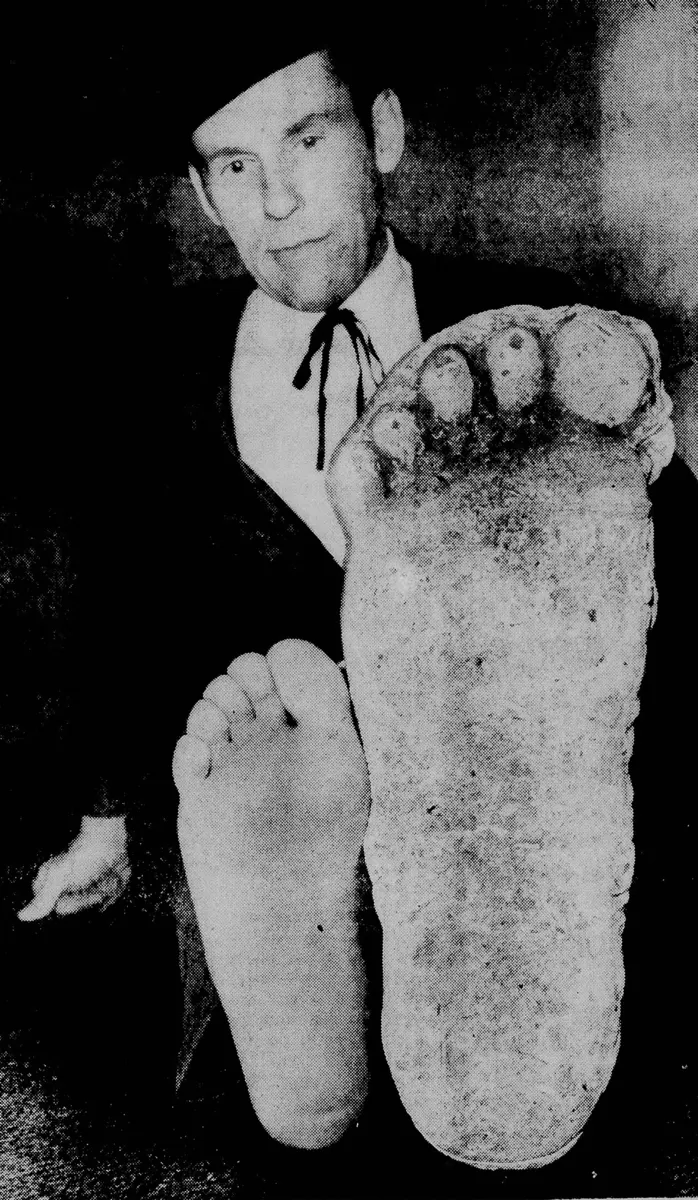
Footprints. The late Idaho State University anthropologist Jeff Meldrum, the field’s best-known academic supporter, put the choice simply: oversized, human-like tracks are “either hoaxed, misidentified, or the trace of a real species.” In 2003 Jimmy Chilcutt, a Texas police investigator who specializes in fingerprints and footprints, told National Geographic that one footprint, found near Walla Walla, Washington, in 1987, had skin ridges running the length of the foot rather than across it as in people, and was “of no known primate that I’ve examined.” The same story noted that many sightings and footprints had proved to be hoaxes.
The Skookum cast. In September 2000, an expedition in Washington’s Gifford Pinchot National Forest found a large impression in mud. Supporters, including Meldrum, said it could well be a Sasquatch body imprint. Skeptoid’s Blake Smith argues that it is more plausibly an elk that lay in the mud near apple bait, and that fingerprint-like ridges on it can be re-created as casting material dries. His verdict: it “has not made a very good scientific impression.”
The 1967 film. Expedition Bigfoot host Ronny Le Blanc told MeatEater that the 1967 Patterson–Gimlin film “still holds the crown” among Bigfoot evidence. Skeptics say it shows a person in a suit, and a 2026 documentary, Capturing Bigfoot, claims a 1966 reel shows a rehearsal. As our report explains, that reel has not been independently authenticated.
The case against
No body. Writer Kyle Hill noted in 2013 that “we have never found any verifiable scat, bones, hair or body.” Skeptical Inquirer’s Michael Dennett put it to National Geographic more bluntly: “The bottom line is, they don’t have a body.” Believers have replies. Todd Prescott told Aeon they may take away their dead; Russell Jones said that “hikers don’t find dead bears in the woods” either. The essay’s own counterpoint is that bear remains are held in museums and private homes.
A record of hoaxes. When Ray Wallace, who ran a construction company in Humboldt County, California, died in November 2002, his family said he had made huge tracks there in 1958 with 16-inch carved wooden feet. The Associated Press noted that the Humboldt Times had coined “Bigfoot” in its coverage. His son Michael said: “The reality is, Bigfoot just died.” The family’s claim concerns the 1958 tracks, not every print since, but it illustrates how tracks can be faked. Bodies shown so far, such as the Minnesota Iceman, are “almost unanimously considered to be hoaxes,” the Aeon essay says.
The DNA. The first systematic genetic survey, led by Oxford’s Bryan Sykes and published in 2014, sequenced 30 hair samples attributed to Bigfoot, the yeti and similar creatures. It concluded that “the hairs were from a range of known extant mammals,” as Aeon summarizes it. Some Bigfooters now put hope in environmental DNA, though one Bigfooter, Robert Leiterman, likened it to “black magic right now.” Details are in our testing guide.
Sightings that track bears. A 2009 Journal of Biogeography paper by Lozier, Aniello and Hickerson modeled 551 BFRO sightings and sounds against the range of black bears. It was written as a “tongue-in-cheek” warning about unreliable data, but the two modelled distributions overlapped heavily, and the authors wrote that they “nonetheless suspect that many Bigfoot sightings are, in fact, of black bears.” A 2023 preprint by data scientist Floe Foxon likewise found more reports where bears are common.
Official records: not the boost some hoped. The U.S. Forest Service’s Bigfoot records, posted in October, include a 1982 memo by wildlife biologist Rodney Johnson, who wrote that the tracks were “made by something other than a 300 pound plus two footed being.” A Border Patrol tracker’s memo called them “a very clever attempt to perpetrate a hoax.” The Department of Agriculture said the files do not “indicate any new agency activity or conclusions regarding Bigfoot,” and that the Forest Service “does not endorse or make any claims regarding the existence of such creatures,” according to the Spokesman-Review. See our report on the 1982 memo and the two Montana records.
Where that leaves it
Sociologists Andrew Bartlett and Jamie Lewis, who conducted more than 160 interviews, mostly with Bigfooters, for a 2026 book, describe the movement as empirical but outside mainstream science, with thousands of testimonies and hundreds of casts, none of it convincing to doubters. The public and scientists, they write, make a simple request: “Habeas corpus. Show the body.” Angelo Capparella of the North American Wood Ape Conservancy has said that without a specimen, “we’re going to be spinning our wheels forever.”
So the honest scorecard is lopsided but not empty. Reports, tracks and the odd puzzling cast are real things people have found and argued over. None has produced a specimen, a verified DNA sequence from an unknown primate or an agency finding that Bigfoot exists. Until one does, each piece remains a claim to be weighed. For more, see the Bigfoot entry and our Washington and Oregon pages.
Sources
- Aeon: Sasquatch science, by Andrew Bartlett and Jamie Lewis (August 7, 2026)
- National Geographic News: Forensic Expert Says Bigfoot Is Real (October 23, 2003)
- Skeptoid #441: The Skookum Cast, by Blake Smith (November 18, 2014)
- MeatEater: What’s the Best Evidence Bigfoot Exists? (January 6, 2023)
- BFRO: Database history and report classification system
- Associated Press via Deseret News: Family says father was Bigfoot (December 6, 2002)
- Lozier, Aniello & Hickerson, Journal of Biogeography: Predicting the distribution of Sasquatch in western North America (2009)
- Phys.org: Data scientist suggests many Bigfoot sightings may be bear sightings (January 31, 2023)
- Scientific American blog: Why Bigfoot is Unlikely Only If You Know What “Unlikely” Means, by Kyle Hill (October 1, 2013)
- Sykes et al., Proceedings of the Royal Society B: Genetic analysis of hair samples attributed to yeti, bigfoot and other anomalous primates (2014)
- The Spokesman-Review: U.S. Forest Service ‘bigfoot files’ are less than meets the eye (November 26, 2026)
- U.S. Forest Service: FOIA Reading Room, “Bigfoot/Sasquatch Records” (posted October 15, 2026)