FIELD FILE · NANDI-BEAROTHERREGIONAL LEGEND
Nandi Bear
Also known as Chemosit, Kerit, Ngoloko, Dubu, Getet
A ferocious, bear-like night raider of western Kenya’s highlands – Africa has no bears, so colonial-era sightings remain hotly debated.
The Nandi bear is East Africa’s most famous mystery carnivore: a heavy, shaggy, high-shouldered beast said to shuffle like a bear, raid villages on moonless nights and kill people by tearing at the head. The puzzle at its core is simple – sub-Saharan Africa has no bears – yet in the early twentieth century a string of British settlers, railway engineers and colonial officers on Kenya’s Uasin Gishu plateau insisted they had seen exactly that.
The English name came from settlers, who heard about the animal mainly from the Nandi people of the western highlands, whose word for a dreaded night-roaming creature was chemosit (also written chimiset). Neighbouring communities had their own names, and by the 1930s writers were lumping together the Nandi kerit, the coastal dubu and the Kipsigis getet as though they were one animal. In local tradition the chemosit is as much a figure of fear as a zoological specimen: some accounts give it a single flaring eye, a half-human shape or a gruesome habit of going for its victims’ heads.
The European paper trail begins in the Journal of the East Africa and Uganda Natural History Society. Around 1912 the farmer Geoffrey Williams described a large, bear-like animal he and a cousin had seen sitting on its haunches near Sirgoit Rock on the then-unsettled plateau. In July 1913 the senior administrator C. W. Hobley gathered further reports – from Major Toulson, from District Commissioner N. E. F. Corbett, from engineers on the new Magadi Railway – and predicted that “the circle is narrowing”. A follow-up by the game ranger A. Blayney Percival was far more cautious.
The animal was never bagged. Instead the reports thinned out as the highlands were settled and big game retreated, and the Nandi bear passed into the classic literature of cryptozoology alongside the okapi, which had famously been dismissed as a traveller’s tale until 1901. Today it is remembered as much for what it says about colonial natural history – eager hunters, second-hand testimony and a landscape that still held genuine surprises – as for any animal that may lie behind it.
- Type
- Other
- Status
- Regional legend
- First reported
- 1912
- Best-known location
- Uasin Gishu Plateau and Nandi Hills, western Kenya
- Also called
- Chemosit, Kerit, Ngoloko, Dubu, Getet
- Reported in
- Kenya
What witnesses describe
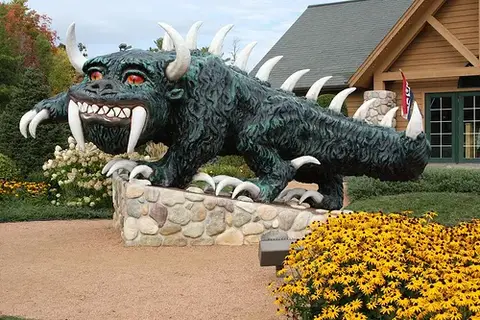
Witnesses described a thick-set animal with long, dark brown or reddish shaggy hair, a high, heavy forequarter and sloping back, a short or absent tail, a large head with a snout and largish ears, and a shambling, bear-like gait. Estimates range from about the size of a hyena to over 1.3 m at the shoulder. Native accounts add a terrifying howl and a habit of attacking the head.
Where and when it’s seen
Forest edges, river gullies and grassland of the western Kenyan highlands – especially the Uasin Gishu plateau around Eldoret, the Nandi Hills and the Kericho area – with a few reports from the Magadi Railway line south-west of Nairobi. Encounters are almost always at dusk or on dark nights.
Notable sightings
- c. 1912Geoffrey Williams on the Uasin Gishu Near Sirgoit Rock, Uasin Gishu Plateau, Kenya
Williams, later a farmer in the Nandi Hills, wrote that while travelling with a cousin before the plateau was settled he saw a large animal sitting up like a bear about 30 yards away. He fired, missed, and watched it disappear among rocks. His account in the natural history society’s journal launched the European legend.
- March 1913District Commissioner Corbett walks into “the beast” Sirgoi River, near Eldoret, Kenya
N. E. F. Corbett, District Commissioner at Eldoret, said he almost stepped on an unfamiliar animal drinking from a wooded stream. He described thick reddish-brown hair, a white streak on the hindquarters and largish ears – but admitted he was without his spectacles and never saw its head properly.
- March 8, 1913Railway engineer’s report Mile 16, Magadi Railway, Kenya
G. W. Hickes, the engineer in charge of building the Magadi line, reported a tawny, shaggy, thick-set animal loping away from the track and said he had never seen anything like it in eighteen years of African railway work. Engineers on the line had earlier reported strange bear-like footprints in mud near a pipeline outlet.
- December 1937Hichens popularises the “kerit” <em>Discovery</em> magazine, London
Former colonial intelligence officer William Hichens wrote that he had heard the creature’s howl and seen six-toed tracks, and quoted the settlers Braithwaite and Archer, who described a shambling dark-brown animal over four feet at the shoulder. The article carried the Nandi bear to a wide British readership.
What could explain it?
- Spotted hyenas – the explanation favoured by zoologist R. I. Pocock in 1930 and by the Natural History Museum in 1932. Large, shaggy individuals have a sloping back, a shuffling lope and a habit of attacking sleepers’ faces.
- Honey badgers (ratels) and aardvarks: G. G. Simpson argued in 1984 that many reports fit the aggressive, low-slung honey badger, and even Hobley noted that sceptics blamed the hairy “ant bear”.
- Large baboons or other primates seen briefly in poor light could explain accounts of an animal standing on its hind legs.
- A surviving chalicothere or giant hyena was proposed by C. W. Andrews and Louis Leakey, but these are known only as fossils millions of years old and there is no modern physical evidence.
- Folklore and hearsay: many accounts were second-hand, translated across languages, and blended a feared spirit-creature of Nandi tradition with settlers’ expectations of finding a new species.
Legend, culture and tourism
Among the Nandi and Kipsigis the chemosit belongs to a body of night-time cautionary tales – keep the door shut, do not walk alone after dark – that are still told today. In colonial Kenya it became a staple of settler conversation and safari campfire stories, and later of cryptozoology books, documentaries and podcasts. Kenya’s Nandi Hills are now better known for tea estates and world-class distance runners than for monsters.
Places to visit
The National Museums of Kenya’s flagship museum explains the country’s real wildlife and fossil heritage, including spotted hyenas and the giant extinct mammals once invoked to explain the legend.
Watch
 ▶ VIDEO
The Nandi Bear: Bear, Hyena or Baboon?
Dr. PolarisA palaeontology-minded look at the historical reports and the hyena, baboon and chalicothere theories.
Where it’s reported
Kenya Uasin Gishu Nandi
Nandi Bear in the news
No recent headlines about the Nandi Bear. Our news desk checks every day — see all cryptid news.
Sources
- Journal of the East Africa and Uganda Natural History Society (1913): C. W. Hobley, “On Some Unidentified Beasts” (via Internet Archive)
- Old Africa Magazine: Eyewitness Reports of the Nandi Bear
- W. Hichens, “African Mystery Beasts”, Discovery (1937), reprinted by StrangeArk (archived)
- Wikipedia: Nandi bear
First published · Updated