FIELD FILE · HODAGOTHERHOAX / DEBUNKED
Hodag
Also known as Rhinelander Hodag, Black Hodag
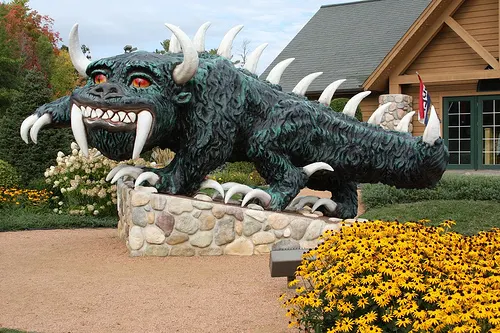
A horned, spiny, grinning beast of Wisconsin logging-camp lore that prankster Eugene Shepard ‘captured’ in 1893 – now Rhinelander’s beloved mascot.
The hodag began life as one of the “fearsome critters” of North Woods logging camps – tall-tale animals that lumberjacks invented to tease newcomers and pass long winter nights. Stories of a ferocious, horned beast with that name were already circulating in the late nineteenth century, and several newspapers ran comic yarns about gullible people swindled by a showman’s “hodag” in the years before 1893.
What turned a campfire joke into Wisconsin’s most famous monster was Eugene Shepard, a Rhinelander timber cruiser, land dealer and celebrated practical joker. In October 1893 he published an illustrated account in the local newspaper claiming that he and a group of men had cornered a hodag in the woods and, after a desperate struggle, killed it with dynamite. A photograph of the posse with the charred “remains” was released to the press.
Three years later, shortly before the first Oneida County Fair in 1896, Shepard announced that he had caught a second hodag alive, overcoming it with a sponge of chloroform on a long pole. He exhibited the creature at the fair and afterward in a darkened shed at his home, where paying visitors peered through a small opening at a hulking, horned shape that moved and growled. In truth it was a wooden model carved by his friend Luke Kearney, covered in ox hide and fitted with bull horns, made to twitch with wires pulled by Shepard’s sons while a hidden dog supplied the growls.
As the story spread through national newspapers, the tale goes that scientists from the Smithsonian Institution announced they would come to Rhinelander to examine the animal – and Shepard owned up to the hoax. Rhinelander, a lumber town facing hard times, decided it liked the attention anyway. The original model has long since disappeared, but the hodag became the official symbol of the city, the mascot of Rhinelander High School and the namesake of the Hodag Country Festival.
- Type
- Other
- Status
- Hoax / debunked
- First reported
- 1893
- Best-known location
- Rhinelander, Oneida County, Wisconsin
- Also called
- Rhinelander Hodag, Black Hodag
- Reported in
- Wisconsin
What witnesses describe
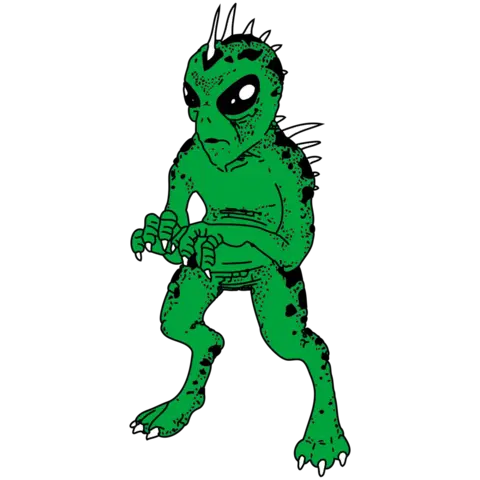
A squat, heavy-bodied beast about seven feet long, with the head of a frog or elephant, a broad, grinning mouth full of sharp teeth, short legs, a pair of thick horns, a row of curved spines down its back and a long tail ending in a spear-like point. It is usually black or dark green and was said to smell of rotting buzzard meat and skunk.
Where and when it’s seen
The pine and hardwood forests and lake country around Rhinelander in Wisconsin’s Northwoods – legend says it eats only white bulldogs, and only on Sundays.
Notable sightings
- October 1893The dynamite “kill” Near Rhinelander, Wisconsin
Eugene Shepard published a dramatic account of hunting down and blowing up a hodag, complete with a photograph of the hunters and the smoking remains. Newspapers far beyond Wisconsin reprinted it.
- 1896A live hodag at the county fair First Oneida County Fair, Rhinelander
Shepard claimed a second hodag had been captured alive and put it on display. Thousands of visitors saw the moving, growling creature – a wire-operated wooden model.
- 1959A gift for a candidate Rhinelander, Wisconsin
During a campaign stop, John F. Kennedy was presented with a hodag carving, a sign of how firmly the creature had become the town’s emblem.
What could explain it?
- The hodag is a confirmed hoax: Eugene Shepard admitted inventing the captures, and the exhibited animal was a carved wooden model operated with wires.
- The creature itself comes from lumber-camp tall tales of “fearsome critters,” told as jokes rather than as genuine animal reports.
- Shepard’s stunts were also good business for a fading lumber town, and newspapers of the era often printed such stories with a knowing wink.
Legend, culture and tourism
Rhinelander proudly calls itself the home of the hodag. A large fiberglass hodag by local artist Tracy Goberville stands outside the Rhinelander Area Chamber of Commerce, dozens more statues are scattered around town (tracked on the Chamber’s “Hodag Finder” map), and the creature names the high school teams, the Hodag Country Festival and countless local businesses. It also appears in classic collections of American logging folklore such as the 1939 book Fearsome Critters.
Places to visit
The town’s best-known photo stop, a larger-than-life fiberglass hodag.
Where it’s reported
Hodag in the news
No recent headlines about the Hodag. Our news desk checks every day — see all cryptid news.
Sources
First published · Updated