FIELD FILE · BEAST-OF-BRAY-ROADDOGMAN & CANINEREGIONAL LEGEND
Beast of Bray Road
Also known as Bray Road Beast, Wisconsin Werewolf, Manwolf, Elkhorn Werewolf
A wolf-headed creature that walks on two legs, reported along a farm road outside Elkhorn, Wisconsin, and made famous by reporter Linda Godfrey in 1991.
Bray Road is an unremarkable two-lane country road running between cornfields just outside Elkhorn, the seat of Walworth County in southeastern Wisconsin. In the late 1980s and early 1990s it acquired an unusual reputation: local young people were whispering about a huge dog or wolf that had been seen standing upright, and the county’s animal control officer was quietly keeping a folder of odd reports labeled “Werewolf.”
In 1991 Linda S. Godfrey, a reporter and illustrator for The Week, a weekly supplement of the Janesville Gazette covering Walworth County, was assigned to chase down the rumors. Her first article appeared on December 29, 1991. It drew on witnesses including Doristine Gipson, who said that on Halloween night 1991 something large and hairy ran at her car after she felt a bump near Bray Road, and Lorianne Endrizzi, who said that in 1989 she had seen a creature with a wolf’s head and a man’s build kneeling at the roadside, holding something in its paws as if eating roadkill.
Godfrey began as a skeptic, but she found that the witnesses were ordinary local people who seemed genuinely shaken, and that some had never told anyone before. The story spread to regional and national TV, curious visitors began cruising Bray Road at night, and her columns grew into the 2003 book The Beast of Bray Road: Tailing Wisconsin’s Werewolf. She went on to write more than 20 books, collecting “manwolf” and “dogman” reports from across the Midwest, until her death in November 2022.
Reports linked to the Beast stretch across Walworth, Racine and Jefferson counties. Some researchers point to a much older account: a night watchman at a school near Jefferson who said in 1936 that he saw a hairy creature digging on an old Native American mound. More recent upright-canine reports came from Spring Prairie in 2018 and Lyons in 2020. Whether one thinks it is a wolf, a bear, a hoax or something stranger, the Beast is firmly part of Wisconsin folklore and a cornerstone of the modern Dogman phenomenon.
- Type
- Dogman & canine
- Status
- Regional legend
- First reported
- 1991
- Best-known location
- Bray Road, Elkhorn, Walworth County, Wisconsin
- Also called
- Bray Road Beast, Wisconsin Werewolf, Manwolf, Elkhorn Werewolf
- Reported in
- Wisconsin
What witnesses describe
A wolf-like animal about six to seven feet tall when standing, covered in grayish-brown fur, with a long canine muzzle, pointed ears and eyes that shine yellow or red in headlights. Its body is often described as muscular and man-like. It is seen both running on all fours and walking, kneeling or crouching on its hind legs.
Where and when it’s seen
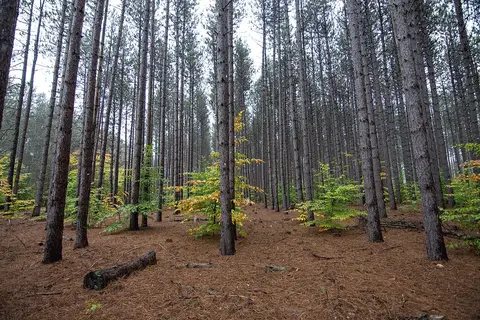
Farm roads, cornfields and woodlots around Elkhorn and Delavan in Walworth County, and more widely across southeastern Wisconsin; usually seen at night in car headlights, occasionally in daytime crossing fields.
Notable sightings
- 1936The watchman’s report Near Jefferson, Wisconsin
A night watchman at a rural school said he saw a large, hairy creature digging on a Native American mound on two nights running. Later researchers count it as the earliest Wisconsin “manwolf” account.
- 1989Lorianne Endrizzi’s roadside sighting Bray Road, Elkhorn
Driving home at night, Endrizzi said she saw a hairy figure with a wolf-like face kneeling at the side of the road, apparently holding food in its paws. She later identified it with a werewolf picture in a library book.
- October 31, 1991Doristine Gipson’s Halloween encounter Near Bray Road, Elkhorn
After feeling her car bump something, Gipson said a large dark creature ran at her and leapt at the vehicle as she drove off. Her account became central to the first newspaper story.
- December 29, 1991Linda Godfrey’s first article Elkhorn, Wisconsin
The Week published Godfrey’s report on the Bray Road sightings with her own illustration. The story was picked up by TV and wire services, making the Beast a national curiosity.
What could explain it?
- Gray wolves, coyotes and large dogs such as Great Pyrenees or Newfoundlands could be mistaken for something stranger in brief nighttime glimpses; wolves occasionally wander into the region.
- A black bear, especially one with mange or standing on its hind legs, could explain an upright, hairy, dog-faced figure.
- Once the story was in the papers, unrelated sightings of odd animals were folded into a single legend – a classic example of contagious reporting.
- The werewolf image itself – a familiar cultural template – may shape how witnesses interpret and later describe an ambiguous animal.
- Some reports may be hoaxes or pranks, particularly after the area became a destination for thrill-seekers.
Legend, culture and tourism
Linda Godfrey’s books made the Beast of Bray Road the prototype of the modern “Dogman” and “upright canine” genre. It inspired a 2005 horror film from The Asylum, the 2018 Small Town Monsters documentary The Bray Road Beast, a 2025 horror comedy, and episodes of MonsterQuest, Lost Tapes and Haunted Highway. Bray Road itself is still a popular nighttime drive for cryptid fans.
Watch
 ARCHIVE.ORG4:07
The Bray Road Beast (featurette)
Small Town MonstersA four-minute preview of Seth Breedlove’s 2018 documentary, which features Linda Godfrey and local witnesses.
Where it’s reported
Beast of Bray Road in the news
No recent headlines about the Beast of Bray Road. Our news desk checks every day — see all cryptid news.
Sources
First published · Updated