FIELD FILE · SISIMITEHOMINIDFOLKLORE
Sisimite
Also known as Sisimito (Belize), Sinsimito (Yucatán), Itacayo, Sismidu (Garifuna)
Central America’s hairy wild man of the mountain caves, said to walk on backward feet, fear water and dogs, and carry off people who stray into the forest.
From the cloud-forested highlands of Honduras to the chicle camps of the Yucatán and the logging country of Belize, people have long told stories of a huge, hairy wild man who lives in caves above the villages. In Honduras he is the Sisimite or Itacayo; in Belize the Sisimito (with a female counterpart, the Sisimita); in Yucatán the Sinsimito; among the Garifuna, Sismidu. Outsiders sometimes call him “the Central American Bigfoot,” though the stories are much older than the modern Bigfoot craze.
The name is generally traced to the Nahuatl tzitzimitl, a word for fearsome star-demons in Aztec belief, and Spanish-language folklorists link it to a sense of being angry or ill-tempered. The Honduran explorer and historian Jesús Aguilar Paz (1895–1974), who recorded much of his country’s folklore, placed the creature in inaccessible caverns high in the mountains, living on wild fruit but descending to carry off women. The anthropologist Anne Chapman described a bear-like, man-shaped being with feet turned backwards.
In Belize, tales of the Sisimito were swapped in the mahogany-cutters’ camps of earlier generations and are still told in villages such as Ranchito and Hill Bank. There the rules are specific: a man who meets its eyes will die within a month, while a woman who does so and escapes will live longer. It is terrified of water and dogs, and in some stories it punishes hunters who kill needlessly or destroy the forest. Among the Q’eqchi’ Maya of southern Belize, the thunder deities are said to have pushed it back into the last deep forests as farmland spread.
The Sisimite is not usually the subject of modern “sighting reports” in the way Bigfoot is. It belongs to a family of cautionary tales – about the wild, the dangers of straying from the village and the boundary between people and forest – told with variations across a whole region.
- Type
- Hominid
- Status
- Folklore
- First reported
- Pre-colonial
- Best-known location
- Mountain forests of Honduras, Belize and the Yucatán
- Also called
- Sisimito (Belize), Sinsimito (Yucatán), Itacayo, Sismidu (Garifuna)
- Reported in
- Mexico Nicaragua Guatemala El Salvador Honduras Belize
What witnesses describe
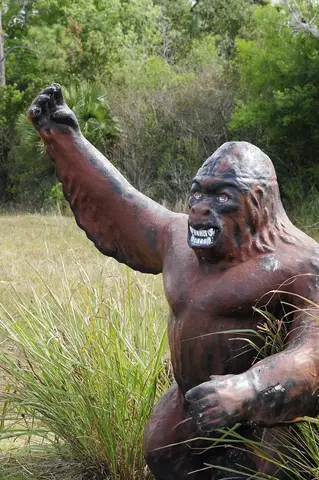
Taller and far stronger than a man, covered in long black or dark-brown hair, with an ape-like face, sometimes only four thumbless fingers, and feet that point backwards so that its tracks seem to lead the wrong way. Some versions say it has no knees and cannot turn easily.
Where and when it’s seen
Caves, rocky high ground and dense mountain forest in Honduras, Belize, Guatemala and the Yucatán Peninsula. In stories it appears on Sundays and holy days, and to hunters, chicle gatherers and loggers working deep in the bush.
Notable sightings
- Mid-20th centuryA night at the chicle camp Yucatán Peninsula, Mexico
A Yucatán Today writer recounts a family story from the chicle-harvesting era, when the writer’s grandfather spent a terrifying night in an abandoned forest camp listening to heavy blows on the door, which the workers blamed on the Sinsimito. It is family testimony rather than documented evidence.
- 1951A wild man on the big screen Hollywood, California
Curt Siodmak’s B-movie Bride of the Gorilla borrowed one of the creature’s regional names, the súkara, for a jungle curse that turns a plantation owner into a beast – an early appearance of the legend in popular culture.
What could explain it?
- The Sisimite fits a worldwide pattern of “wild man” folklore – including backward feet, a feature shared by South America’s Curupira and Mapinguari – which points to shared storytelling motifs rather than an unknown ape.
- No great ape is known from the Americas; real forest animals such as spider and howler monkeys, tapirs, bears in the past, and jaguars may have inspired details.
- The tales function as warnings: stay out of the deep forest alone, respect holy days, don’t over-hunt, and protect women and children – lessons that made sense in remote logging and farming communities.
- Nighttime noises in isolated camps – falling branches, animals, or other people – are easily attributed to a known local monster.
Legend, culture and tourism
The Sisimite is one of the best-known legends of Honduras and a familiar bogeyman in Belize and the Yucatán, retold by grandparents, in school folklore books and in Belize writer Henry Anderson’s “Sisimito” adventure novels. A pool called the Poza del Sisimite in San Vicente, El Salvador, carries its name.
Where it’s reported
Mexico Nicaragua Guatemala El Salvador Honduras Belize
Sisimite in the news
No recent headlines about the Sisimite. Our news desk checks every day — see all cryptid news.
Sources
First published · Updated