COUNTRY FILE · NORTH AMERICA
Cryptids of Mexico
What cryptids are in Mexico? The best-known are La Llorona, Chupacabra, Ahuizotl and El Cadejo, among 5 on file.
Mexico’s strange creatures are rooted in one of the world’s great storytelling traditions, where the Mesoamerican past and Spanish colonial Catholicism blended into something new. The oldest on this site come from the Aztec (Mexica) world: the ahuizotl, a small, dog-like water beast with a hand at the end of its tail, was described by Nahua elders to the friar Bernardino de Sahagún in the 16th-century Florentine Codex, and the same work records a woman heard weeping in the night among the omens before the conquest – often seen as the seed of La Llorona.
Cryptids reported in Mexico
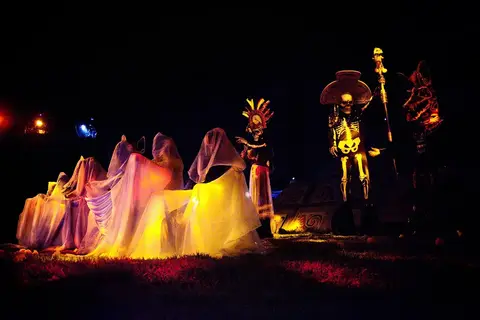 SPECTRAL · 16th century
La Llorona
Canals of Xochimilco, Mexico City
A weeping ghost in white who wanders rivers and canals at night crying for the children she lost – Mexico’s most famous and most widely told legend.
FOLKLORE OTHER · 1995
Chupacabra
Canóvanas, Puerto Rico
The “goat-sucker” of 1990s Puerto Rico: a spiny, bloodsucking beast blamed for livestock deaths that spread across Latin America and Texas.
WIDELY REPORTED LAKE & SEA MONSTER · Pre-colonialAhuizotl
Lakes of the Valley of Mexico
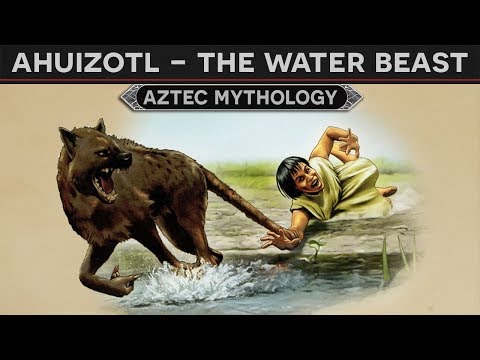
An Aztec water creature like a small black dog with a hand at the tip of its tail, said to cry like a baby and drag people into deep water.
FOLKLORE DOGMAN & CANINE · Pre-colonial roots; recorded 19th century
El Cadejo
Night roads of Guatemala and El Salvador
A spectral dog with burning eyes that follows night travelers in Central America – the white one protects them, the black one leads them to ruin.
FOLKLORE HOMINID · Pre-colonialSisimite
Mountain forests of Honduras, Belize and the Yucatán
Central America’s hairy wild man of the mountain caves, said to walk on backward feet, fear water and dogs, and carry off people who stray into the forest.
FOLKLOREThe legends of Mexico
La Llorona, the weeping ghost who searches rivers and canals for her drowned children, is now Mexico’s most famous legend, told from Chihuahua to Chiapas and staged each autumn on the canals of Xochimilco. Night roads in the south belong to the cadejo, the spectral dog of Central America, and in the jungles of the Yucatán chicle-gatherers once whispered about the Sinsimito, a hairy wild man with backward feet whom Hondurans call the Sisimite. In the 1990s the chupacabra leapt from Puerto Rico to the mainland, and Mexico joined the wave of livestock-killing scares and jokes that followed.
Mexico treats these figures less as zoological puzzles than as living culture: they appear on Day of the Dead altars, in school plays, ballads, films and satire – one 19th-century newspaper even named itself after the ahuizotl to mock the government. Visitors can start at the National Museum of Anthropology in Mexico City, then take a trajinera boat through Xochimilco after dark.
Hotspots
Ancient canals where a floating La Llorona show is staged each autumn for audiences watching from trajinera boats.
Mexico’s great museum of pre-Hispanic cultures, the best place to meet the world of the ahuizotl and Aztec water deities.
Jungle and former chicle country where the hairy Sinsimito is said to live in caves and fear water.
Southern highlands where Zoque communities tell of a black, fiery-eyed dog akin to the cadejo.
Sightings timeline
- 1486–1502A ruler named for the beast Ahuizotl
The Mexica emperor Ahuitzotl ruled under the creature’s name and used it as his glyph. Later chroniclers linked the ruler to the rain gods with whom the animal was associated.
- c. 1577The sixth omen of the <em>Florentine Codex</em> La Llorona
Sahagún’s encyclopedic work on Nahua culture records a woman heard crying through the night as one of the omens before the conquest. It is the earliest written source usually linked to the legend.
- c. 1577Described in the <em>Florentine Codex</em> Ahuizotl
Sahagún’s Nahua collaborators recorded the ahuizotl’s appearance and habits in Book 11. Their account remains the main source for the creature.
- 1895Zelia Nuttall’s study Ahuizotl
The archaeologist Zelia Nuttall discussed the ahuizotl in “A Note on Ancient Mexican Folk-Lore,” drawing scholarly attention to the creature and its possible real-world models.
- 1933First La Llorona film La Llorona
La Llorona, directed by Ramón Peón, was one of the first Mexican sound-era horror films and fixed the ghost’s image for the screen.
- Mid-20th centuryA night at the chicle camp Sisimite
A Yucatán Today writer recounts a family story from the chicle-harvesting era, when the writer’s grandfather spent a terrifying night in an abandoned forest camp listening to heavy blows on the door, which the workers blamed on the Sinsimito. It is family testimony rather than documented evidence.
- 1993The Xochimilco performance begins La Llorona
A floating show of music, dance and theater about La Llorona was first staged on the lake at Cuemanco. It has returned season after season for more than three decades, with audiences watching from trajinera boats.
- 2011“Tracking the Chupacabra” published Chupacabra
Benjamin Radford’s book, the result of a five-year investigation, argued that the original description was shaped by the 1995 film Species and that later carcasses were mangy canids.
Latest from Mexico
No recent cryptid headlines from Mexico. See all the latest cryptid news.
Videos
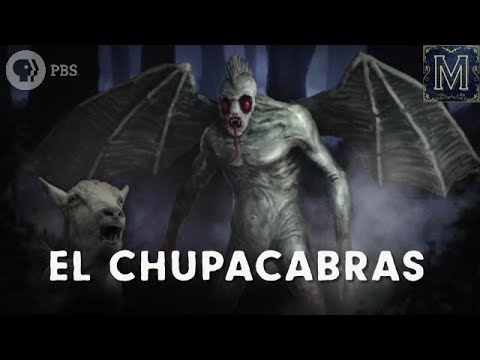 ▶ VIDEO
El Chupacabras, a Modern Mystery
Monstrum | PBS StoriedFolklorist Emily Zarka traces both the Puerto Rican and the Texas chupacabra and the real explanations behind them.
 ARCHIVE.ORG3:04
La Llorona
Pikes Peak Library DistrictA short 2010 storytelling segment from a Colorado public library’s community TV channel – a good example of how the legend is told in the US Southwest.
 ▶ VIDEO
The Legend of La Llorona
Monstrum | PBS StoriedFolklorist Emily Zarka explains the legend’s Nahua and colonial roots and its many regional versions.
 ▶ VIDEO
El cadejo (2006)
Audiovisuales UCAA short Salvadoran film from the Universidad Centroamericana retelling the legend.
 ▶ VIDEO
Ahuizotl – The Water Beast (Aztec Mythology)
InvictaA short history-channel explainer drawing on the <em>Florentine Codex</em> account.