FIELD FILE · NUCKELAVEEOTHERFOLKLORE
Nuckelavee
Also known as Knoggelvi, Devil of the Sea, Mukkelevi (Shetland)
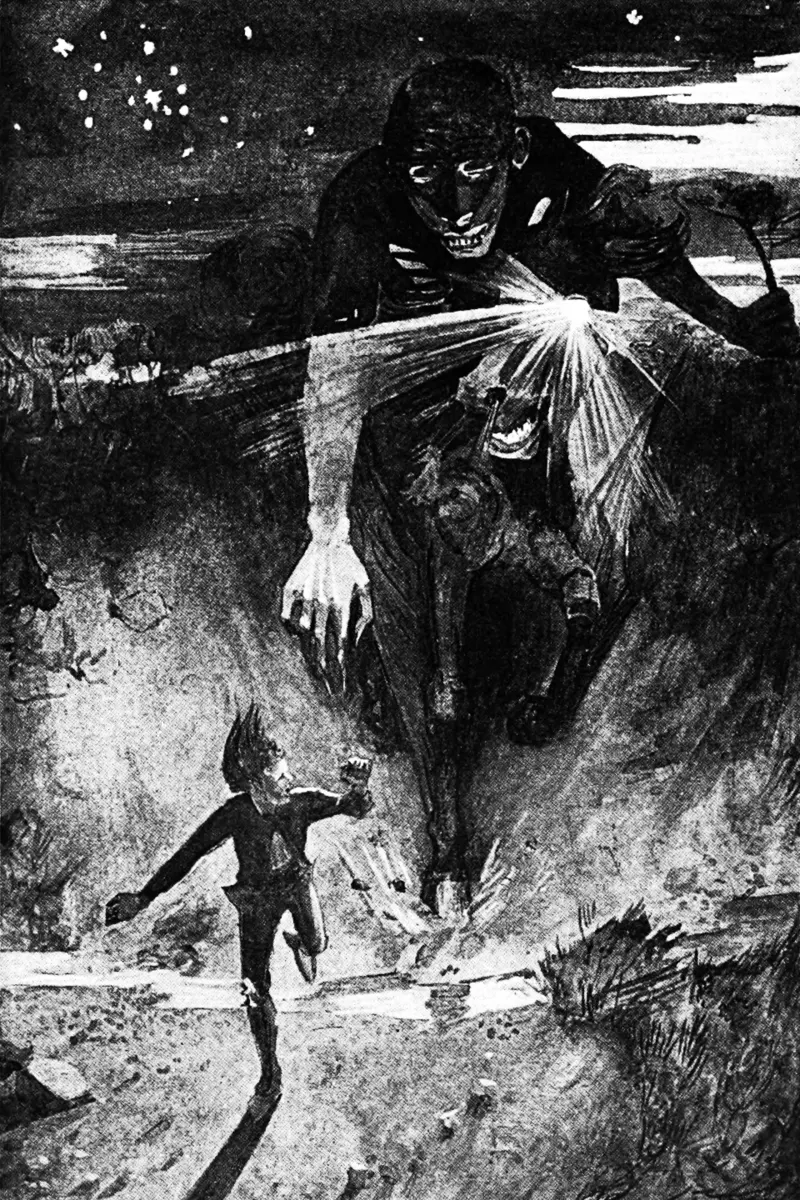
Orkney’s most dreaded sea demon: a skinless horse-and-rider monster blamed for blight, drought and plague, which could not cross running fresh water.
The Nuckelavee is the most terrifying figure in the folklore of the Orkney Islands, off the north coast of Scotland. Islanders described it as a demon that lived in the sea and came ashore on a horse as horrific as itself – or perhaps it was horse and rider in one body. Its name comes from the Orcadian knoggelvi, which the 19th-century folklorist Walter Traill Dennison glossed as “Devil of the Sea”.
Unlike many mischievous fairy beings, the Nuckelavee was pure malice. Its breath withered crops and sickened people and livestock, and Orcadians blamed it for blights, epidemics and long droughts. In the lore Dennison recorded, it was kept in check during the summer months only by the Mither o’ the Sea, a benevolent spirit of the warm season. Its one weakness was fresh water: it would not come ashore in the rain and could not cross a running stream.
Most of what we know comes from Dennison, a farmer and antiquarian from Sanday who spent decades collecting Orkney stories. In 1891 he published in The Scottish Antiquary the account of an old islander called Tammas, who claimed he had met the monster on a starlit night on a narrow road between the sea and a freshwater loch. Tammas escaped by splashing loch water at the beast and leaping across a burn, losing only his bonnet. The tale was reprinted in George Douglas’s Scottish Fairy and Folk Tales (first published c. 1893), which carried it to a wide audience.
Dennison also recorded a belief that the Nuckelavee was enraged by the smoke of kelp-burning, the seaweed-ash industry that began in Orkney in the 18th century, and that it punished islanders by spreading the horse disease mortasheen. Folklorists such as Ernest Marwick have linked it to the Norse water horse (the nøkk) and the Celtic kelpie, and it is often read as a way island communities gave a face to disasters they could not otherwise explain.
- Type
- Other
- Status
- Folklore
- First reported
- 1891
- Best-known location
- Orkney Islands, northern Scotland
- Also called
- Knoggelvi, Devil of the Sea, Mukkelevi (Shetland)
- Reported in
- Scotland
What witnesses describe
In Tammas’s account the lower part was a huge horse with fin-like flaps on its legs, a mouth as wide as a whale’s and a single fiery red eye. Out of its back grew a legless man with arms reaching almost to the ground and an enormous lolling head. Worst of all, it had no skin: raw red flesh, black blood running through yellow veins and white sinews were all exposed. Its breath steamed like a kettle and it bellowed like the roaring sea.
Where and when it’s seen
The sea around Orkney, coming ashore along coastal roads and shorelines at night. It was said never to come on land during rain, and to be held at bay through the summer.
Notable sightings
- 1722 (in legend)Kelp-burning comes to Orkney Stronsay, Orkney
Kelp-burning – roasting seaweed for its alkaline ash – began on Stronsay in 1722. Orkney lore recorded by Dennison held that the acrid smoke enraged the Nuckelavee, which retaliated by striking the islands’ horses with disease.
- 1891Tammas’s encounter is published Orkney
Walter Traill Dennison printed the first-hand account of Tammas, who said the skinless monster chased him along a shore road until he leapt a stream to safety. It is the fullest description of the creature ever recorded.
- c. 1893Into the folk-tale anthologies Scotland
George Douglas included the Nuckelavee in Scottish Fairy and Folk Tales, calling it the “Sea-Devil of the Orkney Islanders”. The book helped turn a local island terror into one of Scotland’s best-known monsters.
What could explain it?
- A folklore personification of disaster: crop blight from salt-laden gales, epidemics and livestock deaths were blamed on a single malevolent being.
- Its skinless horse form may blend the Norse nøkk water spirit with the Celtic kelpie or water horse, reflecting Orkney’s mixed Norse and Scottish heritage.
- Its fear of fresh water mirrors a widespread European belief that evil spirits cannot cross running water.
- Stories like Tammas’s were told by and about individuals and survive mainly through one collector, Walter Traill Dennison, so their details are hard to check.
Legend, culture and tourism
The Nuckelavee is part of Orkney’s rich storytelling heritage alongside selkies, trows and the Finfolk. It has become a favourite of modern horror and fantasy, appearing in games, comics and illustrated monster books, and Orkney’s storytellers and festivals keep the old tales alive. The Orkney Museum in Kirkwall explores the islands’ history and folklore.
Places to visit
The islands’ main history museum, a good starting point for Orkney’s Norse heritage and folk beliefs.
Where it’s reported
Scotland Orkney Islands
Nuckelavee in the news
No recent headlines about the Nuckelavee. Our news desk checks every day — see all cryptid news.
Sources
First published · Updated