Field file · Other · Regional legend
Lava Bear
Also known as Dwarf Bear of Oregon, Sand Lapper, Oregon Dwarf Bear
Small, woolly ‘dwarf bears’ trapped in Oregon’s high-desert lava beds from 1917 to 1934, later judged stunted black bears and adopted as a school mascot.
In May 1917 a sheepherder named O. T. McKendree, tending flocks in northern Lake County, Oregon, saw his dog barking up a juniper tree. The animal he shot proved to be a bear, but a tiny one, about 23 pounds by his estimate, with woolly fur the color of buckskin. A taxidermist in The Dalles mounted it, and it went on display in a Lakeview drugstore, where a local man photographed it for the Oregon Sportsman. Within months, people were talking about a separate species of dwarf bear living in the black lava beds around Fort Rock.
The stories grew fast. Some old-timers said the little bears were a cross between a black bear and a grizzly, some said a bear shrunk by the barren lava country, and the humorist Irvin S. Cobb, who came out to hunt one in 1920, wrote in the Saturday Evening Post that it might even descend from the Asian sun bear. Cobb never found one, but his article made the animal famous. Trappers brought in more: in 1923 and 1924 a government trapper named Alfred Andrews took one dead and one alive, and the live bear was exhibited in Portland, Bend and Klamath Falls before it vanished while on tour. Further captures followed in 1924, 1933 and 1934.
Scientists never accepted a new species. The biologist C. Hart Merriam, who studied the mounted 1917 bear, judged it an immature, possibly abnormal black bear, and the Oregon wildlife biologist Stanley Jewett wrote in 1922 that, for all his searching, he had found only common black bears and grizzlies in the region, and that the bears killed there since 1917 had been normal black bears. The accepted explanation is that the “lava bears” were cubs and underfed small adults, stunted by poor forage in a dry, rocky landscape.
The legend lives on in Bend, where the high school chose the Lava Bear as its mascot in 1924, soon after a live specimen was shown in town, and where it remains the name of the school’s teams.
What witnesses describe
A bear far smaller than a normal adult: about 17 to 30 inches long, 12 to 18 inches high and 23 to 35 pounds, with woolly light-brown or buckskin fur, sometimes described as sandy or yellowish.
Where and when it’s seen
The lava fields, juniper flats and dry lakebeds of the northern Great Basin in central Oregon: the Fort Rock and Fossil Lake country, Summer Lake and Crescent Lake, with a final capture near Scar Mountain in the Cascades.
Notable sightings
- May 1917McKendree’s small bear Near Fossil Lake, Oregon
Sheepherder O. T. McKendree shot a tiny woolly bear in a juniper tree. It was mounted and shown in Lakeview, and its photograph appeared in the Oregon Sportsman that October.
- September 1920Irvin S. Cobb’s hunt Lake County, Oregon
Cobb searched for a lava bear for the Saturday Evening Post and found none, but returned convinced the animal might exist. His article appeared on January 1, 1921.
- 1923Andrews takes a lava bear Near Fort Rock, Oregon
Government trapper Alfred Andrews reported killing a small bear near Fort Rock and sent the specimen to the state biological survey office.
- May–June 1924A live lava bear on tour Portland, Bend and Klamath Falls, Oregon
Andrews caught a live male of about 28 pounds and exhibited it for a fee. Thousands paid to see it in Portland, and it later disappeared, reportedly taken or sold by his partner.
- 1934The last captures Crescent Lake and Scar Mountain, Oregon
Two more small bears were caught that year, one east of Crescent Lake and one by a road crew near Scar Mountain in the Willamette National Forest. They were the last animals identified as lava bears.
What could explain it?
- Stunted black bears: scientists, beginning with C. Hart Merriam, concluded that the animals were American black bears that were small because of cub age or poor feeding in harsh lava country.
- No separate population was ever found. Stanley Jewett reported in 1922 that he could find no evidence of anything but black bears and grizzlies in the region, and the bears killed afterward were normal black bears.
- Promotion and showmanship: the live bear shown in 1924 was charged for, and newspapers and a national magazine fed public interest in a ‘missing link’ bear.
- Misidentification: young black bears are small and fur color varies widely, so a cub or a wiry adult seen at a distance may be taken for a separate kind.
Legend, culture and tourism
The lava bear is one of the Pacific Northwest’s better-documented near-miss cryptids, a mystery that traced back to a real mounted animal. Bend Senior High School adopted the Lava Bear as its team mascot in 1924, and a 2013 statewide Oregonian poll chose the Bend Lava Bears as Oregon’s best mascot for the largest schools. A bear sculpture, Grizzly (2001), stands in a roundabout on Bend’s east side a block from the school.
Places to visit
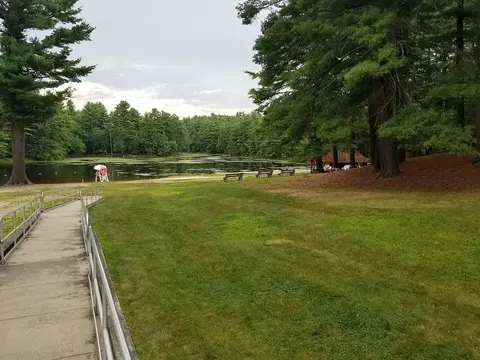
A natural-history and cultural museum on the high desert, a good place to learn about the landscape and wildlife of the lava country where the bears were reported.
A volcanic tuff ring rising from the desert floor in the heart of the country where lava bears were trapped.
Where it’s reported
Sources
First published · Updated