FIELD FILE · FUR-BEARING-TROUTLAKE & SEA MONSTERHOAX / DEBUNKED
Fur-bearing Trout
Also known as Furry trout, Fur-covered trout, Loðsilungur (Iceland)
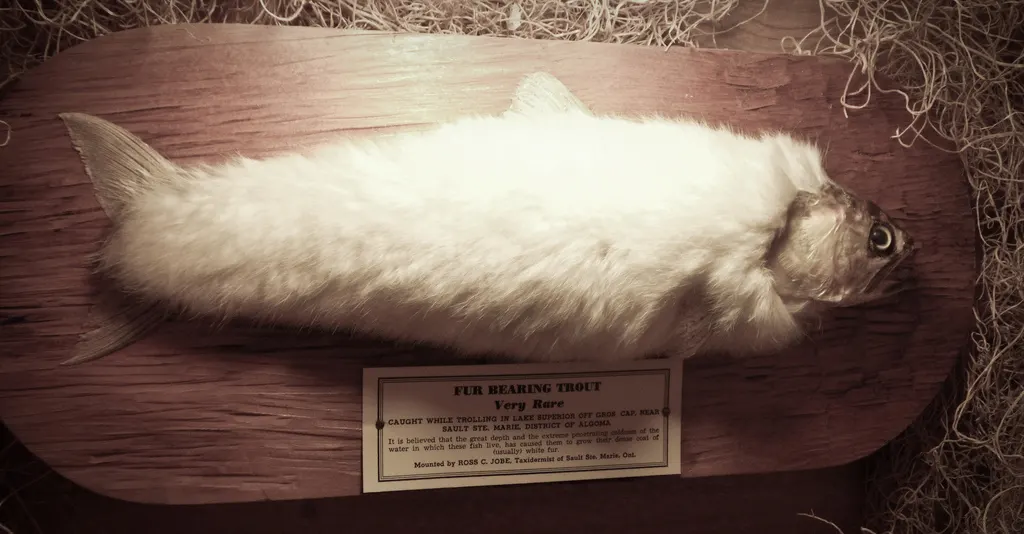
A trout said to grow a thick fur coat to survive icy northern waters – a tall tale kept alive by joke postcards and rabbit-fur taxidermy mounts.
The fur-bearing trout is a fish story in the most literal sense: a trout that supposedly grows a thick pelt to cope with bitterly cold water. Most people meet it as a mounted specimen in a bar, tackle shop or roadside museum – a perfectly ordinary trout covered in white fur, usually with a straight-faced label explaining its rarity.
Versions of the tale are old and widespread. Popular retellings trace it to Scottish settlers in Canada writing home about “furried animals and fish,” and Iceland has its own furry trout, the loðsilungur, described in print by 1900. The earliest known American publication is a 1929 article in Montana Wildlife by J.H. Hicken, who solemnly advised that a furry trout pulled from frigid water might explode from the sudden change in temperature.
The legend found its most enthusiastic promoter in Salida, Colorado. In the late 1930s Wilbur B. Foshay – a former Minneapolis utilities tycoon who had served prison time for mail fraud and was then running Salida’s chamber of commerce – publicized “Chaffee County fur-bearing trout” in the icy Arkansas River. The Salida Daily Mail introduced the fish with photographs on June 23, 1938, and other Colorado papers and radio picked it up; one explanation blamed jugs of hair tonic spilled into the river. Today a furry trout mount is displayed at the Salida Museum.
The most famous specimen of all came from the Great Lakes. Ross C. Jobe, a taxidermist in Sault Ste. Marie, Ontario, made white-furred trout said to have been caught while trolling in Lake Superior. One was donated to the Royal Scottish Museum in Edinburgh (now National Museums Scotland) by a visitor who believed it genuine; museum staff identified it as an ordinary trout with rabbit fur attached.
- Status
- Hoax / debunked
- First reported
- 1929
- Best-known location
- Salida (Colorado), Montana and Lake Superior
- Also called
- Furry trout, Fur-covered trout, Loðsilungur (Iceland)
What witnesses describe
A normal trout – often brown or brook trout – covered from behind the head to the tail in dense white or brown fur, with fins and head left bare.
Where and when it’s seen
Very cold northern rivers and lakes – Montana streams, the Arkansas River near Salida, Colorado, and Lake Superior – supposedly growing its fur in winter.
Notable sightings
- 1929Montana Wildlife’s exploding trout Montana
J.H. Hicken wrote in Montana Wildlife about trout that grew fur in cold water, the earliest known American printing of the tale.
- June 23, 1938Salida’s furry trout Salida, Colorado
The Salida Daily Mail ran photos of a “Chaffee County fur-bearing trout,” part of Wilbur Foshay’s publicity campaign. Other Colorado newspapers and Denver radio repeated the story that autumn.
What could explain it?
- All known specimens are taxidermy hoaxes: ordinary trout with rabbit, beaver or other fur glued on.
- The tale is a classic piece of tall talk and civic promotion – Salida’s version was openly a chamber-of-commerce publicity stunt.
- Real fish infected with the water mold Saprolegnia can grow cottony tufts that might inspire such stories, though the growths are thin and patchy rather than true fur.
Legend, culture and tourism
Furry trout mounts and joke postcards are staples of Western and Great Lakes kitsch, displayed in places like the Salida Museum and Ripley’s Believe It or Not! museums. The fish is often counted among the American fearsome critters alongside the jackalope, and Salida still enjoys its role in the legend.
Where it’s reported
Colorado Montana Canada Iceland
Fur-bearing Trout in the news
No recent headlines about the Fur-bearing Trout. Our news desk checks every day — see all cryptid news.
Sources
First published · Updated