Field file · Spectral · Folklore
Charro Negro
Also known as El Charro Negro, The Black Horseman, Señor del Cerro (Mixtec variants)
A tall horseman in black charro dress on a huge black horse who offers gold on lonely Mexican roads, tied to the devil and warnings against greed.
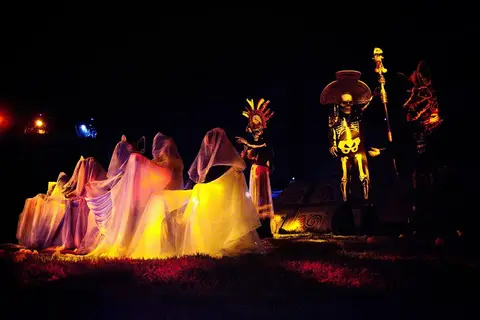
El Charro Negro, the Black Charro, is one of Mexico’s best-known roadside legends. He is said to be a tall, elegantly dressed horseman in black charro costume, often with silver embroidery and a wide-brimmed hat, riding a large black horse. He appears at night on lonely roads, trails and empty countryside, and offers travellers money, gold or a ride.
Most versions treat him as the devil, or a wealthy man damned for a pact with the devil who now tempts others into the same bargain. The standard moral is a warning against greed and the easy fortune that comes at a price. Tellers say that accepting his gifts binds the person to him, that the gold may turn to ash, and that prayer or the name of God makes him vanish. The story is closely related to European and American tales of the crossroads deal.
The legend is associated especially with Jalisco, the heartland of charro culture. Spanish-language sources suggest it grew out of colonial-era mixing of Catholic ideas about the devil with local beliefs, and some date its present form to the early twentieth century; these origin claims are not firmly documented. In several Indigenous regions it has parallels in the “lord of the hill”, a guardian of the land who punishes greed and is approached with offerings; among the Wixárika the figure has been linked to dark deities associated with colonisers. Those traditions are living ones and deserve their own context.
The Charro Negro features in B. Traven’s story Macario, in the animated film La leyenda del Charro Negro (2018) and in countless retellings.
What does Charro Negro look like?
A tall man in black charro clothes with a wide sombrero, riding a very large, unnaturally dark horse sometimes said to have red or glowing eyes. His face is handsome or hidden in shadow.
Where is Charro Negro seen?
Night-time country roads, crossroads and cave mouths, particularly in rural Jalisco and the Mexican highlands; he is also placed in the north and south in regional variants.
Charro Negro sightings
- 1950sMacario in print and film Mexico
B. Traven’s story Macario, later filmed, is cited in Spanish-language sources as a literary appearance of the Charro Negro tradition.
- 2018La leyenda del Charro Negro Mexico
Anima Estudios released an animated film that made the legend’s villain a mainstream cinema figure.
Is Charro Negro real? What could explain it
- The legend is a moral tale about greed and about danger on remote roads at night, where bandits and accidents were real risks.
- It blends the Catholic devil with Indigenous ideas of hill-lords and underworld guardians, a common pattern in Mexican folk religion.
- Sightings are usually told as second-hand stories rather than documented events.
Legend, culture and tourism
The Black Charro appears in films, comics, radio and wrestling nicknames, and is mentioned with La Llorona at Día de Muertos and Halloween storytelling. He is distinct from El Sombrerón, a separate figure of southern Mexico and Central America.
Where it’s reported
Sources
First published · Updated