Field file · Spectral · Folklore
La Cegua
Also known as Segua, Tzegua
A horse-faced ghost of Costa Rican and Nicaraguan lore that appears as a beautiful woman on lonely roads to punish womanisers and drunkards.
La Cegua is a spectre of Costa Rican folklore, also told in Nicaragua and Guatemala. She appears to men travelling alone at night on country roads as an attractive woman in black, white or pink, sometimes mounted on horseback or crying like a child by the road.
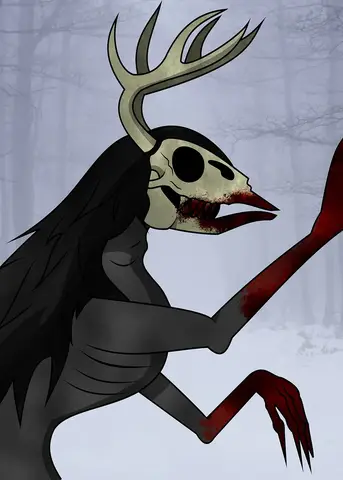
When a man offers a ride or picks up the child, her face turns into the rotting head of a horse or a horse skull with burning eyes and foul breath. Tellings say she frightens victims to death, drives them mad or leaves a bite on the cheek of those who escape.
The most common origin story says she was a young woman who struck her mother when she was forbidden to go to a party, and was cursed for it. The name is linked to the Nahuatl word for woman, and she is considered a relative of the Siguanaba of Central America, and of La Sayona and La Llorona.
In Costa Rica the story serves as a moral tale for drinkers, philanderers and anyone walking alone after dark, and it is told at dances and festivals in Guanacaste.
What does La Cegua look like?
A beautiful dark-haired woman in a long dress, with a face that turns into a rotting horse’s head or skull.
Where is La Cegua seen?
Lonely mountain roads, rivers and horse pastures at night, particularly in rural Costa Rica and Guanacaste.
La Cegua sightings
- 2000Scholarly study of Central American legends Central America
Anna Fernández Poncela’s Protagonismo femenino en cuentos y leyendas de México y Centroamérica (2000) is a cited academic source on the Cegua’s story.
Is La Cegua real? What could explain it
- The Cegua is a cautionary folktale about infidelity, drinking and filial disrespect, not a reported animal.
- Horses loose on dark roads, their eyes reflecting headlights, along with fatigue and alcohol, can account for modern ‘encounters’.
Legend, culture and tourism
The Cegua belongs to the family of Central American female ghosts alongside La Llorona and the Siguanaba, and is a staple of Costa Rican storytelling and school folklore.
Where it’s reported
Sources
First published · Updated