FIELD FILE · WAMPUS-CATBIG CATREGIONAL LEGEND
Wampus Cat
Also known as Wampus, Catawampus, Gallywampus, Whistling Wampus
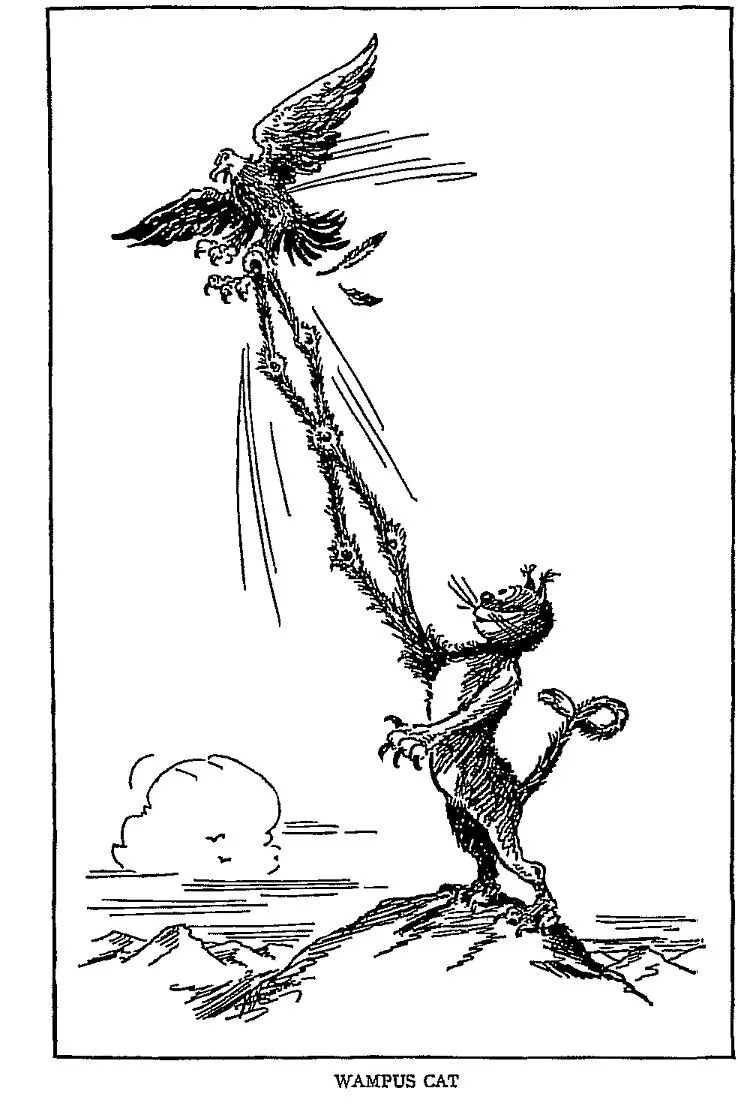
A huge, glowing-eyed cat of Southern folklore, blamed for dead livestock from Tennessee to the Ozarks – and now a beloved six-legged school mascot.
The wampus cat is the South’s all-purpose phantom feline: a big, dark, cat-like animal with glowing eyes and a scream like a cougar’s, said to prowl the woods of the Southern Appalachians and the Ozarks. Depending on who is telling the story it is a real-looking panther, a monstrous beast 15 or 20 feet long, a shape-shifter, or a comic creature with six legs. What unites the versions is the name – and the habit of blaming the wampus for anything that goes wrong in the dark.
The name itself is a clue to the legend’s roots. In 19th-century American slang, “catawampus” could mean something crooked or askew, and it was also used for a fierce imaginary beast. Early dialect collectors recorded “catawampus cat” and plain “wampus” for a creature heard whining around camps at night, and by the early 20th century “wampus cat” was turning up in newspapers across the South – as a nickname for troublemakers, a team name, and the culprit behind livestock losses. In the 1930s, papers in the North Carolina Piedmont blamed it for dead cattle, pigs and dogs, and a 1936 Knoxville News-Sentinel piece described a beast with eyes “like small moons.”
A popular modern tale gives the wampus cat a Cherokee origin: a woman who spied on a sacred men’s ceremony while wearing a cougar skin and was cursed to roam the forest as half-woman, half-cat; another version names a heroine, Running Deer, who wore a cat mask to defeat an evil spirit. Historians note that these stories are hard to trace before the late 20th century and do not appear in James Mooney’s 1900 collection Myths of the Cherokee. They are best read as stories told about Cherokee tradition rather than documented Cherokee oral history.
The wampus cat also roamed the Ozarks, where folklorist Vance Randolph recorded it as an “amphibious panther” that swam like a giant mink, and where it went by names like “whistling wampus.” In 1939 Henry H. Tryon put it in his tongue-in-cheek bestiary Fearsome Critters. Today it is perhaps best known as a mascot: Conway High School in Arkansas has called its teams the Wampus Cats since the early 1920s, and schools in Oklahoma, Texas, Louisiana and Idaho share the name.
- Type
- Big cat
- Status
- Regional legend
- First reported
- 1890s
- Best-known location
- Southern Appalachians and the Ozarks
- Also called
- Wampus, Catawampus, Gallywampus, Whistling Wampus
- Reported in
- Arkansas Missouri North Carolina Tennessee
What witnesses describe
Usually a large, dark-furred cat the size of a cougar or bigger, with glowing yellow or green eyes, big claws and a piercing, woman-like scream. Some stories make it half-woman, half-cat; mascot versions give it six legs – four for running and two for fighting.
Where and when it’s seen
Mountain coves, river bottoms, swamps and the edges of farms in East Tennessee, western and Piedmont North Carolina and the Ozarks; heard or seen at night, often after livestock or dogs go missing.
Notable sightings
- October 13, 1922Conway’s Wampus Cats Conway, Arkansas
The Log Cabin Democrat printed what local historians consider the first reference to Conway High School’s teams as the Wampus Cats. The six-legged mascot remains the school’s symbol a century later.
- December 14, 1936“Eyes like small moons” Knoxville, Tennessee
The Knoxville News-Sentinel described the wampus cat as a creature 15 or 20 feet long with eyes like small moons – a sign of how big the legend had grown in East Tennessee.
- 1951Vance Randolph’s amphibious panther Ozark Mountains
In We Always Lie to Strangers, folklorist Vance Randolph recorded Ozark tales of the wampus as a panther that leaped into rivers and swam like a colossal mink.
- May 1964The Johnston County wampus hunt Near Princeton, Johnston County, North Carolina
After the Goldsboro News-Argus dubbed a reported creature the “Wampus Cat,” hundreds of armed residents searched the woods at night. Sheriff Howard Olive Jr. called it a teenage prank and a poor joke.
What could explain it?
- Cougars, bobcats and other wildcats – including escaped or wandering animals – easily account for night-time screams and occasional livestock kills.
- Feral or stray dogs were responsible for many of the livestock losses newspapers blamed on the wampus cat.
- The name grew out of the slang word “catawampus,” and much of the legend is tall-tale humor told in lumber camps, newspapers and around campfires.
- The widely shared Cherokee origin story cannot be traced to documented Cherokee tradition and appears to be a late-20th-century retelling.
Legend, culture and tourism
The wampus cat is a fixture of Southern storytelling and a favorite school mascot – Conway High School in Arkansas unveiled a bronze six-legged Wampus Cat statue, and schools in Atoka (Oklahoma), Itasca (Texas), Leesville (Louisiana) and Clark Fork (Idaho) share the name. It has also lent its name to blues bands and to a house at the fictional American wizarding school Ilvermorny in the Harry Potter universe.
Where it’s reported
Arkansas Missouri North Carolina Tennessee
Wampus Cat in the news
No recent headlines about the Wampus Cat. Our news desk checks every day — see all cryptid news.
Sources
First published · Updated