FIELD FILE · MOON-EYED-PEOPLEHUMANOIDFOLKLORE
Moon-Eyed People
Also known as Moon-eyed folk
In Cherokee tradition, a pale people who lived in the southern mountains before the Cherokee and could not see by day – later reshaped by settler myth.
The Moon-Eyed People come from Cherokee tradition as it was reported by early American writers: a people who lived in the southern Appalachians before the Cherokee arrived, who saw poorly in daylight and moved about at night, and who were eventually driven out of the country. They are not a monster in the usual sense, and for Cherokee communities the account belongs to a living body of oral history. What outsiders later made of it is a separate – and often troubling – story.
The earliest written mention is a single sentence in Benjamin Smith Barton’s 1797 book New Views of the Origin of the Tribes and Nations of America. Barton quoted Colonel Leonard Marbury, who said the Cherokee had found the land occupied by “moon-eyed people” who could not see in the daytime, and had expelled them. Barton guessed they might have been albinos. A generation later, in 1823, Tennessee historian John Haywood wrote that the Cherokee had found “white people” near the head of the Little Tennessee River and drove them, after a war, down the Tennessee to the mouth of Chickamauga Creek.
Around 1900, the Smithsonian ethnologist James Mooney summarized these accounts in Myths of the Cherokee, calling the tradition of an earlier white race “dim but persistent.” He also recorded a story told by Harry Smith, an Eastern Cherokee man born around 1815, about a race of very small, perfectly white people who once lived at the ancient mound on the Hiwassee River at the mouth of Peachtree Creek, a few miles from present-day Murphy, North Carolina.
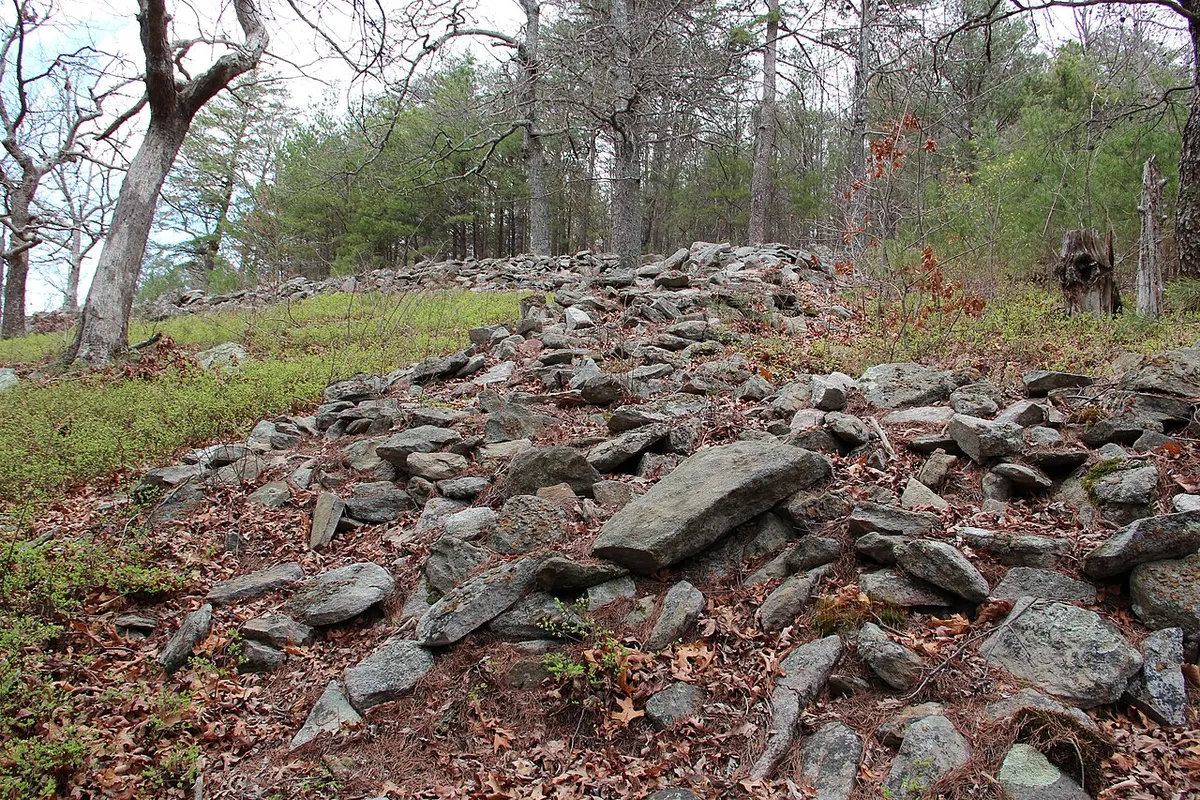
In the 19th and 20th centuries, white writers stretched the story far beyond its sources, linking the Moon-Eyed People to the mythical Welsh prince Madoc, to the mysterious stone wall on Fort Mountain in Georgia and to the ancient mounds of the Southeast. Historians and archaeologists now see much of this as part of the “Mound Builder myth” – the false 19th-century belief that a lost white race, not Native Americans, built the region’s earthworks. Today the tradition lives on in Cherokee storytelling, in a carved soapstone figure at the Cherokee County Historical Museum in Murphy, and in Appalachian folklore.
- Type
- Humanoid
- Status
- Folklore
- First reported
- 1797
- Best-known location
- Southern Appalachians – Murphy, North Carolina, and Fort Mountain, Georgia
- Also called
- Moon-eyed folk
- Reported in
- Georgia North Carolina Tennessee
What witnesses describe
Described as small, pale or white-skinned people with large, light-sensitive eyes who could not see well in daylight and were active at night or by moonlight; some later retellings add that they were short and bearded.
Where and when it’s seen
The valleys of the Hiwassee, Little Tennessee and Tennessee rivers in western North Carolina, eastern Tennessee and northern Georgia, in the distant past before the Cherokee settled there.
Notable sightings
- 1797Barton’s first written account Philadelphia, Pennsylvania
Benjamin Smith Barton published Colonel Leonard Marbury’s report that the Cherokee had found and expelled “moon-eyed people” who could not see by day.
- 1823Haywood’s history of Tennessee Tennessee
John Haywood wrote that the Cherokee had warred with an earlier “white” people near the Little Tennessee River, who agreed to leave the country in peace.
- 1841The Murphy effigy is unearthed Murphy, North Carolina
According to local historians, a farmer named Felix Ashley dug up a three-foot soapstone carving of two figures on his land. It is now displayed at the Cherokee County Historical Museum, where some link it to the Moon-Eyed People.
- c. 1900James Mooney’s Myths of the Cherokee Washington, D.C.
Mooney’s landmark study gathered the earlier accounts and recorded a Cherokee tradition of small white people who once lived at a mound on the Hiwassee River near Murphy.
- 1968The Fort Mountain marker Fort Mountain State Park, Chatsworth, Georgia
A historical marker beside the park’s ancient stone wall repeated the story of the Moon-Eyed People and the theory, popular at the time, that they had built it.
What could explain it?
- The first written accounts are secondhand: Barton heard the story from Marbury, not from Cherokee speakers, which makes it hard to know its original form and meaning.
- The tradition may preserve memories of earlier Native peoples of the region – archaeology shows the Southeast was home to Mississippian and other communities long before Euro-American contact – rather than a different race.
- Barton himself guessed the Moon-Eyed People were albinos; albinism, found in every human population, causes sensitivity to bright light.
- Links to Welsh explorers and a lost white race grew out of the 19th-century Mound Builder myth, which archaeology has thoroughly disproved.
Legend, culture and tourism
The Moon-Eyed People belong first to Cherokee oral tradition and should be understood in that context. They are also a familiar part of North Carolina and Georgia mountain lore: visitors to Murphy can see the soapstone “Moon-Eyed People” effigy, and Fort Mountain State Park’s mysterious wall still draws hikers curious about the story.
Places to visit
A museum in Murphy’s old Carnegie library with Cherokee artifacts, Trail of Tears history and the soapstone effigy often linked to the Moon-Eyed People.
A mountaintop park with an 855-foot stone wall thought to have been built by early Native Americans, whose origin has inspired many legends.
Where it’s reported
Georgia North Carolina Tennessee
Moon-Eyed People in the news
No recent headlines about the Moon-Eyed People. Our news desk checks every day — see all cryptid news.
Sources
First published · Updated