FIELD FILE · BELL-WITCHSPECTRALFOLKLORE
Bell Witch
Also known as Kate, Old Kate Batts’ Witch, The Bell Witch of Tennessee
An invisible, talking spirit said to have tormented the Bell family on their Tennessee farm from 1817 to 1821 – America’s most famous haunting legend.
John Bell and his family moved from North Carolina around 1804 to a farm on the Red River in northwest Robertson County, Tennessee, near today’s town of Adams, about 40 miles north of Nashville. According to the legend, from about 1817 the household was plagued by strange happenings: knocking and scratching on the walls, the sound of gnawing on bedposts, covers pulled from beds, and an odd animal – a dog’s body with a rabbit’s head – that the Bells could never catch.
The disturbances grew into a voice. The invisible presence sang hymns, quoted sermons, gossiped about neighbors and argued with visitors. It reserved its cruelty for John Bell, whom it vowed to kill, and his daughter Betsy, who was said to be slapped, pinched and pulled by the hair. Asked who it was, it gave many answers, but the name that stuck came from its claim to be “Old Kate Batts’ witch,” referring to a neighbor, so the family called it Kate. John Bell fell ill and died on December 20, 1820; the story says a strange vial was found beside him, and the spirit gloated that it had poisoned him.
In 1821 the voice announced it was leaving, promising to return in seven years – and, according to the family, it briefly did in 1828. Betsy broke off her engagement to Joshua Gardner, a match the spirit had opposed, and later married her former schoolteacher, Richard Powell. One of the most famous episodes tells how General Andrew Jackson came to investigate, only for his wagon to stick fast until the voice let it move; Jackson supposedly fled the next morning. Historians have found no record of that visit.
Almost everything known about the Bell Witch comes from Martin V. Ingram’s 1894 An Authenticated History of the Famous Bell Witch, written more than 70 years after the events and built partly on a manuscript said to be by John Bell’s son Richard Williams Bell that no one else has seen. Skeptics regard much of it as embellished folklore or fiction; others see it as a valuable record of nineteenth-century belief. Either way, it is Tennessee’s most famous ghost story and a template for countless American hauntings.
- Type
- Spectral
- Status
- Folklore
- First reported
- 1817
- Best-known location
- Bell farm, Red River, Adams, Robertson County, Tennessee
- Also called
- Kate, Old Kate Batts’ Witch, The Bell Witch of Tennessee
- Reported in
- Tennessee
What witnesses describe
Usually invisible, known by its voice – sometimes a faint whisper or singing, sometimes a harsh, mocking speech – and by physical attacks, knocks and noises. It was also said to appear as animals, including a black dog, birds and a strange rabbit-headed creature.
Where and when it’s seen
The former Bell farm and its surroundings along the Red River near Adams, Tennessee, including the nearby cave now known as the Bell Witch Cave.
Notable sightings
- 1817The first disturbances Bell farm, Robertson County, Tennessee
The Bells reported knocking, scratching and gnawing sounds in their house and a strange animal in the fields, the start of a four-year haunting.
- December 20, 1820Death of John Bell Bell farm
After a long illness, John Bell died. According to the legend a vial of dark liquid was found beside him and the spirit claimed to have poisoned him.
- 1821The spirit takes its leave Bell farm
The voice reportedly told the family it was departing and would return in seven years. Betsy Bell ended her engagement to Joshua Gardner the same year.
- 1894Ingram’s <em>Authenticated History</em> Clarksville, Tennessee
Newspaper editor Martin V. Ingram published the first full-length account of the haunting, the source for nearly every later retelling.
What could explain it?
- Skeptics such as Joe Nickell compare the case to poltergeist fakery, in which a family member – often an adolescent at the center of events – causes the disturbances.
- The detailed story was written down only in 1894, more than 70 years later, and depends on a manuscript nobody else has seen; much may be embellished or invented.
- There is no evidence Andrew Jackson ever visited the Bell farm, and the episode appears nowhere in his own papers.
- Historians read the legend as a reflection of local tensions, belief in witchcraft and the anxieties of frontier and slaveholding society.
Legend, culture and tourism
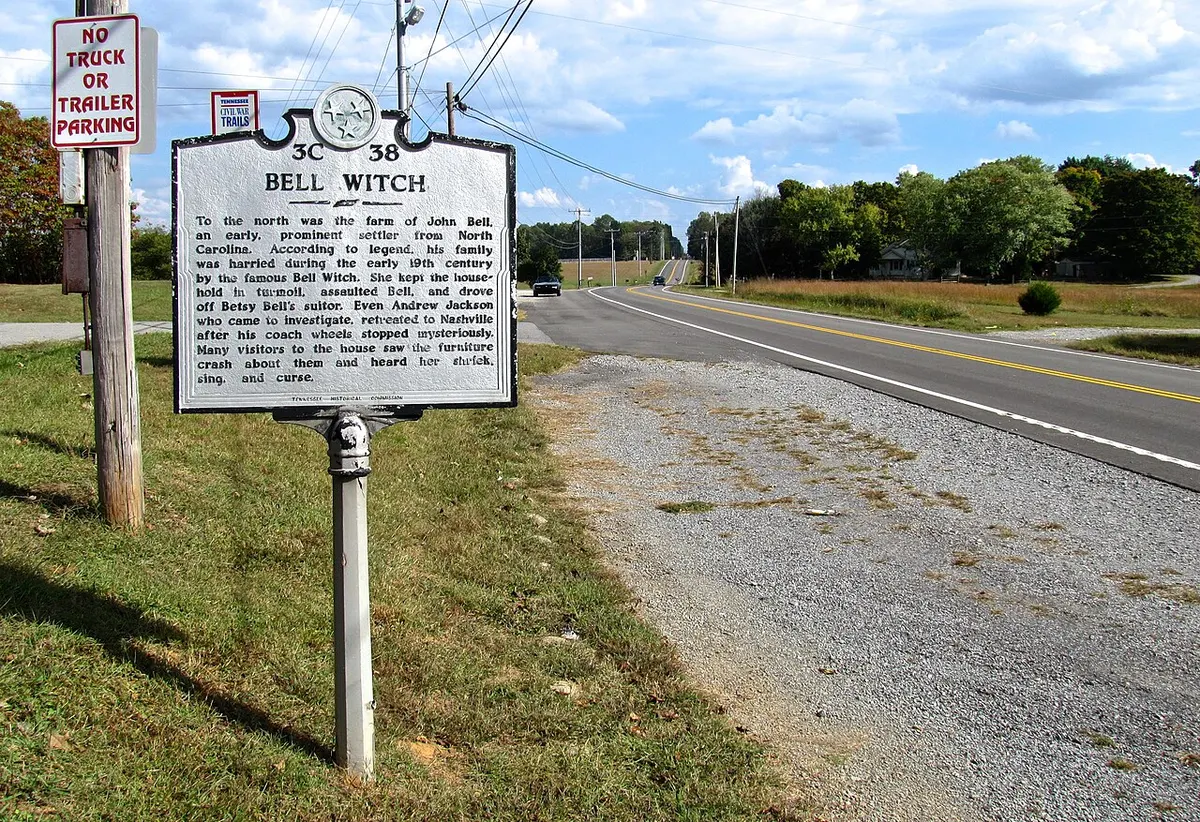
Adams has embraced its legend: a Tennessee Historical Commission marker stands on U.S. 41, visitors can tour the privately owned Bell Witch Cave and a replica cabin on the old farm, and the town holds an autumn Bell Witch festival. The story inspired the 2006 film An American Haunting and several other movies, and has influenced haunted-house cinema from Poltergeist to Paranormal Activity.
Places to visit
A privately owned cave on the former Bell farm, open for tours in summer and October.
Where it’s reported
Bell Witch in the news
No recent headlines about the Bell Witch. Our news desk checks every day — see all cryptid news.
First published · Updated