FIELD FILE · NIGHT-MARCHERSSPECTRALFOLKLORE
Night Marchers
Also known as Huakaʻi pō, Ka huakaʻi o ka pō, ʻOiʻo, Spirit ranks
Huakaʻi pō – ghostly processions of chiefs, warriors and gods in Hawaiian tradition, heralded by drums, chants and torchlight on sacred nights.
The huakaʻi pō, or night marchers, are among the most widely known and respected traditions in Hawaiʻi. They are processions of the dead – aliʻi (chiefs), warriors, kahuna, ancestral guardians known as ʻaumakua, and sometimes the gods themselves – who travel along old paths after dark. According to tradition, the marchers continue in death the roles they held in life, escorting their chiefs to heiau, battlefields and other significant places, or coming to accompany a dying descendant into the afterlife.
Hawaiian accounts describe the signs of an approaching procession: the beat of pahu drums, the sound of conch shells, chanting, a sudden smell, and a line of torches growing brighter in the darkness. Processions of the gods were said to burn with especially bright light. Traditions compiled by folklorist Martha Beckwith and other collectors place the marches between sunset and the early hours of the morning, often on the sacred nights of the Hawaiian lunar month dedicated to the gods Kū, Lono and Kāne.
The danger lay in the old kapu system, under which commoners were forbidden to look upon a sacred chief. Seeing the procession, or being seen by it, was believed to bring death – unless a relative among the marchers recognized you and spoke for you. Hawaiian guidance, passed down in families, is to get out of the way; if that is impossible, to lie face down, avoid looking, and call out one’s moʻokūʻauhau (genealogy) so an ancestor might intercede. Planting kī (ti) around a home is said to turn processions aside.
This is a living tradition rather than a monster story. Families on every island tell their own accounts, and particular places – among them parts of Kalapana on Hawaiʻi Island, Iwilei in Honolulu and valleys on Maui and Oʻahu – are associated with the marchers. Writing in Ka Wai Ola, the Office of Hawaiian Affairs newspaper, a Hawaiian storyteller cautioned that traditions vary between families and islands, and that many dramatic claims repeated online have little basis in oral tradition. The heart of the belief is respect: for ancestors, for sacred places and for the people who still keep the stories.
- Type
- Spectral
- Status
- Folklore
- First reported
- Pre-colonial
- Best-known location
- Throughout the Hawaiian Islands
- Also called
- Huakaʻi pō, Ka huakaʻi o ka pō, ʻOiʻo, Spirit ranks
- Reported in
- Hawaii
What witnesses describe
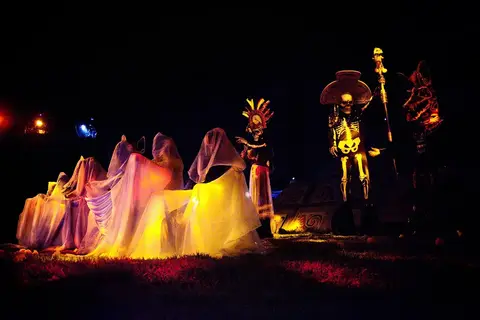
A procession of human figures – warriors with spears and clubs, chiefs, priests, sometimes gods – carrying torches, often said to move without their feet touching the ground. Witnesses more often hear than see them: drumming, conch shells, chanting or flutes, accompanied by a strong odor and approaching torchlight.
Where and when it’s seen
Old trails and routes between the mountains and the sea, heiau and battle sites, and places associated with ancient chiefs, on all the main Hawaiian Islands. They appear at night, most often on the sacred nights of the lunar month or when a descendant is about to die.
Notable sightings
- 1932Kepelino’s traditions published Bishop Museum, Honolulu
Martha Beckwith’s translated edition of Kepelino’s Traditions of Hawaii, from a 19th-century Hawaiian manuscript, was issued as a Bishop Museum bulletin. It preserved Hawaiian descriptions of the marches, including the belief that seeing one was fatal unless a relative among the dead interceded.
- 1940Beckwith’s Hawaiian Mythology Hawaiʻi
Beckwith’s Hawaiian Mythology gathered accounts of the night marchers, among them a Kona story of a young man who witnessed a procession and later its gathering of dance and games, and whose grandfather recognized that he had been with “our people of the night.”
- June 1963A procession at Iwilei Iwilei, Honolulu, Oʻahu
A family account retold in Ka Wai Ola describes a boy, sleeping in the family car, who saw a procession of warriors; his mother chanted the family genealogy, and he woke unharmed the next morning.
What could explain it?
- The tradition is part of Hawaiian spiritual and cultural life, tied to the kapu system, ancestor relationships and sacred geography; it is not a claim about an unknown creature.
- Skeptics suggest that wind in valleys, surf, distant drumming or music, and lights on hillsides can be heard or seen as a procession, especially in places already known for the stories.
- Collectors of Hawaiian tradition observed that a Hawaiian might attribute a sudden roadside death to the night march where a physician would call it heart failure – one event, two explanations.
Legend, culture and tourism
Night marcher stories are told in Hawaiian families, in island ghost-story traditions and on popular “chicken skin” tours, and they appear in films such as Netflix’s Finding ʻOhana (2021). Many residents, Native Hawaiian and otherwise, still take care around places associated with the marchers. Visitors are asked to respect heiau, burial sites and other sacred places, and to listen to how local families tell these stories rather than treating them as entertainment.
Where it’s reported
Night Marchers in the news
No recent headlines about the Night Marchers. Our news desk checks every day — see all cryptid news.
Sources
First published · Updated