FIELD FILE · MAPINGUARIHOMINIDFOLKLORE
Mapinguari
Also known as Mapinguary, Kida harara (Karitiana), Juma

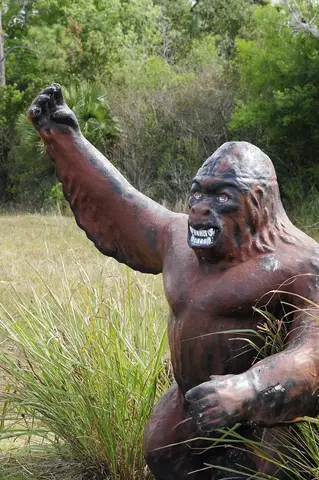
A shaggy, foul-smelling giant of Amazonian tradition with backward feet and a belly mouth – suspected by one scientist of being a ground sloth.
Deep in the Brazilian Amazon, rubber tappers, hunters and Indigenous communities tell of the Mapinguari: a huge, hairy forest being with a stench so overpowering it can make a person dizzy. It is one of the great figures of Amazonian storytelling, and it is understood in many ways at once – as a dangerous animal, a guardian of the forest, a punishment for those who break the rules, or even an elder or shaman transformed in old age.
The folklorist Luís da Câmara Cascudo traced the name to Tupi-Guarani words meaning roughly “the thing with the twisted foot,” a reference to the backward-pointing feet shared by several forest spirits of Brazilian lore. He suggested the creature is a composite, drawing on figures such as the Curupira (invulnerable, backward-footed) and giants of other traditions. Different peoples know it by their own names: the Karitiana of Rondônia call it kida harara, the “laughing beast.” Stories also echo the Afro-Brazilian Quibungo, another hairy ogre with a gaping vertical mouth.
Descriptions vary from river to river. In many it has a single eye in its forehead and a huge mouth running from face to stomach; in Acre it was said to have skin as hard as a crocodile’s, and bullets could only harm it near the navel. Twentieth-century rubber-tapper stories add a moral twist: the Mapinguari punishes those who go hunting on Sundays and holy days.
In the 1990s the ornithologist David Oren, then at the Emílio Goeldi Museum in Belém, gave the legend a scientific spin. After interviewing scores of witnesses, he proposed that the stories preserve memories of – or encounters with – a surviving giant ground sloth. His expeditions drew wide press coverage but found no physical proof, and most scientists remain unconvinced. For many Amazonian communities, the Mapinguari never needed a fossil to be real: it is part of a living relationship with the forest.
- Type
- Hominid
- Status
- Folklore
- First reported
- Pre-colonial
- Best-known location
- Brazilian Amazon rainforest
- Also called
- Mapinguary, Kida harara (Karitiana), Juma
- Reported in
- Brazil
What witnesses describe
Usually described as taller than a man when it rears up, covered in long reddish, brown or black hair, with long claws, backward-turned or pestle-shaped feet and a terrible smell. Traditional accounts give it a single eye and a vertical mouth on its belly; some describe armoured, shell-like skin. Its call is said to be a loud, human-like scream.
Where and when it’s seen
Dense terra-firme rainforest across the western and southern Brazilian Amazon – Acre, Amazonas, Pará, Rondônia and Mato Grosso – often near palm groves, and in some stories travelling with herds of white-lipped peccaries.
Notable sightings
- c. 1930Inocêncio’s encounter Uatumã River, Amazonas
A man named Inocêncio, lost in the forest, later said he met an upright, roaring animal and fired at it. His story was collected by the cryptozoologist Bernard Heuvelmans and became a staple of Mapinguari literature.
- 1993Oren’s ground-sloth paper Belém, Pará
David Oren published “Did ground sloths survive to Recent times in the Amazon region?” in the Goeldi Museum’s journal, arguing that witness descriptions matched a large mylodontid sloth.
- 1990s expeditionsSearching the Tapajós Near Barra do São Manuel, Tapajós River
Oren made several expeditions in the 1990s and gathered testimony from more than 50 witnesses. Hair samples proved to be from an agouti, and DNA from droppings matched a giant anteater rather than any unknown animal.
What could explain it?
- Giant ground sloths did live in South America until roughly 10,000 years ago; folk memories of them, or of their fossils, may have helped shape the legend, though no recent remains have ever been found.
- Real Amazonian animals – the giant anteater, which stands up on its hind legs and has formidable claws, plus jaguars, tapirs and spider monkeys – could account for frightening encounters in thick forest.
- Features such as a mouth on the belly, a single eye and backward feet belong to a wider family of mythical beings in Brazilian folklore, pointing to storytelling traditions rather than zoology.
- Physical evidence collected so far, including hair and dung, has been identified as coming from known animals.
Legend, culture and tourism
The Mapinguari is a living part of Amazonian oral tradition among Indigenous peoples, riverside communities and former rubber tappers, and it has become a national folklore figure in Brazil, retold in books, schools and popular media. It is often portrayed today as a protector of the forest that punishes greedy hunters and loggers – a role that resonates in debates about the Amazon’s future.
Places to visit
The Amazon research museum where David Oren worked, with a zoo-botanical park devoted to the region’s wildlife.
Where it’s reported
Brazil Amazonas Acre Pará Rondônia Mato Grosso
Mapinguari in the news
No recent headlines about the Mapinguari. Our news desk checks every day — see all cryptid news.
Sources
First published · Updated