FIELD FILE · HOOP-SNAKEREPTILIANFOLKLORE
Hoop Snake
Also known as Hoopsnake, Horn snake (related legend)
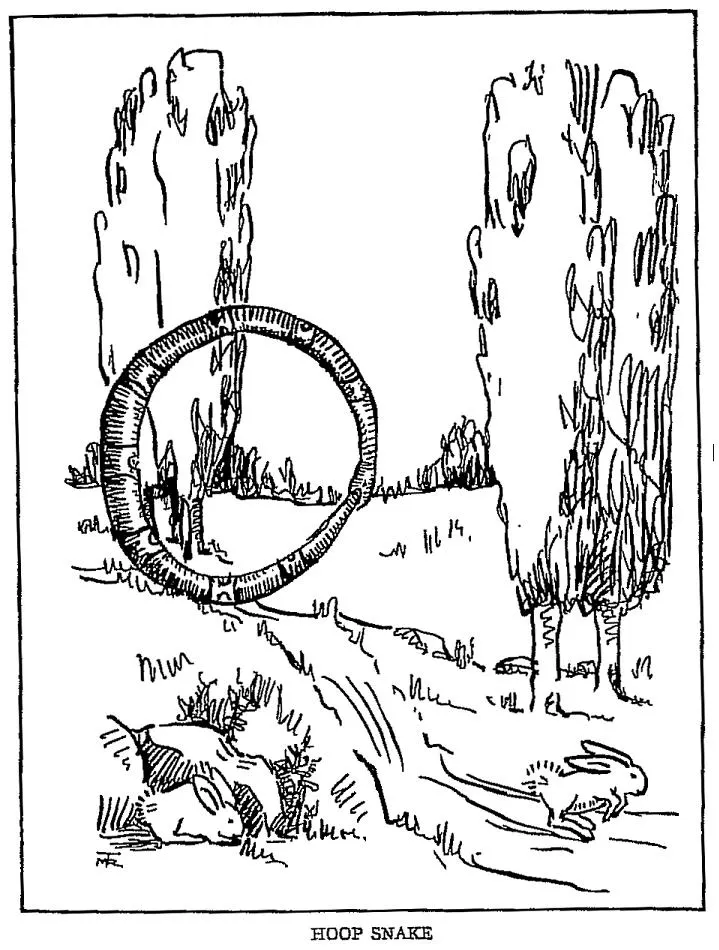
A legendary snake that bites its own tail and rolls downhill like a wheel to chase its victims, striking with a venomous tail that kills trees.
The hoop snake is one of the most widespread animal legends of rural America. According to the tale, this snake can take the tip of its tail in its mouth, form a hoop and roll after its prey – or after a terrified farmer – at tremendous speed, especially downhill. When it catches up, it lets go and strikes with a stinger on the end of its tail, a stinger so venomous that if it misses and hits a tree instead, the tree swells up and dies.
The story is old. A version appears in a 1784 travel account, J.F.D. Smyth’s A Tour in the United States of America, and it seems to have blended with an equally old belief in the “horn snake,” a snake with a deadly spine on its tail. By the 19th and 20th centuries hoop-snake stories were told from Pennsylvania and the Virginias to North Carolina, across the Ozarks of Missouri and Arkansas, in Texas tall tales about Pecos Bill, and up into the St. Croix valley on the Wisconsin–Minnesota border. Folklorist Vance Randolph recorded Ozark old-timers in 1951 who insisted the snake “rolls hoop fashion through the hills.”
Folklore supplied plenty of practical advice. Run uphill, since the snake can only roll down; hop through a fence, since it must uncoil to get through; or dodge behind a tree, which will take the poisoned blow for you. In many of the best stories the victim is not a person at all but a tree, a hoe handle or a wagon tongue that swells to enormous size after being stung – Otto Ernest Rayburn’s Ozark Country (1941) tells of a sting that grazed a woman’s skirt and turned three tubs of wash water green.
Herpetologists have dismissed the hoop snake for more than a century. But the legend persists as a classic piece of American tall talk, and versions are also told in Canada and Australia.
- Type
- Reptilian
- Status
- Folklore
- First reported
- 1784
- Best-known location
- Rural America, especially Appalachia and the Ozarks
- Also called
- Hoopsnake, Horn snake (related legend)
What witnesses describe
An ordinary-looking snake, often described as dark and several feet long, that forms a perfect wheel by holding its tail in its jaws, with a hard, venomous stinger or horn at the tip of its tail.
Where and when it’s seen
Hilly farm country, woods and roadsides – the steeper the hill, the faster the snake – most often in summer, when snakes are active.
Notable sightings
- 1784An early written account London (describing North America)
J.F.D. Smyth’s A Tour in the United States of America includes one of the earliest printed references to the rolling hoop snake.
- 1941Three tubs of green wash water Ozarks, Missouri and Arkansas
Otto Ernest Rayburn’s Ozark Country preserved a hoop-snake tale in which the stinger only brushed a woman’s skirt, yet turned her wash water green.
- 1951Randolph’s Ozark old-timers Ozarks, Missouri and Arkansas
Folklorist Vance Randolph reported that many older Ozark residents still believed in a snake that rolled through the hills like a hoop and stung trees to death.
What could explain it?
- No snake can roll by holding its tail in its mouth; herpetologists, including the authors of Snakes of Virginia (1981), call the tale nonsense.
- The mud snake and rainbow snake of the Southeast are the usual suspects: they often lie in loose, flat coils that look like a hoop, and they have a hard, pointed tail tip – harmless, according to the Florida Museum of Natural History – that they press against a captor.
- Snakes have occasionally been seen grasping their own tails, which may have lent credibility to the tale.
- Above all, the hoop snake is a tall tale, told for fun and to test the gullibility of listeners, much like the fearsome critters of the lumber camps.
Legend, culture and tourism
The hoop snake features in Pecos Bill stories, Appalachian and Ozark storytelling, West Virginia snakelore, African American folk narratives recorded in the 1930s, children’s books and cartoons, and Australian bush yarns. It is often listed among the fearsome critters of American folklore.
Where it’s reported
Arkansas Minnesota Missouri North Carolina Pennsylvania Texas Virginia Wisconsin West Virginia Australia Canada
Hoop Snake in the news
No recent headlines about the Hoop Snake. Our news desk checks every day — see all cryptid news.
Sources
First published · Updated