Field file · Humanoid · Folklore
Black Annis
Also known as Black Agnes, Black Anna, Cat Anna
A blue-faced, iron-clawed hag of Leicestershire folklore said to lurk in a Dane Hills cave and snatch children – perhaps echoing a medieval anchoress.
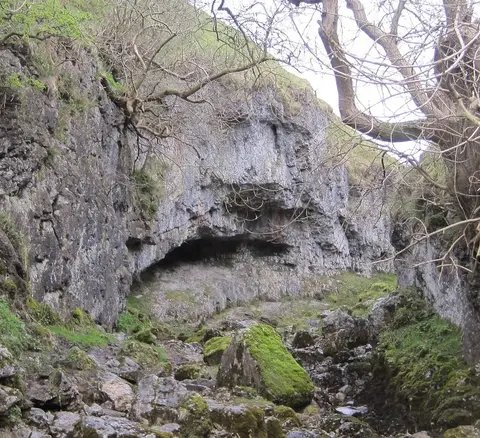
Black Annis, also written Black Agnes or Black Anna, is a bogeywoman from the folklore of Leicestershire. She is described as a blue-faced hag with iron claws who lived in a cave in the Dane Hills, on the western side of Leicester, with a great oak at its entrance. From there, according to the story, she would creep out at night to catch lambs and children, flaying them and wearing the skins around her waist.
Her legend served a practical purpose: parents used it to keep children indoors after dark. Folk memory said that cottages in the area were built with small windows so that Annis could only reach in one arm, and that her teeth grinding and her howl, audible for miles, were a warning to bolt the door and hang skins and herbs at the windows. The cave, said to have been dug out of the sandstone by her claws, was known as Black Annis’s Bower.
The earliest written trace is not a story but a pair of eighteenth-century title deeds, dated 13 and 14 May 1764, naming a field as “Black Anny’s Bower Close”; they were later cited in C. J. Billson’s County Folklore: Leicestershire and Rutland (1895). Annis also appears in a local custom, in which a dead cat, sometimes scented with aniseed, was dragged from her bower to the mayor’s door on Easter Monday, and in an 1837 Leicester stage play, Black Anna’s Bower.
Victorian writers connected her with the Celtic goddess Anu or Danu, an idea later taken up by some Wiccan and neo-pagan authors. The historian Ronald Hutton rejects it, arguing that the figure was based on Agnes Scott, a late medieval anchoress, or possibly a nun who cared for lepers, who lived in a Dane Hills cave and was buried at Swithland, and whose memory was twisted into a bogey.
What does Black Annis look like?
A tall, wrinkled old woman with a blue or dark face, long iron claws and grinding teeth; sometimes shown as a cat-like figure and dressed in a girdle of skins.
Where is Black Annis seen?
A cave called Black Annis’s Bower in the Dane Hills, beneath an oak, and the lanes and cottages around Glenfield and western Leicester after dark.
Black Annis sightings
- May 13, 1764Black Anny’s Bower Close Leicestershire
A title deed dated this day (with a second on May 14) names a field Black Anny’s Bower Close, the earliest known written reference to the name.
- 1837Stage play Leicester Theatre
A play titled Black Anna’s Bower, or the Maniac of the Dane Hills was staged in Leicester, evidence that the name was well known locally.
- 1842Agnes Scott link Leicester
A newspaper item in the Leicester Chronicle associated Annis with a woman named Agnes Scott, her grave and a cave in the Dane Hills.
- 1895County Folklore Leicestershire and Rutland
C. J. Billson’s Folklore Society volume recorded the cave, the deeds and the Easter Monday custom, fixing the legend for later writers.
Is Black Annis real? What could explain it
- The legend appears to be a bogey story told to keep children safe from the outdoors, a role shared by figures such as Jenny Greenteeth and Peg Powler.
- Hutton’s theory ties her to Agnes Scott, a medieval holy woman, with the monstrous image perhaps arising from post-Reformation hostility towards anchorites.
- The Celtic goddess theory of Annis as Anu has been dismissed by most folklorists as a Victorian confusion of similar names.
- The Easter Monday cat-hunt echoes other English hound-and-lure customs and was said to have died out by the late eighteenth century.
Legend, culture and tourism
Black Annis is a staple of Leicester’s local lore, appearing in ghost-walk talks, children’s stories and modern horror and fantasy writing. The Dane Hills are now suburbs and parkland, but the name Black Annis’s Bower lives on in local history publications.
Places to visit
Parkland on the former Dane Hills, the area where the bower was traditionally placed.
Where it’s reported
Sources
First published · Updated